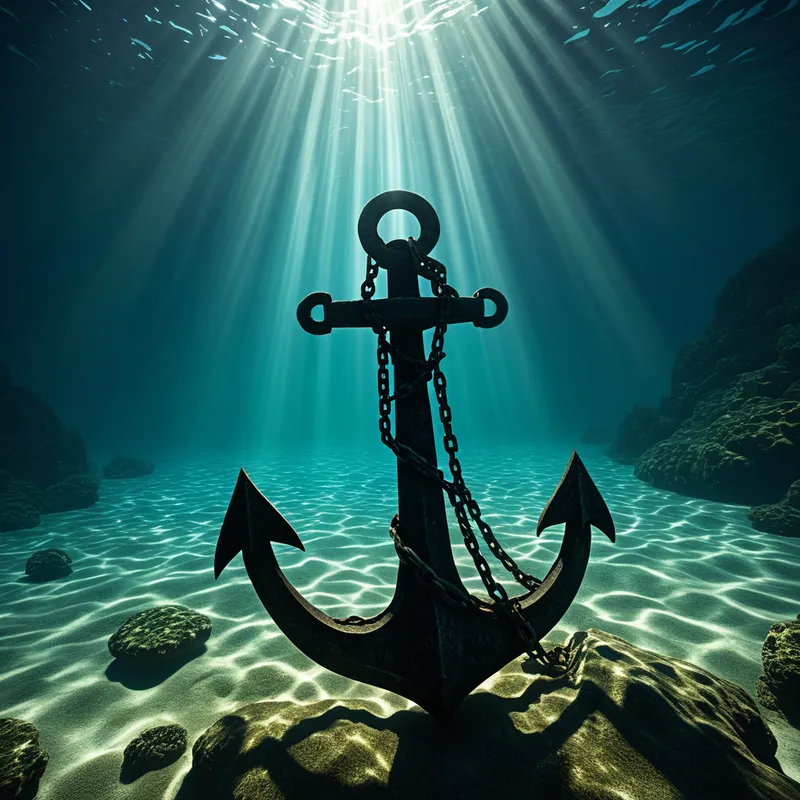
The Anchor Myth Meaning & Symbolism
A symbol of hope cast into the abyss, holding fast the soul against the storm, connecting the temporal world to the eternal, unseen shore.
The Tale of The Anchor
Hear now, you who are adrift on the wine-dark sea of this world. There is a story older than the oldest keel, whispered in the creak of timbers and the sigh of the deep.
In the beginning of a soul’s long voyage, there is only the ship and the shore. The shore is memory, solid and known. The ship is the vessel of life, pushed from the dock by an unseen wind. For a time, the waters are calm, the horizon a gentle line. But the true sailor knows this is a prelude. The sea, in its heart, is a realm of chaos—a leviathan’s playground where winds howl like lost spirits and waves rise like mountains intent on crushing heaven itself.
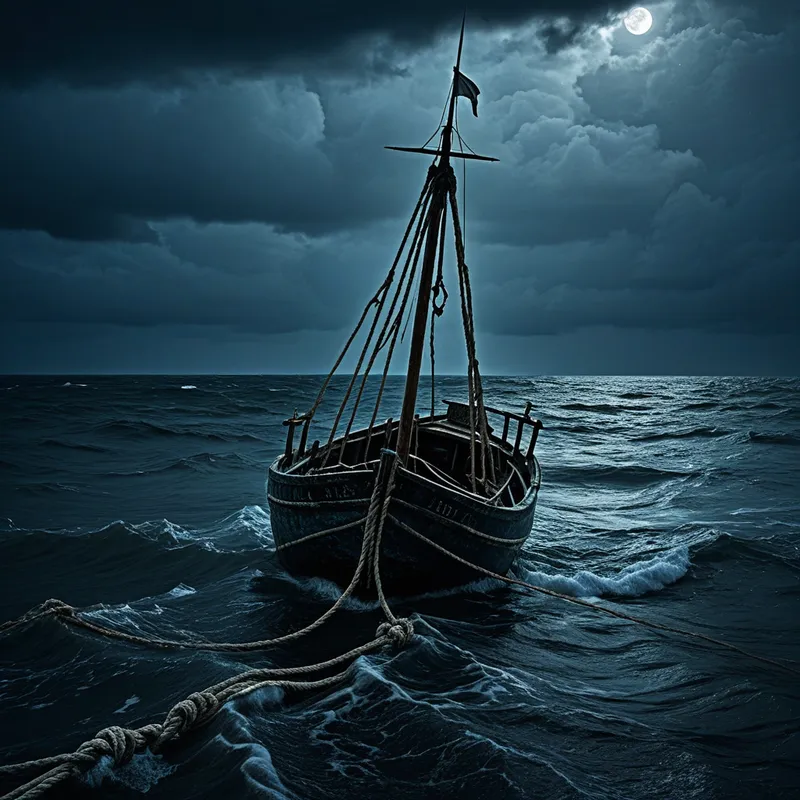
Such a storm found a certain vessel. Not a king’s galley, but a humble fishing boat, its planks groaning, its mast a bowed back against the lash. The crew, seasoned yet terrified, had thrown everything overboard—their catch, their spare sails, their very hope. The world had shrunk to the next wall of black water, the next shriek of the gale. The shore was a forgotten dream. The abyss below yawned, a promise of cold, final silence.
In the heart of this maelstrom stood one figure, salt crusting his beard, his eyes not on the consuming waves but on the heaving deck. In his hands, he held not a steering oar, but a thing of cold, heavy iron: the ship’s anchor. It was an ugly, brutal thing, a claw meant for mud and rock. While others bailed water, he labored with a terrible, focused slowness. He fed the great chain, link by groaning link, over the side. Then, with a strength born of absolute necessity, he lifted the anchor itself and committed it to the void.
It did not splash. It was swallowed. The chain snapped taut, a iron tendon vibrating with a deep, fundamental note that cut through the storm’s cacophony. The ship, which had been spinning in the fury, gave a tremendous shudder. It did not stop moving—the waves still battered it—but its wild, circular flight was arrested. It now rode the storm, pitching and rolling, but held. It was no longer adrift. It was fastened to something beneath the storm.
All night, the chain sang its low song. The sailor, his hands raw on the rope tied to the chain, did not sleep. He listened to that song and watched the horizon. He was not waiting for the storm to end. He was waiting for the dawn. And when it came, a thin, grey light revealed not a calm sea, but a sea still powerful. Yet, the ship was there. It had held. The anchor, unseen in the profound dark below, had found purchase on a reality the storm could not touch.
Cultural Origins & Context
The symbol of the anchor as a profound emblem of hope and steadfastness emerged from the crucible of early Christian culture, a community often adrift in a sea of persecution and existential uncertainty. It predates the widespread use of the cross as public iconography. For these early believers, living within the vast, often hostile Roman Empire, the anchor served as a perfect, clandestine symbol. To the casual observer, it was a mundane maritime tool, but to the initiated, it encoded a deep theological truth.
This myth was passed down not in grand epics but in catacomb art, on worn seals, and in the cryptic language of the Epistles. The author of the Letter to the Hebrews writes of hope as "an anchor of the soul, both sure and steadfast, and which entereth into that within the veil." Here, the anchor’s function is alchemized: it does not hold a ship to the seabed, but the soul to the divine, penetrating the veil between the seen and unseen worlds. Its societal function was one of covert solidarity and profound psychological stabilization—a reminder that their identity and destiny were secured in a realm beyond the reach of imperial power or temporal suffering.
Symbolic Architecture
The Anchor is a master symbol of the ego in relation to the Self. The ship represents the conscious life, battered by the external storms of circumstance and the internal squalls of emotion and doubt. The storm is the chaos of the unconscious, the upwelling of everything the conscious mind cannot control: fear, rage, despair, and primal terror.
The anchor is the conscious act of faith, not in the cessation of the storm, but in the existence of a ground beneath the chaos.
Its two flukes symbolize duality—spirit and matter, heaven and earth, conscious and unconscious—that must unite to achieve grip. The chain is the linchpin, the connecting principle, often representing tradition, ritual, prayer, or disciplined thought that links the temporal to the eternal. The seabed it grasps is the bedrock of the Self, the indestructible, non-psychological ground of being. The myth teaches that stability is not found in calm weather, which is an illusion, but in a connection to a depth that weather cannot affect.
The Dreamer's Resonance
When the Anchor appears in modern dreams, it rarely manifests as a simple nautical object. The dreamer may find themselves in a building that sways like a ship, and their only task is to secure a central, crucial bolt to the floor. They may dream of holding a rope that descends into a dark hole in their own living room floor, feeling a terrifying but steady pull from below. They may be in a chaotic, shifting landscape and discover a single, immovable stone to which they can cling.
These dreams signal a critical process of psychic grounding. The dreamer is likely experiencing a period of extreme instability, transition, or anxiety—a "storm" in their waking life. The somatic feeling is often one of desperate tension in the arms and hands, the body’s memory of holding on. The psychological process is the unconscious presenting a symbol of stabilization. The dream is not offering an escape from the storm, but the means to endure it. It invites the dreamer to ask: What is my anchor? To what unseen, inner reality can I fasten my current chaos to prevent my complete disintegration?
Alchemical Translation
The alchemical journey of individuation is a voyage into the unknown waters of the self. The initial stage, nigredo, is the black storm—the confrontation with shadow, despair, and the dissolution of old, rigid identities. The ego-ship is shattered in its pretensions of control.
The act of casting the anchor is the opus of the will at its most profound. It is the decision to seek connection in the midst of dissolution, to choose orientation over escape.
This is the albedo, the whitening. It is not a solution, but a clarification. By holding fast to the anchor—the symbol of meaning, the connection to the transpersonal Self—the chaotic elements begin to separate. The soul learns to ride its affects, not be drowned by them. The chain, the conscious link, is tempered in this struggle, moving from iron certainty to flexible, tensile strength.
Finally, the anchor’s ultimate purpose is revealed not in the storm, but after. The rubedo, the reddening or culmination, is the dawn where the ship, though battered, remains. The individual has not been saved from the experience, but through it. They have discovered that their core is not the fragile ship of ego, but the connection itself—the chain, the anchor, the ground. They realize they are not just the vessel tossed on the surface, but also the depth that holds it. They have become, in part, the very steadfastness they sought. The anchor is then integrated; it is no longer a tool, but a quality of the soul—the achieved, unshakable hope that has been tested in the abyss and found solid.
Associated Symbols
Explore related symbols from the CaleaDream lexicon: