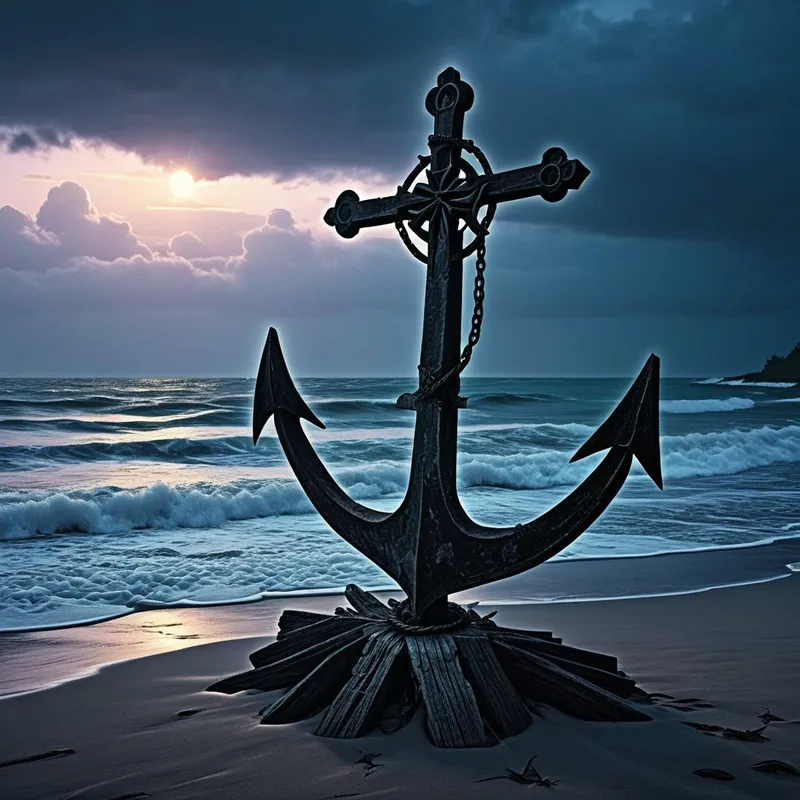
Anchor Cross Myth Meaning & Symbolism
A forgotten Christian symbol merging the anchor of hope with the cross of sacrifice, representing the soul's steadfastness in turbulent seas.
The Tale of Anchor Cross
Listen, and hear a tale not of grand cathedrals, but of salt-stained wood and whispered prayers. It begins not on land, but in the belly of the abyss, on the wine-dark sea where the wind screams like a banshee and the waves are mountains that seek to bury you.
The sailors knew this terror. They were men of the Aegean and the Ionian, their world a fragile shell of timber on an infinite, hungry deep. Their gods were the old ones—Poseidon with his trident, the capricious winds—but a new whisper had come ashore. A whisper of a carpenter who walked on water and stilled storms. They heard tales of a sign, a terrible and beautiful sign of execution that had become a symbol of salvation. But how does a man of the sea, whose life depends on holding fast, relate to a tree of suffering?
One night, a storm fell upon a ship like the fist of heaven. The mast groaned, the sails tore into spectral rags, and the hold began to swallow the bitter sea. The captain, a man named Andreas, had prayed to every saint he knew, but the deep did not listen. In his despair, clutching the ship's wheel as it fought to spin him into the void, a vision burned behind his eyes. Not of dry land, but of the one thing that could keep a ship from being dashed upon the rocks: its anchor, heavy, sure, and hooked into the unseen foundation of the world.
And in that same moment, he saw the cross. Not as a thing of gold, but as the ship's own timbers, the intersecting beams that gave it structure. A cry was torn from his lungs, not of fear, but of a desperate, unifying insight. "Hold us fast!" he roared into the gale. "As the anchor holds the ship, hold us fast upon your tree!"
With a piece of charcoal from the dying galley fire, he stumbled to the mainmast. There, with hands that shook not from terror but from revelation, he drew. He drew the clean, sharp stock and flukes of an anchor. And then, through its very center, he drew the vertical beam and crossbeam of the crucifix. The two symbols became one—the hope of the seafarer married to the sacrifice of the savior.
As the last line was drawn, a strange calm did not settle upon the sea, but within the ship. The waves still raged, the wind still howled, but the vessel ceased its frantic pitching. It was as if it had found its purchase, not on the seabed, but on something immovable that transcended the storm itself. They were not saved from the tempest, but held secure within it. At dawn, exhausted and awestruck, they found themselves in calm waters, the symbol on the mast standing stark against the rising sun—a silent testament to a hope that hooks into the eternal.
Cultural Origins & Context
This is not a myth from council chambers or theological treatises. It is a folk myth, born in the liminal space where early Christianity met the ancient, vocational realities of Mediterranean life. It emerged from the oral traditions of sailors, fishermen, and coastal communities for whom the sea was both livelihood and grave.
The symbol itself, the anchor-cross, has archaeological provenance. It is found scratched into the walls of the catacombs in Rome, often beside the word "SPES"—Latin for "hope." For a persecuted community, the anchor was a discreet yet powerful symbol. To a Roman, it spoke of maritime trade; to a Christian, it spoke of the soul anchored in Christ, a hope that secured them against the storms of persecution. The myth of Andreas and the storm is the narrative embodiment of this symbol. It was a story told on docksides and in taverns, a way to translate abstract theological hope into the visceral, physical language of survival. Its function was profoundly psychological: to provide a narrative anchor for people whose lives were inherently unstable, offering a model of faith that was not about escaping turmoil, but finding an unshakable point within it.
Symbolic Architecture
At its core, the Anchor Cross is a symbol of synthesis. It does not replace one tool with another, but forges a new instrument from two profound realities of the human condition.
The anchor represents the ego's need for stability. It is heavy, material, and functional. It hooks into the known world, the "ground" of our daily realities, professions, and identities. Psychologically, it is our conscious standpoint, our attempt to hold position amidst the psychic currents.
The cross represents the Self's reality of transformation through sacrifice. It is vertical, reaching between heaven and earth, and horizontal, embracing the breadth of human experience. It signifies a painful but necessary intersection, the death of an old state of being for the birth of a new.
The Anchor Cross teaches that true hope is not a passive wish, but an active, grappling hook cast into the depths of the transcendent. It is the ego consenting to be secured by something beyond its own weight.
In their union, the myth proposes that our deepest stability (the anchor) is found not in avoiding the transformative crisis (the cross), but by allowing the crisis to become the very point of attachment. The ego's strength is perfected in its conscious tethering to the Self's transformative process.
The Dreamer's Resonance
When the Anchor Cross appears in modern dreams, it rarely comes as a neat symbol. It manifests as a somatic experience. The dreamer may feel themselves on a terrifyingly unstable surface—a raft on a night sea, a crumbling cliff edge, a floor that has turned to liquid. The anxiety is profound, a primal fear of dissolution.
Then, an action or image emerges. The dreamer might find a chain in their hands, or feel a heavy, reassuring weight in their chest. They may see a hybrid object—a tree with metal roots, a heart with a hook at its core. This is the psyche constructing its own Anchor Cross. The dream signals a critical phase where the conscious personality (the sailor on the storm-tossed deck) is encountering overwhelming contents from the unconscious (the chaotic sea). The psyche is attempting to forge a new connection, to find a "holding" function.
The dreamer undergoing this process often feels, in waking life, a simultaneous sense of crisis and a strange, nascent calm—the "eye of the storm" feeling. They are in the alchemical stage of solutio, where old certainties are dissolved. The Anchor Cross dream is the psyche's instinctive move toward the next stage: coagulatio—the formation of a new, more resilient structure of meaning.
Alchemical Translation
The myth models the individuation process with stark, maritime clarity. The initial state is the storm: a life crisis, depression, anxiety, or loss that threatens to shatter the individual's sense of identity and purpose (the ship).
The heroic act is not fighting the storm, nor is it magically escaping it. It is the internal act of symbolic creation. Andreas, in his despair, does not receive a ready-made salvation; he creates the unifying symbol. This is the essence of active imagination—confronting the chaos and consciously forging a new image that bridges the conscious mind and the unconscious depth.
The alchemy occurs in the fusion: the heaviest tool of the material world is pierced by the symbol of spiritual transformation. The base metal of mundane hope is transmuted into the gold of transcendent assurance.
For the modern individual, this translates to a profound inner work. When in a life-storm, the task is to ask: "To what, beyond my own failing strength, can I secure myself?" It is not about finding a simplistic answer, but about crafting a personal, living symbol—a synthesized image of your deepest struggle (the anchor of your situation) and your highest potential meaning (the cross of your transformation). This becomes your psychic anchor point. You may still be in the storm, but you are no longer of it. You have found a stability that does not depend on calm seas, but on the depth of your own connection to the timeless. The myth of the Anchor Cross ultimately tells us that we are not called to be weathervanes, spun by every wind, but vessels, designed to be held fast by a hope that hooks into the bedrock of being itself.
Associated Symbols
Explore related symbols from the CaleaDream lexicon: