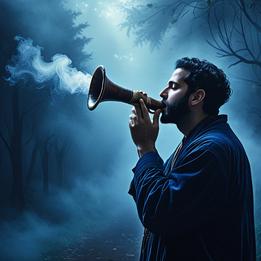
Shofar
A ram's horn trumpet used in Jewish rituals, symbolizing divine calls, repentance, and spiritual awakening.
Shofar Dream Meaning
A ram's horn trumpet used in Jewish rituals, symbolizing divine calls, repentance, and spiritual awakening.
Interpretive Themes
Mythological Resonance
The Walls of Jericho
Hebrew BibleThe shofar's blast, following the Ark of the Covenant, caused the walls of Jericho to collapse, symbolizing divine power breaking through earthly barriers.
Binding of Isaac
Jewish TraditionA ram, caught by its horns, was sacrificed in Isaac's place; the shofar, made from a ram's horn, commemorates this substitution and divine mercy.
Cultural Lenses
Middle Eastern Perspective
View Context →In Jewish tradition, the shofar announces Rosh Hashanah and Yom Kippur, calling for repentance. Historically used in temple ceremonies and battles, it symbolizes God's voice and covenant renewal in modern Judaism.
Jungian Perspective
View Context →Represents the Self's call to individuation, breaking through persona constraints. The horn symbolizes phallic energy directed toward spiritual realization, awakening unconscious contents to consciousness.
Freudian Perspective
View Context →Phallic symbol representing repressed sexual energy seeking expression. The blowing action symbolizes oral fixation and the sound represents suppressed desires demanding attention from the superego.
Gestalt Perspective
View Context →Represents unfinished business demanding attention. The shofar is the dreamer's own voice calling for integration of neglected aspects, with the sound representing what needs to be expressed.
Cognitive Perspective
View Context →Symbolizes attention-alerting mechanism in the brain. Represents cognitive dissonance resolution or schema change, with the sound triggering memory consolidation and pattern recognition processes.
Evolutionary Perspective
View Context →Primitive warning system evolved from animal horn signals. Represents group cohesion mechanisms, territory marking, and mating calls transformed into spiritual alert systems for community survival.
Global/Universal Perspective
View Context →Across cultures, horns signal transitions, divine presence, and community gatherings. From Viking lur to Tibetan dungchen, horn instruments universally mark sacred time and space boundaries.
East Asian Perspective
View Context →Similar to Buddhist conch shells announcing teachings. In Shinto, horns purify spaces. Modern interpretations connect to qi energy flow and meridian awakening through sound vibration therapy.
South Asian Perspective
View Context →Parallels to Hindu shankha (conch) announcing rituals and battles. In Ayurveda, specific sounds balance doshas. Tantric traditions use horn sounds to awaken kundalini energy.
European Perspective
View Context →Medieval church horns announced services. Celtic carnyx used in battle. Modern neopagan traditions incorporate horns in solstice ceremonies as earth energy awakeners.
African Perspective
View Context →Traditional horn instruments like kudu horns communicate across distances in rituals. Used in initiation ceremonies, royal announcements, and as voice amplifiers for ancestral communication in many cultures.
Modern Western Perspective
View Context →In contemporary spirituality, represents breaking limiting beliefs. Used in sound baths for frequency healing. Symbolizes authentic self-expression and boundary-setting in therapeutic contexts.
Historical Authorities
Want a deeper analysis?
Get a personalized interpretation of your entire dream including this symbol.
Interpret My DreamThe Oracle's Prediction
Combine multiple symbolsA sudden, clear insight or 'awakening' that breaks a long-standing personal limitation.
Timeframe
Immediate (Next 48h)
Intensity
Deep
A need for urgent course correction in a key area of life.
Timeframe
Immediate (Next 48h)
Intensity
Deep
Common Appearances & Contexts
| Context | Emotion | Interpretation |
|---|---|---|
| Context Hearing distant shofar | Emotion Longing | Interpretation Spiritual calling awaits |
| Context Blowing shofar yourself | Emotion Empowerment | Interpretation Taking spiritual initiative |
| Context Broken shofar | Emotion Despair | Interpretation Blocked spiritual connection |
| Context Multiple shofars sounding | Emotion Overwhelm | Interpretation Too many callings |
| Context Ancient shofar ceremony | Emotion Reverence | Interpretation Connecting with tradition |
| Context Shofar in storm | Emotion Fear | Interpretation Chaotic spiritual change |
| Context Shofar at sunrise | Emotion Hope | Interpretation New spiritual beginning |
| Context Silent shofar | Emotion Frustration | Interpretation Unheard spiritual voice |
| Context Shofar in battle | Emotion Courage | Interpretation Spiritual warfare engaged |
| Context Shofar as gift | Emotion Gratitude | Interpretation Spiritual responsibility received |
| Context Shofar underwater | Emotion Confusion | Interpretation Muffled spiritual message |
| Context Shofar healing ceremony | Emotion Peace | Interpretation Spiritual restoration occurring |
Interpret Your Full Dream
Beyond this symbol, every dream carries a unique story. Share your dream for a personalized AI-powered interpretation.