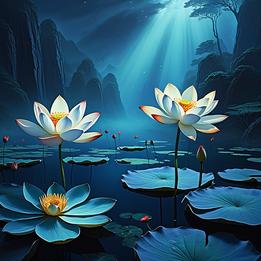
Bunhongsi Lotus
A sacred lotus in Korean Buddhist art symbolizing enlightenment emerging from worldly suffering, often depicted with vibrant red petals.
Bunhongsi Lotus Dream Meaning
A sacred lotus in Korean Buddhist art symbolizing enlightenment emerging from worldly suffering, often depicted with vibrant red petals.
Interpretive Themes
Mythological Resonance
Padmasambhava
BuddhistThe Lotus-Born Buddha who brought Buddhism to Tibet, emerging from a lotus like spiritual revelation from worldly confusion.
Nefertem
EgyptianGod of the lotus who rises from primordial waters at dawn, bringing healing and transformation like the Bunhongsi's emergence.
Cultural Lenses
Jungian Perspective
View Context →Represents the Self archetype and individuation process—the psyche's natural movement toward wholeness. The red color symbolizes vital life energy and passion integrated with spiritual awareness.
Freudian Perspective
View Context →Symbolizes sexual imagery (phallic stem, vaginal flower) and repressed desires for purity. The mud represents unconscious primal urges, while the bloom signifies sublimation into spiritual ideals.
Gestalt Perspective
View Context →Represents the dreamer's relationship between their 'dirty' aspects (mud) and 'pure' aspirations (flower). The symbol invites exploration of how opposites coexist in personal experience.
Cognitive Perspective
View Context →Acts as a mental schema for 'transformation' and 'purity.' The brain processes it as a metaphor for overcoming adversity, activating neural pathways associated with hope and resilience.
Evolutionary Perspective
View Context →Taps into innate human attraction to symmetrical flowers (indicator of health) and clean water sources. The red color triggers alertness and significance detection mechanisms.
East Asian Perspective
View Context →In Korean Buddhism, Bunhongsi specifically represents the Buddha's teachings emerging in the human realm. Historically used in temple art, it now symbolizes cultural heritage and spiritual tourism.
South Asian Perspective
View Context →In Hinduism, the lotus (padma) symbolizes divine birth, purity, and spiritual authority. Associated with deities like Vishnu and Lakshmi, it remains central to ritual and iconography.
Middle Eastern Perspective
View Context →In ancient Egyptian culture, the lotus represented rebirth and the sun—closing at night and reopening at dawn. This solar symbolism persists in regional art and architecture.
European Perspective
View Context →In Christian iconography, the lotus sometimes appears as a variant of the lily, representing Mary's purity and resurrection. In heraldry, it symbolizes perfection and nobility.
African Perspective
View Context →In ancient Egyptian tradition (Nile Valley), the blue lotus symbolized creation, rebirth, and altered states of consciousness. Used in rituals, it continues in cultural revival movements.
Modern Western Perspective
View Context →Popular in tattoo culture and mindfulness practices as a symbol of personal growth through adversity. Often divorced from religious context, representing individual resilience.
Global/Universal Perspective
View Context →Cross-culturally recognized as a symbol of purity emerging from impurity, spiritual awakening, and beauty in adversity. Appears in world religions and contemporary spiritual movements.
Historical Authorities
Want a deeper analysis?
Get a personalized interpretation of your entire dream including this symbol.
Interpret My DreamThe Oracle's Prediction
Combine multiple symbolsA period of mental clarity will emerge from current difficulties.
Timeframe
Lunation (~29 Days)
Intensity
Deep
Healing will come through acceptance rather than resistance.
Timeframe
Seasonal (~3 Months)
Intensity
Deep
Common Appearances & Contexts
| Context | Emotion | Interpretation |
|---|---|---|
| Context Blooming in mud | Emotion Hope | Interpretation Overcoming difficult circumstances. |
| Context Wilting lotus | Emotion Sadness | Interpretation Spiritual disconnect felt. |
| Context Holding lotus | Emotion Peace | Interpretation Inner harmony achieved. |
| Context Lotus in temple | Emotion Reverence | Interpretation Sacred guidance present. |
| Context Multiple lotuses | Emotion Joy | Interpretation Abundant spiritual growth. |
| Context Lotus in storm | Emotion Anxiety | Interpretation Faith being tested. |
| Context Gifting lotus | Emotion Love | Interpretation Sharing spiritual wisdom. |
| Context Lotus painting | Emotion Inspiration | Interpretation Creative awakening occurring. |
| Context Lotus roots | Emotion Curiosity | Interpretation Exploring spiritual foundations. |
| Context Lotus in water | Emotion Calm | Interpretation Emotional purification process. |
| Context Plucking lotus | Emotion Guilt | Interpretation Forcing spiritual progress. |
| Context Golden lotus | Emotion Awe | Interpretation Divine revelation experienced. |
Interpret Your Full Dream
Beyond this symbol, every dream carries a unique story. Share your dream for a personalized AI-powered interpretation.