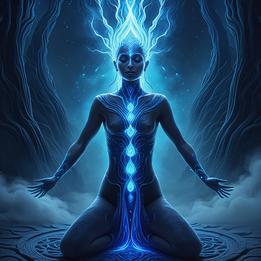
Kundalini
A dormant spiritual energy coiled at the base of the spine, representing untapped potential and awakening consciousness through ascension.
Kundalini Dream Meaning
A dormant spiritual energy coiled at the base of the spine, representing untapped potential and awakening consciousness through ascension.
Interpretive Themes
Mythological Resonance
Shakti
HinduThe primordial cosmic energy, often depicted as a goddess, who lies dormant (as Kundalini) until awakened to unite with Shiva (consciousness) at the crown.
Caduceus
GreekThe staff of Hermes, featuring two serpents entwined around a central rod, symbolizing the balanced ascent of opposing energies and healing, akin to the Kundalini channels (Ida and Pingala).
Cultural Lenses
South Asian Perspective
View Context →Rooted in Tantric Hinduism and yoga traditions, Kundalini represents Shakti (divine feminine energy) ascending through chakras to unite with Shiva, symbolizing enlightenment. Modern yoga adapts this for spiritual practice.
Jungian Perspective
View Context →Symbolizes the individuation process—the awakening of the unconscious Self integrating with consciousness. Represents psychic energy transformation and wholeness through archetypal serpent imagery.
Freudian Perspective
View Context →Interpreted as repressed libidinal energy seeking release, with spinal imagery suggesting sexual sublimation. The awakening represents unconscious desires surfacing, often with psychosomatic manifestations.
Gestalt Perspective
View Context →Seen as the dreamer's unmet potential or unfinished business becoming conscious. The energy represents aspects of self seeking integration into the whole personality.
Cognitive Perspective
View Context →Viewed as a metaphor for sudden insight or cognitive restructuring. The awakening represents neural reorganization or breakthrough thinking patterns emerging.
Evolutionary Perspective
View Context →Interpreted as ancient survival mechanisms—heightened awareness states that once served threat detection. The energy represents primal alertness systems activating.
Modern Western Perspective
View Context →Often secularized as personal growth metaphor in self-help contexts. Represents unlocking potential, with commercialized yoga and mindfulness adapting traditional concepts.
Global/Universal Perspective
View Context →Cross-cultural symbol of spiritual energy found in various traditions (Chinese Qi, Polynesian Mana). Represents universal human experience of transformative inner power.
East Asian Perspective
View Context →Parallels Qi/Chi energy concepts in Taoism and Traditional Chinese Medicine. While distinct, both involve vital energy circulation for health and spiritual cultivation.
Middle Eastern Perspective
View Context →Resonates with Sufi concepts of spiritual ascent (Mi'raj) and divine energy. Some Islamic mysticism references serpentine energy, though distinct from Hindu origins.
European Perspective
View Context →Historically viewed through esoteric traditions like Theosophy. Modern interpretations blend Eastern concepts with Western occultism, emphasizing consciousness expansion.
African Perspective
View Context →Echoes in concepts of vital force (like Nyama in Mande traditions) and serpent deities (Damballah). Represents ancestral power and life energy in various indigenous systems.
Historical Authorities
Want a deeper analysis?
Get a personalized interpretation of your entire dream including this symbol.
Interpret My DreamThe Oracle's Prediction
Combine multiple symbolsA profound shift in perspective or a moment of radical insight.
Timeframe
Immediate (Next 48h)
Intensity
Deep
A period of intense emotional or psychic turbulence.
Timeframe
Lunation (~29 Days)
Intensity
Deep
Common Appearances & Contexts
| Context | Emotion | Interpretation |
|---|---|---|
| Context Serpent rising | Emotion Awe | Interpretation Spiritual awakening imminent. |
| Context Energy blockage | Emotion Frustrated | Interpretation Resistance to change. |
| Context Sudden heat | Emotion Overwhelmed | Interpretation Powerful energy release. |
| Context Spine tingling | Emotion Excited | Interpretation Energy movement beginning. |
| Context Chakra alignment | Emotion Peaceful | Interpretation Harmonious integration occurring. |
| Context Fear of awakening | Emotion Anxious | Interpretation Resisting transformation. |
| Context Ecstatic bliss | Emotion Ecstatic | Interpretation Full awakening achieved. |
| Context Loss of control | Emotion Terrified | Interpretation Energy overwhelming psyche. |
| Context Guided meditation | Emotion Calm | Interpretation Preparing for awakening. |
| Context Physical symptoms | Emotion Confused | Interpretation Body processing energy. |
| Context Ancient temple | Emotion Reverent | Interpretation Connecting to tradition. |
| Context Modern yoga class | Emotion Inspired | Interpretation Contemporary practice context. |
Interpret Your Full Dream
Beyond this symbol, every dream carries a unique story. Share your dream for a personalized AI-powered interpretation.