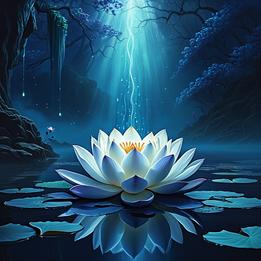
Buddhist Lotus
A sacred flower symbolizing spiritual awakening, purity rising from muddy waters, and enlightenment through transformation.
Buddhist Lotus Dream Meaning
A sacred flower symbolizing spiritual awakening, purity rising from muddy waters, and enlightenment through transformation.
Interpretive Themes
Spiritual Awakening
highCore Buddhist symbol of Buddha's enlightenment.
Purity and Perfection
highFlower grows clean from muddy water.
Transformation and Growth
highSymbolizes personal and spiritual evolution.
Resilience and Strength
mediumRooted in mud yet blooms beautifully.
Divine Birth and Creation
mediumAssociated with divine beings and creation myths.
Mythological Resonance
Brahma
HinduThe creator god emerges from a lotus that grows from Vishnu's navel, symbolizing cosmic creation from primordial waters.
Padmasambhava
BuddhistThe 'Lotus-Born' guru who brought Buddhism to Tibet, said to have been born miraculously from a lotus flower.
Cultural Lenses
Jungian Perspective
View Context →Symbol of the Self, representing individuation and psychic wholeness. The lotus emerging from mud signifies consciousness rising from the unconscious, integrating shadow aspects into complete personality.
Freudian Perspective
View Context →Phallic symbol representing sexual energy and libido. The unfolding petals suggest sexual awakening or repression, with the muddy origins connecting to primal, unconscious desires and childhood development.
Gestalt Perspective
View Context →Represents the figure-ground relationship in perception. The lotus as figure against muddy background symbolizes how consciousness organizes experience, highlighting what emerges as meaningful from life's complexity.
Cognitive Perspective
View Context →Metaphor for schema development and cognitive growth. The lotus represents how mental frameworks evolve from basic experiences, with the flower symbolizing organized thought patterns emerging from chaotic information processing.
Evolutionary Perspective
View Context →Symbolizes adaptive advantage of spiritual cognition. The lotus represents evolved capacity for meaning-making, with its growth pattern mirroring how humans find purpose and resilience in challenging environments for survival benefits.
South Asian Perspective
View Context →In Hinduism and Buddhism, represents divine beauty, purity, and spiritual perfection. Historically associated with deities like Vishnu and Lakshmi, used in rituals, and symbolizes the chakras in yoga practice.
East Asian Perspective
View Context →In Chinese Buddhism, symbolizes purity, harmony, and summer. Associated with Guanyin, used in art and architecture, and represents scholarly refinement in Confucian contexts as 'the gentleman's flower'.
Middle Eastern Perspective
View Context →In ancient Egyptian culture, represented creation, rebirth, and the sun. Associated with Nefertem, god of perfume and lotus, and used in funerary art to symbolize resurrection and eternal life.
Modern Western Perspective
View Context →Popular symbol in mindfulness and wellness movements. Represents personal growth, resilience, and meditation practice, often divorced from religious context and used in tattoo art and spiritual merchandise.
Global/Universal Perspective
View Context →Cross-cultural symbol of spiritual awakening and beauty from adversity. Appears in various religious traditions worldwide, consistently representing transcendence, purity, and the human capacity for transformation.
African Perspective
View Context →In ancient Egyptian tradition, the blue lotus symbolized creation and rebirth. Used in religious ceremonies and art, associated with the sun god Ra and represented daily renewal and cosmic cycles.
European Perspective
View Context →In esoteric traditions like Theosophy, represents spiritual evolution and the chakras. Adopted from Eastern traditions during colonial encounters, now symbolizes mystical awakening in New Age and alternative spirituality movements.
Historical Authorities
Want a deeper analysis?
Get a personalized interpretation of your entire dream including this symbol.
Interpret My DreamThe Oracle's Prediction
Combine multiple symbolsA profound insight or moment of clarity that resolves a long-standing inner conflict.
Timeframe
Lunation (~29 Days)
Intensity
Deep
Common Appearances & Contexts
| Context | Emotion | Interpretation |
|---|---|---|
| Context Seeing a lotus bloom in muddy water | Emotion hope | Interpretation Personal growth emerging from difficult circumstances. |
| Context Holding a lotus flower | Emotion peace | Interpretation Connection to spiritual practice or inner peace. |
| Context Lotus wilting or dying | Emotion anxiety | Interpretation Concerns about spiritual stagnation or lost purity. |
| Context Multiple lotuses in a pond | Emotion wonder | Interpretation Community spiritual growth or collective awakening. |
| Context Lotus with bright light | Emotion awe | Interpretation Direct experience of enlightenment or divine presence. |
| Context Trying to pick a lotus | Emotion frustration | Interpretation Struggle to attain spiritual goals or purity. |
| Context Lotus transforming into something else | Emotion curiosity | Interpretation Major spiritual transition or personal metamorphosis. |
| Context Lotus in unexpected place | Emotion surprise | Interpretation Spiritual insight appearing in mundane life. |
| Context Lotus with specific colors | Emotion contemplation | Interpretation Different spiritual qualities based on color symbolism. |
| Context Lotus as part of meditation | Emotion calm | Interpretation Integration of spiritual practice into daily life. |
| Context Lotus being destroyed | Emotion fear | Interpretation Threats to spiritual integrity or values. |
| Context Lotus giving off fragrance | Emotion bliss | Interpretation Experience of spiritual qualities affecting environment. |
Interpret Your Full Dream
Beyond this symbol, every dream carries a unique story. Share your dream for a personalized AI-powered interpretation.