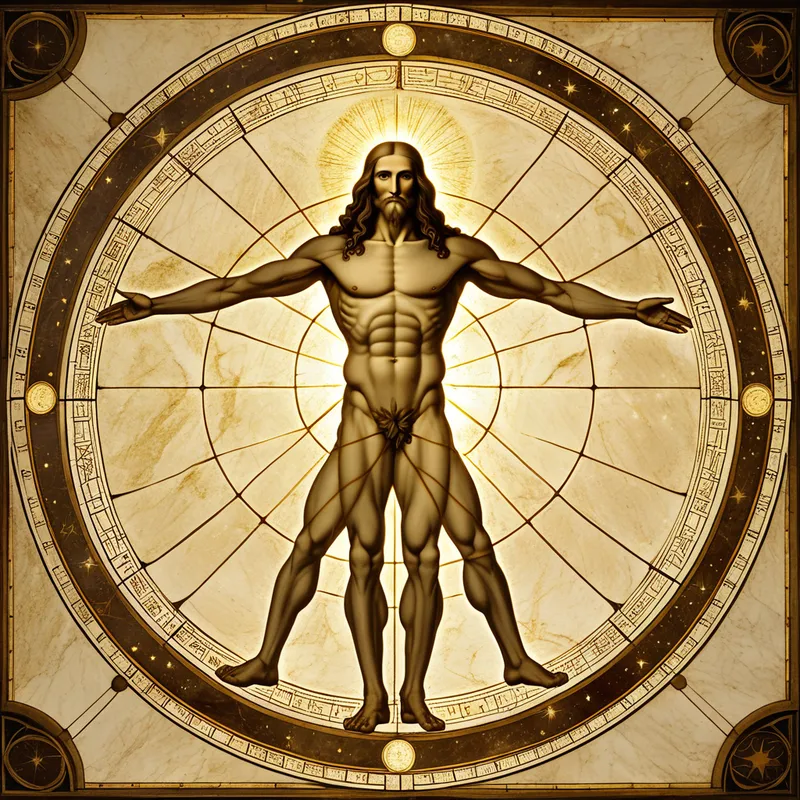
Vitruvian Man Myth Meaning & Symbolism
A human figure inscribed within the perfect forms of circle and square, embodying the divine measure of man as the microcosm of the universe.
The Tale of Vitruvian Man
In the deep quiet of the world’s turning, between the sleep of the Dark Ages and the waking dream of a new dawn, there came a whisper. It was not a voice of thunder, but the soft, insistent scratch of a stylus on vellum, the sigh of a page turning in a forgotten text. The whisper spoke of a lost measure, a divine proportion hidden in the very bones of creation.
In a chamber of stone and dust, lit by the frail, determined flame of a single candle, a seeker bent over his work. He was not a king or a conqueror, but a listener—a man who heard the music of the spheres in the fall of water and the flight of a bird. Before him lay the ghost of an idea, a memory from the ancient world: the words of Marcus Vitruvius Pollio, who declared that a man, with arms and legs outstretched, could be made to fit within the perfect circle and the perfect square.
But words were ghosts. The seeker needed flesh, bone, and truth. He sought not just any man, but Man himself—the template of all humanity. He dissected the night, peeling back the skin of the heavens to study the muscles of the stars. He descended into the dark, moist earth of churchyards, not in horror, but in reverence, to learn the architecture of tendons and the vaulting of ribs. His quest was a sacred violation, a loving autopsy of God’s greatest work.
For nights uncounted, the two forms—the circle, emblem of the divine, the cosmos, the soul’s endless journey; and the square, symbol of the earthly, the material, the four solid corners of the world—resisted union. The human form, in all its beautiful, asymmetrical reality, seemed to rebel against this geometric tyranny. The circle demanded a center, the square demanded alignment. The man’s outstretched limbs threatened to break the perfect lines.
Then, in a moment of grace that felt less like discovery and more like remembrance, the harmony was revealed. The seeker’s hand moved. He placed the man’s navel at the heart of the circle. He placed his feet upon the base of the square. And in a second, sublime superposition, he centered the man’s genitals within the square. Two centers. One form. The man’s fingertips and heels now kissed the circumference of the celestial wheel. His head and outstretched arms defined the height and breadth of the material world.
There was no fanfare. Only the settling of dust. The figure now lived in two realms at once, a citizen of heaven and earth. He was still, yet containing all motion; measured, yet embodying infinite possibility. The whisper had become a permanent, silent shout etched in ink: Look. This is what you are. This is your potential. You are the measure of all things.
Cultural Origins & Context
This is not a myth of gods on Olympus, but a myth of the human mind reclaiming its throne. It was born in the 15th century, in the ferment of the Italian Renaissance. The tale is inextricably linked to one man, Leonardo da Vinci, though its philosophical DNA comes from the classical world via Vitruvius’s De Architectura.
The myth was “told” not in epic poetry, but in private notebooks—the Codices—and in the intellectual salons of Florence and Milan. Its tellers were artists, architects, philosophers, and patrons who believed in Humanism. Its societal function was revolutionary: to dethrone the medieval view of humanity as a fallen, sinful creature and re-crown it as the glorious, rational, and divinely-proportioned center of a knowable universe. It was a visual manifesto. By proving that the human form was geometry made flesh, it provided a sacred justification for the study of nature, anatomy, and art. It declared that to understand the world, one must first understand the human being, for we contain its blueprints.
Symbolic Architecture
The Vitruvian Man is a mandala of the self. Its power lies in its ruthless, beautiful synthesis of opposites.
The Circle represents the realm of spirit, the infinite, the cosmos, and the divine intellect. It is the soul’s boundless potential. The Square represents the realm of matter, the finite, the earthly, and the body. It is the self as a creature of limits, gravity, and time. The human figure is the living bridge, the tertium quid that reconciles these two eternal opposites.
The true self is not found in the circle or the square alone, but in the precise, dynamic tension of inhabiting both simultaneously.
Psychologically, the figure represents the ego’s ideal state: perfectly centered within the eternal (the circle) while being fully grounded and functional in reality (the square). The two centers—navel and genitals—speak to dual origins: one of spiritual birth (the navel as the point of original connection), and one of physical, creative generation. It is the archetype of the Creator, who imposes the order of mind (geometry) onto the chaos of experience (the flesh).
The Dreamer's Resonance
When this pattern stirs in the modern unconscious, it often manifests not as a clear drawing, but as a somatic or spatial experience. One may dream of stretching their arms so wide they touch the walls of the universe, or of feeling their body pulse with a precise, mathematical rhythm. It is the dream of perfect fit.
To dream of the Vitruvian Man is to undergo a process of psychic re-alignment. The somatic sensation is one of expansion and containment at once—a thrilling, sometimes anxious, feeling of reaching one’s limits while discovering a new center of gravity. Psychologically, this indicates a confrontation between one’s infinite potential (aspirations, spirit, ideas) and one’s finite reality (responsibilities, body, circumstances). The dream asks: Where is your center? Are you stretched to breaking point between heaven and earth, or have you found the pivotal point where you can turn, balanced, within both worlds? It is a call to measure oneself, not against others, but against one’s own inherent, divine geometry.
Alchemical Translation
The journey of the Vitruvian Man is the alchemical individuation process in its most elegant form. The prima materia (raw material) is the ordinary, asymmetrical, conflicted human being. The goal is the Lapis Philosophorum—the perfected, balanced self.
The first operation is Solve: the analytical, often brutal dissection of the self. This is Leonardo in the anatomy theatre, seeking truth in the marrow. It is our own modern introspection, therapy, or shadow-work—taking ourselves apart to understand our components. The second is Coagula: the synthesis. This is the moment of insight where the disparate parts—spirit and matter, ambition and limitation, mind and body—are seen not as warring factions, but as necessary coordinates in a grander design.
Individuation is not about becoming a perfect circle or a perfect square, but about discovering the unique, living equation that allows you to inhabit the sacred space where they intersect.
The triumph is not conquest, but calibration. The modern individual, in their struggle for wholeness, is engaged in this same act of measurement. We seek to center our spiritual longing (the circle) within the practical confines of our lives (the square). The myth teaches that wholeness is a dynamic, active state of balance. It is the conscious creation of a life where our reach (our fingertips on the celestial wheel) is exactly matched by our foundation (our feet firmly on the earthly square). We become, at last, the architect of our own humanity.
Associated Symbols
Explore related symbols from the CaleaDream lexicon: