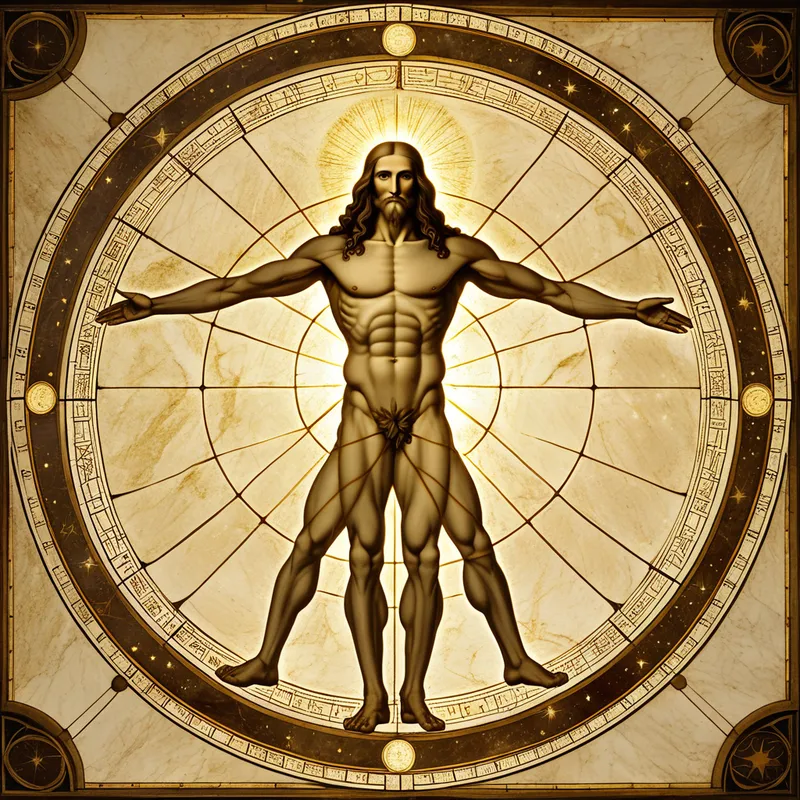
The Dream of Humanism: A Call to the Center
The Somatic Echo
It begins not as an idea, but as a sensation. A hollow ache in the solar plexus, a feeling of being a ghost in your own machine. You move through the world, but your actions feel like borrowed scripts. There is a profound loneliness, not for company, but for coherence. The body feels like a collection of disparate parts—a nervous system wired for alarm, a heart armored behind protocols, a mind running legacy software on outdated hardware. This is the somatic echo of humanism: the visceral, pre-verbal longing for integration. It is the grief of the fragmented self, sensing the blueprint of its own wholeness just beyond the reach of memory. You feel like an archive of someone else’s life, and the dream comes to return the deeds to your name.
The Dreamer's Log
The dreamer stands in a vast, silent library that is also a server farm. Rows of glowing server racks hum where bookshelves should be. They are drawn to one particular terminal. On its screen, instead of code, flows a continuous, elegant script in a forgotten language they somehow understand. It is not a story of conquest or love, but a meticulous, compassionate log of mundane moments: the weight of a coffee cup at dawn, the precise texture of regret, the silent rebellion of a sigh. As they read, the cold light from the servers softens, warming to the color of parchment.
This dream is an alchemical retrieval: the cold, logical archive of the self is being rewritten by the warm, specific poetry of lived experience.

The False Lead
This is not a dream about becoming more social, more politically engaged, or more altruistic. That is its most common and seductive misinterpretation—the ego’s attempt to outsource the inner work to the outer world. The dream of humanism is not an exhortation to save humanity, but to reclaim your own. It is not a call to action, but a call to attention. The terror here is not of isolation, but of discovering that the persona you’ve curated—the efficient professional, the reliable friend, the contained individual—is a sophisticated prosthesis over a deeper, wilder, and more complex humanity you have been taught to exile. This dream marks a structural shift from performing a self to inhabiting one.
Psychological Architecture
The architecture here is one of reclamation. Shadow work in this domain is the painstaking audit of internal exile. Which emotions were deemed "unproductive" and locked away? Which instincts were labeled "irrational" and silenced? Which vulnerabilities were seen as security flaws and patched over? The individuation process is the slow, often terrifying, reintegration of these exiled parts. It is recognizing that your rage holds your boundaries, your grief holds your depth, and your irrational longing holds your true north. This is not adding new features to the ego; it is dismantling the firewall between the ego and the soul. The psyche must descend into its own basement, not to fight monsters, but to read the meters, to see what systems are still running in the dark, consuming power, keeping the whole structure cold.
Mythic Resonance
We see this in the myth of Osiris. He is not simply killed by Set; he is dismembered, his parts scattered across the land, lost. Isis does not wage a war of revenge. Her work is the meticulous, grieving, loving work of recollection. She travels the length of the world, finding each piece—the arm in the river, the heart in the desert—and brings it back. The final resurrection is not a reassembly of the old form, but the creation of a new, integrated sovereignty born from the act of gathering what was lost. The dream of humanism is this Isis-work performed on the self. We are both the scattered god and the devoted seeker.
Symbolic Nodes
- Abandoned or Repurposed Libraries/Archives: The stored, unintegrated data of the self.
- Glitching Machines or Interfaces: The failure of purely logical systems to contain lived experience.
- Warm Light in Cold Places: The emergence of feeling in sterilized zones of the psyche.
- Forgotten Rooms in a Familiar House: Unexplored or sealed-off aspects of the inner world.
- Being Shown a Manual or Blueprint: Access to the innate, organic instructions for being.
Archetypal Resonance
The energy here is most potently that of The Creator Archetype. Not its shadow of mad, solipsistic invention, but its essential core: the Artist who brings form out of chaos, the Architect who follows an inner blueprint. This archetype resonates because humanism, in the dreamscape, is fundamentally a creative act. You are not discovering a pre-packaged self; you are composing a sovereign one from the raw, disparate materials of your experience—your joys, your traumas, your banalities, your epiphanies. The somatic echo is the Creator’s restlessness with the blank canvas or the flawed draft. The alchemical potential is the moment the scattered notes become a coherent song, the moment the collection of parts reveals the shape of the whole being you were always meant to author.
The Alchemical Process
The transmutation is from Fragment to Fabric. The prima materia is the heap of disowned parts: the orphaned emotions, the mechanized behaviors, the forgotten memories. The heat is applied by the sustained, non-judgmental attention of the dreamer turned inward. This is the nigredo—the blackening. It feels like a dissolution, a terrifying loss of the known, coherent "I." The pressure is the courage to feel the specific gravity of each reclaimed fragment—the weight of the old grief, the sharp edge of the buried anger—without rushing to categorize or repress it again. The albedo (whitening) is the insight that these are not flaws, but threads. The rubedo (reddening) is the weaving. Sovereignty is not control; it is the resilient, complex, beautiful pattern that emerges when every thread, light and dark, is included in the loom. The self becomes less of a statue and more of a tapestry.

The Integration Protocol
Question 1: Where in my life do I feel like a highly competent system administrator for a feeling I am not allowed to have? Question 2: What single, mundane sensation (the feel of a doorknob, the taste of bread, the sound of my own breath) feels most vividly, undeniably real to me right now? Question 3: If my current sense of self is a well-organized office, what is in the locked filing cabinet marked "not relevant to current operations"?
Action 1 (Somatic Reclamation): For one minute, sit in silence and do nothing but feel the entire surface of your skin—the air on it, the cloth against it. Do not analyze, simply sense. You are reclaiming the body as a field of experience, not a tool. Action 2 (Unstructured Scripting): Take a pen and paper. Write the sentence "The machine reported:" and then finish it with the first bureaucratic, logical, or numb thought that comes to mind (e.g., "...all systems nominal."). On the next line, write "The human whispered:" and finish it with the raw, simple, uncensored feeling beneath that report (e.g., "...I am so tired."). Repeat five times. Action 3 (Ritual of Reintegration): Find a small object that represents a part of yourself you've dismissed as weak, messy, or impractical. Place it in the center of your living space for a day. Do not explain it or hide it. Simply let it occupy space, as that part of you deserves to do.
Final Validation
The path of humanism is arduous because it asks you to forsake the clean, efficient lie for the complex, messy truth. It is easier to live as a ghost in a well-designed machine. To feel the full spectrum of your being—the absurd, the tragic, the tender, the furious—is to consent to a kind of beautiful chaos. This dream is your psyche’s most profound act of loyalty. It is calling you not to be a better person, but a more complete one. It is reminding you that you are not a problem to be solved, but a universe to be inhabited. The integration is the moment you stop curating your humanity and finally, fearlessly, begin to live it.