The Sacred Architecture: Geometry in the Dreaming Soul
The Somatic Echo
Before the mind sees the shape, the body feels the structure. This is not a visual experience, but a tectonic one. It is the deep, internal hum of a tuning fork struck against the bedrock of your being. You wake with a sense of profound order, or its terrifying absence—a spine that feels too straight, a heart that seems to beat in a perfect, metronomic rhythm that is not your own. Alternatively, it is a visceral nausea, a dizziness born from standing in a room where the walls refuse to meet at right angles, where the floor slopes into a non-Euclidean abyss. The somatic echo of geometry is the body’s raw recognition of pattern. It is the clench of muscle against an invisible constraint, or the unsettling expansion of the chest when an internal scaffolding you didn’t know you relied upon suddenly dissolves. This is the feeling of the psyche under construction—or deconstruction. The blueprint is being redrawn in the marrow.
The Dreamer's Log
I am in a library of impossible scale, its shelves stretching into a starless dark. I am not looking for a story, but for a specific theorem. I find the book—it is bound in cold metal—and when I open it, the pages are not flat. The diagrams rise into the air: glowing, three-dimensional proofs of a love that ended, each angle a precise measure of grief. I try to close the cover, but the geometry will not fold back in.
This is the alchemical process of quantification: the psyche’s desperate, initial attempt to contain the uncontainable—emotion, trauma, loss—within a rational, measurable structure. It is the mind building a cage of logic around a wild heart.

The False Lead
Do not mistake this for mere intellectualism or a sign you should study mathematics. The dream of geometry is not about logic, but about the architecture of meaning. It is not a cognitive puzzle to be solved, but a somatic reality to be inhabited. The terror of the shifting wall is not about bad luck or spatial confusion; it is the profound disorientation that comes when a fundamental belief—a wall you leaned your whole life upon—reveals itself to be fluid, untrustworthy. Conversely, the comfort of the perfect sphere is not simple aesthetic pleasure; it is the deep, bodily sigh of encountering a truth that holds you completely, without edge or flaw. This theme speaks to the very foundations of your inner world. To see it as a mere symbol is to stand outside the cathedral and comment on the shape of its stones, never feeling the vaulted silence within.
Psychological Architecture
This is the Shadow work of the foundation. Every psyche builds itself upon certain axioms: I am worthy. The world is safe. Love is reliable. These are the unseen right angles, the load-bearing walls of identity. A dream of crumbling geometry, of floors turning to liquid, signals that these axioms are being stress-tested by life. The Shadow here is the repressed awareness that your foundation was built on borrowed, unstable, or inherited blueprints. The individuation process at play is one of conscious re-creation. You are not merely repairing a crack; you are being asked to become the architect of your own soul’s structure. This requires descending into the basement of the self, into the dusty, forgotten plans, and assessing what is sound and what is mere facade. It is a deeply lonely and courageous act—to dismantle, even partially, the house of the self while still living within it. The new geometry that emerges is not imposed from a textbook, but grown from the inside out, a unique crystallization of your lived truth.
Mythic Resonance
Consider the myth of the Minotaur and the Labyrinth. The story is not about the monster, but about the structure that contains it. Daedalus, the architect, built an inescapable maze—a geometric prison for a shameful secret. The hero, Theseus, can only navigate it with a thread, a line through the complexity. This is the universal firmware: the psyche creates intricate, defensive structures (labyrinths) to corral its own monstrous, unintegrated aspects. The dream of geometry often presents this labyrinth, or the thread, or the shocking center where the beast resides. The alchemical task is not to slay the Minotaur, but to understand why you needed such a convoluted prison in the first place, and to walk out with the beast integrated, the labyrinth now a map you hold in your hand, not a trap you are lost within.
Symbolic Nodes
- The Labyrinth/Maze: The complexity of a psychological problem, a defensive structure of the psyche.
- The Sphere: Wholeness, the Self, containment, or sometimes isolation.
- Fractals: Infinite complexity born from simple repetition, the pattern of trauma or generational inheritance.
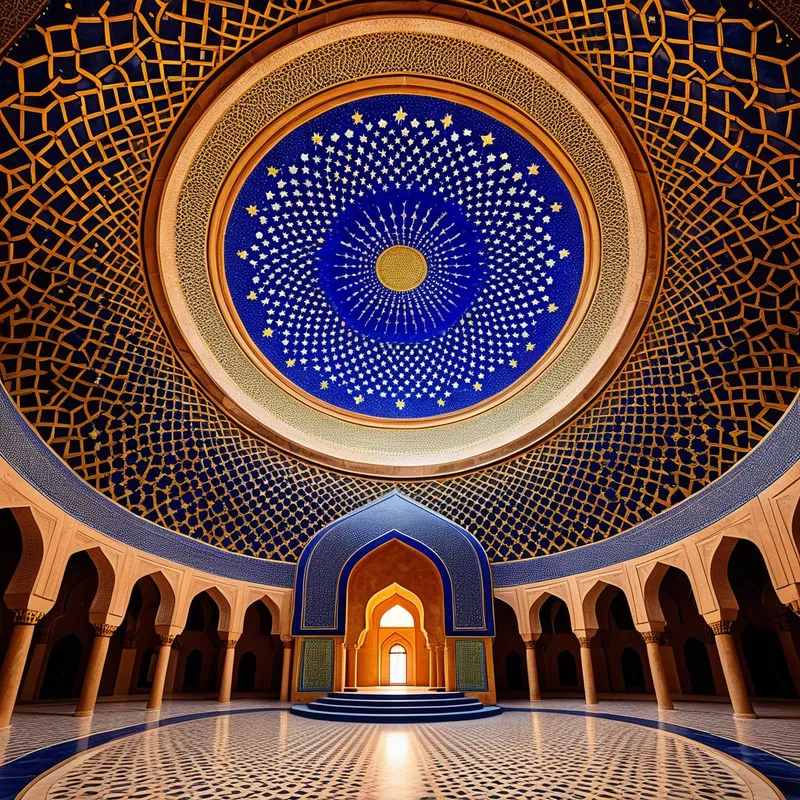
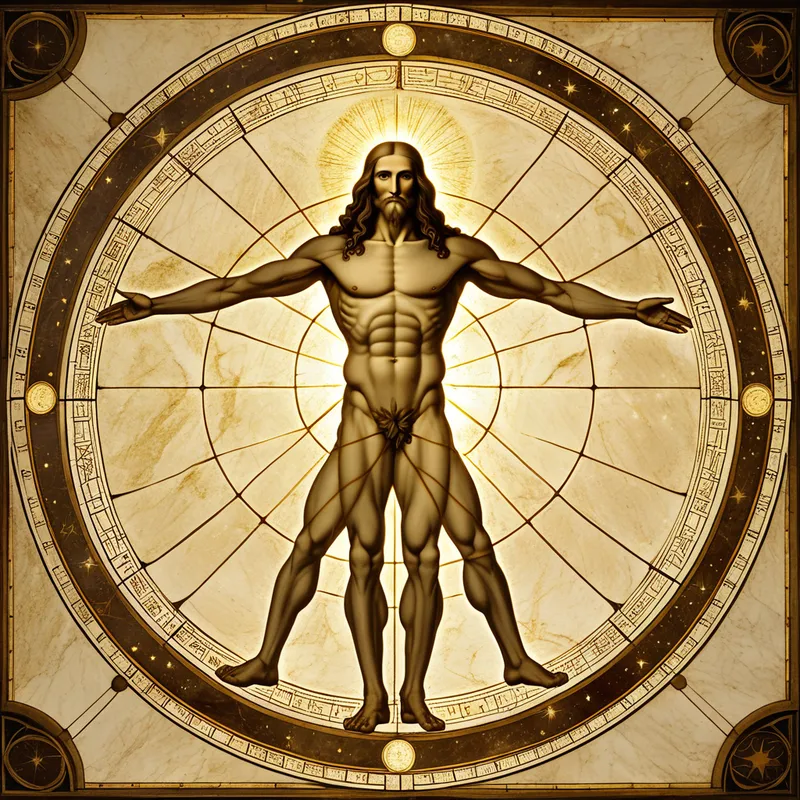
- Sacred Geometry (Flower of Life, Metatron's Cube): The imprint of a higher, organizing principle, a connection to archetypal reality.
- Impossible Shapes (Penrose Triangle, Möbius Strip): Cognitive dissonance, a logical paradox at the heart of an emotional experience.
- Shattered Glass/Crystal: A rupture in one’s worldview or self-perception.
- Blueprints & Grids: The planning stage of the psyche, potential yet unrealized.
Archetypal Resonance
The Creator Archetype is the master architect active in this theme. Its energy is not about painting a landscape, but about drafting the very laws of that landscape’s reality. The somatic echo of perfect form or terrifying distortion is the Creator’s hand feeling for the right material—the substance of your life—to shape. Its shadow, the Mad Scientist or Self-Centered Architect, appears when we rigidly impose a personal geometry upon the fluid world of relationship and emotion, building cold, logical fortresses that keep life out. The alchemical potential here is immense: to move from being a prisoner of your internal architecture (the labyrinth) to becoming its conscious, compassionate creator. The Creator does not fear the dismantling of old forms, for it knows that within the rubble lie the raw materials for a truer, more beautiful structure—one that allows for both sanctuary and sky.
The Alchemical Process
The transmutation here is from fragmentation to foundational sovereignty. The prima materia is the shattered mirror of your self-concept, the confusing blueprint, the oppressive grid. The heat is applied through the intense, sustained pressure of contradiction—the lived experience that your old “geometry” no longer fits, that your equations of love, success, or safety no longer balance. This pressure feels like a perpetual state of psychic vertigo. The alchemical vessel is your conscious attention, held steady amidst the disorientation. Within this vessel, the old, rigid structures must dissolve. This dissolution is not destruction, but a return to potential. The atoms of your understanding separate. Then, in the silence that follows the ruin, a new pattern begins to coalesce—not from an external ideal, but from an internal, organic necessity. The leaden feeling of being trapped by your own mind’s design is transmuted into the golden awareness that you are, and have always been, the designer. You gain sovereignty over the inner realm.

The Integration Protocol
Question 1: Where in my waking life do I feel a similar somatic echo—the clench of a rigid structure or the dizziness of a missing support? What belief or expectation is that geometry representing?
Question 2: If the dream’s geometric form (sphere, maze, fractal) were a model of a current relationship, challenge, or inner conflict, what would each angle, line, and intersection represent?
Question 3: What one, small “axiom” of my personal reality—a foundational “I am” or “The world is” statement—feels ready to be examined, not as truth, but as a hypothesis?
Action 1 (Grounding the Angle): When you feel the disorientation of psychic shift, find a right angle in your physical environment—a door frame, a book, a table corner. Place your hands on it. Feel its certainty. Then, close your eyes and imagine that stability turning inward, not as a rigid wall, but as a spine of clarity you can choose to lean on.
Action 2 (Blueprint Revision): Take a large sheet of paper. Without thinking, draw the “map” of a current struggle as an abstract geometric landscape. Use only shapes, lines, and patterns. Where are the blockages? The open spaces? The fragile bridges? Title this “The Old Blueprint.” On a second sheet, intuitively draw the geometry of a resolution. Do not illustrate the solution, but let its structure emerge as form.
Action 3 (Ritual of Rescaling): Find a small, clear quartz or other stone. Sit with it, and for a few minutes, project onto it the feeling of an overly rigid, constricting mental structure. Then, take it to a natural body of water—a stream, the sea, even a steady rain gutter. Place it in the flow and witness the water, the ultimate solvent of form, flowing over it. Leave it there. You are not destroying the structure, but submitting it to a larger, more fluid order.
Final Validation
To dream of geometry is to feel the immense, often terrifying, responsibility of your own consciousness. It is to be made aware of the girders and ghosts that hold you up, and the silent labor of their rearrangement. This is not easy work. It asks you to be both the building and the architect, the equation and the variable. The dizziness is real. The longing for a perfect, unchanging form is a deep human ache. Yet within that very ache is the signature of the Creator. You are not lost in the labyrinth; you are the labyrinth learning its own shape. The lines you dream are not constraints, but the first, sacred strokes of a map you are drawing for a self you have not yet met, but are forever in the process of becoming.