Vimana Myth Meaning & Symbolism
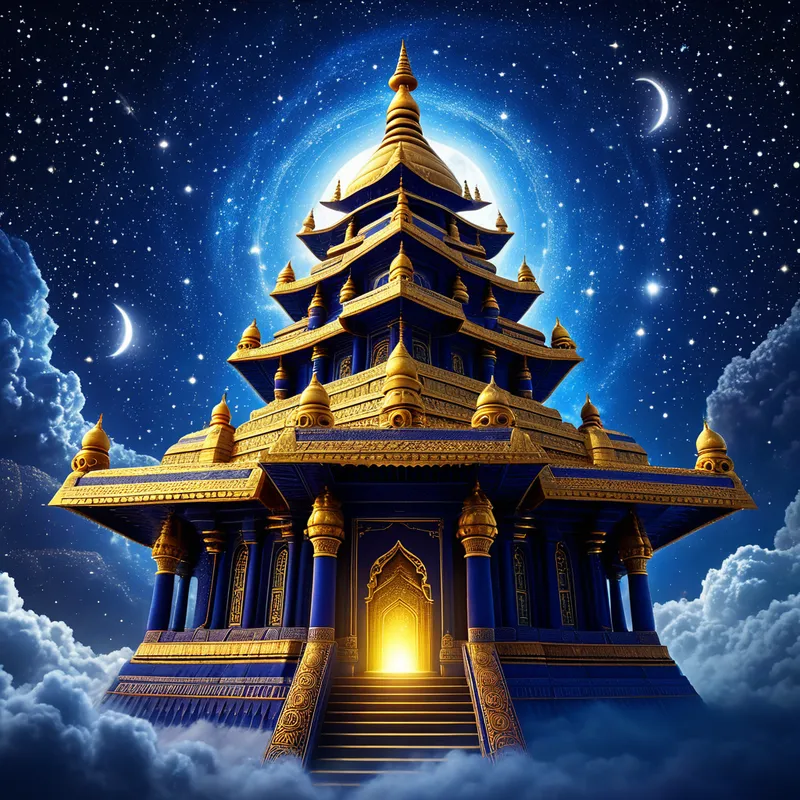
The myth of celestial Vimanas, divine flying chariots, embodies the ascent of consciousness, the sovereignty of the soul, and the perilous journey to the luminous sky.
The Tale of Vimana
Listen, and let the winds of time carry you back to an age when the sky was not a ceiling, but a road. When the sun was not merely a star, but the blazing wheel of Surya's chariot. In that age, the gods did not dwell in some distant heaven; they traversed the three worlds in vessels of unimaginable splendor—the Vimanas.
Hear now of the Gandharva lord, Vishvakarma, whose mind was a forge of cosmic possibility. From the essence of sunlight and the breath of the wind, he shaped a chariot not for earth, but for the vault of heaven. Its body was of beaten gold, lighter than a cloud, stronger than a mountain's bone. Its wheels were not wheels, but spinning spheres of captured lightning. At its heart thrummed a jewel, the Chintamani, pulsing with the will of its rider.
And who would ride such a craft? It was Indra, the thunder-wielder, who claimed it. With a roar that shook the foundations of the clouds, the Vimana ascended. It did not fly; it commanded the sky. It carved pathways through the realms of Antariksha, leaving trails of shimmering energy. From its heights, Indra beheld the world—the winding rivers like silver threads, the mountains like sleeping giants, the petty wars of men like embers sputtering in the mud.
But the sky is not empty. It is a field of conflict. The Asuras, ever-envious, crafted their own dark vessels, forged in subterranean fires, powered by wrath and ambition. The air became a battlefield. Beams of pure solar energy, the Sudarshana Chakra, clashed with projectiles of solidified shadow. The Vimana danced, a luminous predator, evading, striking, a testament to the pilot's unity with the machine. To ride the Vimana was not to steer a vehicle; it was to become an extension of divine will, a sovereign intelligence navigating the chaos between order and oblivion.
And in rare, blessed moments, a worthy mortal might be granted passage. A king of pure heart, a sage of fierce austerity, would feel the wind change, hear a hum not of this earth. Looking up, they would see the chariot descend, a fragment of another order visiting this one. To step aboard was to have the scales fall from the eyes, to see the interconnected web of life from a perspective untouched by dust or desire. It was a glimpse of Moksha, not as a philosophical concept, but as a visceral experience of ascent. Then, as swiftly as it came, the Vimana would withdraw, returning to its celestial circuits, leaving the mortal world forever altered, forever small, and forever haunted by the memory of the boundless sky.
Cultural Origins & Context
The seeds of the Vimana myth are found in the Vedas, particularly the Rigveda, where the chariots of the gods—like that of the dawn goddess Ushas—are described with poetic grandeur. These were not yet the complex, mechanized palaces of later Puranic and epic literature, but potent symbols of divine mobility and sovereignty. The concept evolved through texts like the Ramayana and the Mahabharata, where Vimanas like Pushpaka become central to the narrative, objects of desire and instruments of power.
These stories were the province of the Brahmin priests and the itinerant Suta storytellers. Recited at royal courts and during great sacrificial festivals, they served multiple functions: they reinforced cosmic and social order (the gods in their chariots ruled justly, so too should kings); they explained the awe-inspiring phenomena of the skies (thunder was Indra's chariot rolling); and they mapped a cosmology where ascent—spiritual, moral, and intellectual—was the ultimate human endeavor. The Vimana was a narrative vehicle, literally and metaphorically, for exploring the relationship between the terrestrial and the celestial.
Symbolic Architecture
At its core, the Vimana is a symbol of the vehicle of consciousness. It represents the structured, intentional means by which the psyche—the individual soul or Jivatman—ascends from the muddled, conflict-ridden earthly plane (Bhuloka) to the clarity and unity of the higher mind or spirit (Svargaloka).
The Vimana is not an escape from the world, but the instrument for achieving the correct perspective on the world.
Its intricate construction by Vishvakarma signifies that this vehicle of ascent is not stumbled upon; it must be built through conscious effort, discipline (the craft of the gods), and the integration of one's inner resources (the precious materials). The pilot's unity with the craft symbolizes the state of Dharana and Dhyana, where the seeker and the means of seeking become one. The battles in the aerial realm represent the inevitable psychic conflicts encountered during spiritual growth—the clashes with old habits, shadow aspects (the Asuras), and inflated fantasies that can sabotage the journey.
The Dreamer's Resonance
When the image of a Vimana surfaces in a modern dream, it rarely appears as an ancient chariot. It may manifest as a strangely silent aircraft, a glowing geometric shape, a car that can suddenly lift off the road, or a room that detaches and floats away. This is the psyche signaling a powerful process of ascent or transcendence.
Somatically, the dreamer may report sensations of lifting, weightlessness, or a humming vibration. Psychologically, this dream emerges at crossroads where the conscious ego is being called to rise above a limiting situation, a entrenched pattern, or a clouded emotional state. The Vimana dream suggests the dreamer possesses, or is developing, an internal structure—a "psychic vehicle"—capable of navigating this shift. However, the dream also carries the myth's inherent warnings: Is the vehicle intact, or damaged? Is the dreamer piloting it, or is it out of control? Is the ascent graceful, or is it a frantic escape? These details reveal whether the transcendence is grounded in integrated consciousness or in spiritual bypassing.
Alchemical Translation
The myth of the Vimana provides a profound model for the alchemical process of individuation—the forging of a coherent, sovereign Self from the raw materials of the psyche. The journey begins on the "battlefield," the conflicted terrain of ordinary life.
First, one must recognize the need for a vehicle—mere willpower or intellectual understanding is insufficient for the journey. This is the stage of building the Vimana through analysis, self-reflection, and the careful crafting of a personal practice or philosophy (Vishvakarma's craft). Then comes the perilous ascent through the Antariksha, where one encounters and must engage with psychic projections, complexes, and the seductive "dark technologies" of the shadow (the Asuric vessels).
The goal is not to destroy the shadow, but to outmaneuver its claims to sovereignty, to integrate its energy without being hijacked by it.
Successful navigation requires becoming one with the vehicle—the conscious ego aligning totally with the deeper, guiding Self. The triumphant state is not arrival at a static heaven, but the achievement of sovereign perspective. The individuated Self, like Indra in his Vimana, gains the capacity to hold the whole of one's life—the beauty and the mud, the triumphs and the wounds—in a single, compassionate gaze. From this height, one can descend back into the world, not as an escapee, but as a ruler of one's own inner kingdom, capable of acting with clarity, power, and a wisdom that has seen the world from the road of the sun.
Associated Symbols
Explore related symbols from the CaleaDream lexicon:
- Spaceship
- Ufo
- Cosmic Space Station
- Heavenly Chariot
- Time-Traveling Carriage
- Weather Balloon
- Segway
- Aerial Tramway
- Airplane Takeoff
- Space Shuttle Launch
- Futuristic Hovercraft
- Etherial Spacecraft
- Retro Spacecraft
- Jetpack
- Wright Brothers' Plane
- Holographic Bus
- Hoverboard
- Hyperloop Train
- Magnetic Levitation Train
- Warp