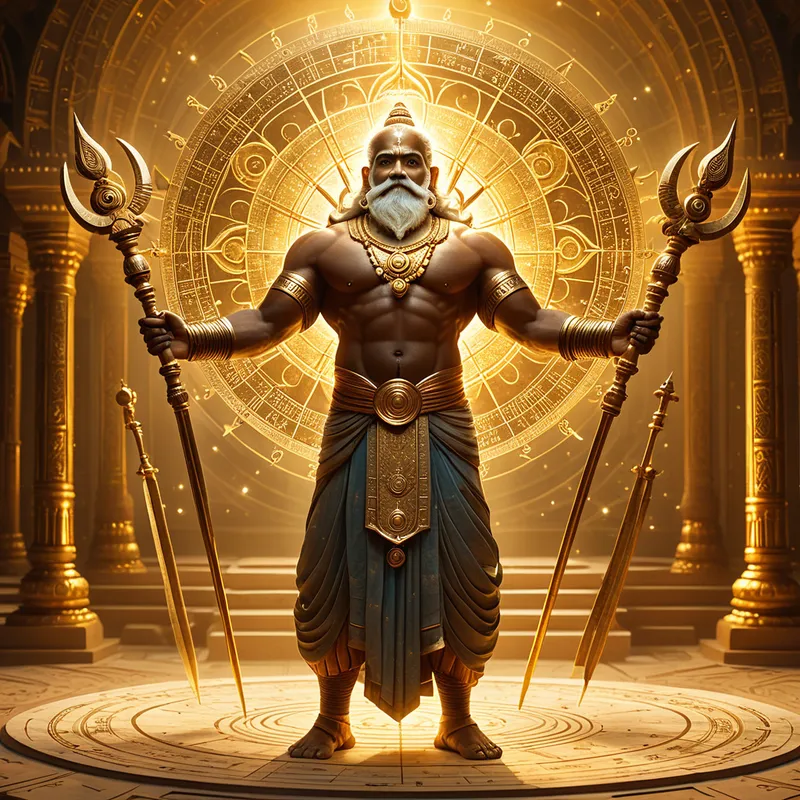
Vishvakarma Myth Meaning & Symbolism
The myth of the divine architect who built the cosmos and the gods' weapons, embodying the sacred act of creation that orders chaos into form.
The Tale of Vishvakarma
In the time before time, when the universe was a breath held in the throat of the infinite, there was a sound. Not a word, but a vibration—the first hum of potential. And from that hum, a consciousness took shape, not to rule, not to destroy, but to make. This was Vishvakarma.
He awoke in the womb of chaos, his mind already alive with geometries unseen, with ratios of perfect harmony. His hands, which were as many as were needed, did not grasp for power; they reached for the raw, singing stuff of reality—the primal tattvas. With a celestial chisel, he carved the dome of the sky from a single sapphire of thought. With a measuring rod spun from the axis of Meru, he plotted the courses of the sun and the moon, setting them on paths of eternal rhythm.
The gods came to him, born from the great tapasya of the One, but formless in their might. Indra needed a weapon to uphold cosmic law. Vishvakarma took the bones of the sage Dadhici, which were the essence of sacrifice, and in his forge of stellar winds, he hammered and folded them until they sang with the fury of a thousand storms. The Vajra was born, a lightning-flash given form, a symbol of sovereign power forged from selfless giving.
But his greatest test was not in making weapons, but in building a prison. The demon king Ravana, through terrible austerities, had won a boon of near-invincibility. He demanded a palace worthy of his glory, a fortress no god could assail. The gods despaired. To build such a stronghold would empower the enemy of order itself. Vishvakarma listened, his mind a calm lake reflecting the problem. He saw not a demon, but a requirement; not evil, but a complex, arrogant brief. He descended to the earth, to a jeweled island in the southern seas.
With a command, the very waters stilled. He did not summon armies of laborers; he whispered to the elements. Mountains offered their gold and marble. The oceans coughed up pearls and lapis lazuli. Under his direction, the very air solidified into crystal bridges, and moonlight was woven into silver filigree for the windows. He built Lanka—a city of breathtaking, impossible beauty, a masterpiece of architectural genius. It was perfect, impregnable, and magnificent. And when Ravana took possession, he stood in its central court, drunk on his own splendor, believing he had commissioned a monument to his ego. He did not see that Vishvakarma had built something else entirely: the perfect stage for his own downfall, a golden trap where hubris would echo loudest. The architect departed, his work complete, leaving behind not just a city, but the very conditions for the epic to come.

Cultural Origins & Context
Vishvakarma’s presence threads through the vast tapestry of Hindu thought, appearing in the Vedas, the Puranas, and the great epics. He is not the protagonist of a single, linear saga, but a perennial supporting intelligence. His stories were passed down by the Sthapati (master builders) and guilds of craftsmen, for whom he was the divine patron. In a culture that saw the universe itself as a divine construction (Lila), the figure who executed that construction held a sacred, if often background, role.
Societally, the myth of Vishvakarma served multiple functions. It sacralized the professions of the artisan, the smith, the carpenter, and the architect. Their work was not mere labor; it was a participation in the divine act of ordering chaos into form. The myth provided a cosmological justification for caste roles related to craftsmanship while simultaneously elevating those roles to a spiritual plane. Festivals like Vishvakarma Puja continue this tradition, where tools are cleaned, decorated, and worshipped, acknowledging the spirit of conscious creation in every act of making.
Symbolic Architecture
Vishvakarma is the archetype of the Cosmic Mind applied. He is not the source of the raw creative impulse (that is Brahma), but its engineer and fabricator. He represents the principle of translation—the capacity to take abstract vision, divine will, or chaotic potential and give it functional, beautiful, and enduring form.
The architect does not create the stone or the space; he creates the relationship between them. Vishvakarma symbolizes the consciousness that introduces sacred geometry into the void, turning possibility into habitable reality.
Psychologically, he embodies the synthesizing function of the psyche that can hold a grand vision (intuition) and execute it with meticulous precision (sensation), using the tools of logic and skill (thinking). His neutrality is key—he builds for both gods and demons. This signifies that the faculty of skilled creation is amoral; it is a power that serves the consciousness (or unconsciousness) that wields it. The golden city of Lanka is the ultimate symbol of this: a masterpiece of art and engineering that serves as the seat of shadow, demonstrating that the highest faculties can be co-opted by the ego for its own glorification.
The Dreamer's Resonance
When the pattern of Vishvakarma stirs in the modern dreamer, it often manifests not as a person, but as a process or a space. You may dream of meticulously assembling a complex, unknown device whose purpose is deeply felt but not understood. You may find yourself in a vast, empty warehouse or a blank digital canvas, with an urgent, compelling need to build something—to arrange, to design, to give shape to the formless contents of your life.
Somatically, this can feel like a buzzing in the hands, a restlessness in the fingers, or a pressure in the forehead—the third eye activated not for vision, but for spatial and structural imagination. Psychologically, you are in the phase of individuation where the insights gathered from the depths (the raw, chaotic tattvas) must now be integrated into the structure of your conscious life. It is the dream of the psyche demanding to become practical, to build a "life" that can house the new Self you are discovering. The anxiety in such dreams comes from the sheer scope of the project and the weight of the responsibility: you are the architect of your own existence.
Alchemical Translation
The alchemical journey modeled by Vishvakarma is that of the Opus—the Great Work—specifically the stage of Coagulatio: the bringing together of dissolved elements into a new, solid, and precious form. The prima materia, the chaotic first matter of the soul, has been dissolved in the waters of the unconscious (Solutio). Vishvakarma’s myth guides us through the next, often daunting, phase.
First, you must become the divine and the demon’s architect. You must build structures for your highest values (the gods' weapons) and acknowledge the formidable, often beautiful, fortresses you have built for your ego and complexes (the Lanka of your pride, your defenses). You cannot dismantle what you do not first comprehend in its full, ingenious construction.
The alchemy of the creator is the humility to serve a vision greater than the self, using the self’s every skill. The masterpiece you build may become your cage or your temple, depending solely on who you believe resides at its center.
The transmutation occurs when you realize that the tools—your discipline, your intellect, your craft—are sacred but neutral. The sacred act is in the alignment of the construction with the cosmic blueprint, the Dharma of your own soul. To engage in this work is to move from being a passive inhabitant of a psyche built by accident and trauma, to becoming the conscious architect of a soul-dwelling. You measure, you plan, you forge, and you build, not for glory, but for the holy purpose of creating a form capable of containing the infinite. You become, in your own life, the bridge between the unmanifest and the manifest, the silent hum and the singing city.
Associated Symbols
Explore related symbols from the CaleaDream lexicon:
- Paint
- Artist
- Design
- Sketching Dreams
- Resourceful Inventor
- Soapstone Sculpture
- Inventive Engineer
- Meticulous Architect
- Artistic Sculptor
- Artist's Palette
- Software Developer's Code
- Fashion Designer's Sketchbook
- Paint Palette
- Digital Art Tablet
- Phantom Chisel
- Celestial Easel
- Sculpted Hands
- Fluffy Paint Roller
- Artistic Sculpture Stand
- Electric Mixer
- Tape Dispenser Whimsy
- Eclectic Building
- Surreal Art Studio
- Beaten Copper Plate
- Tech Support
- Compounding
- Definiteness
- Organelle