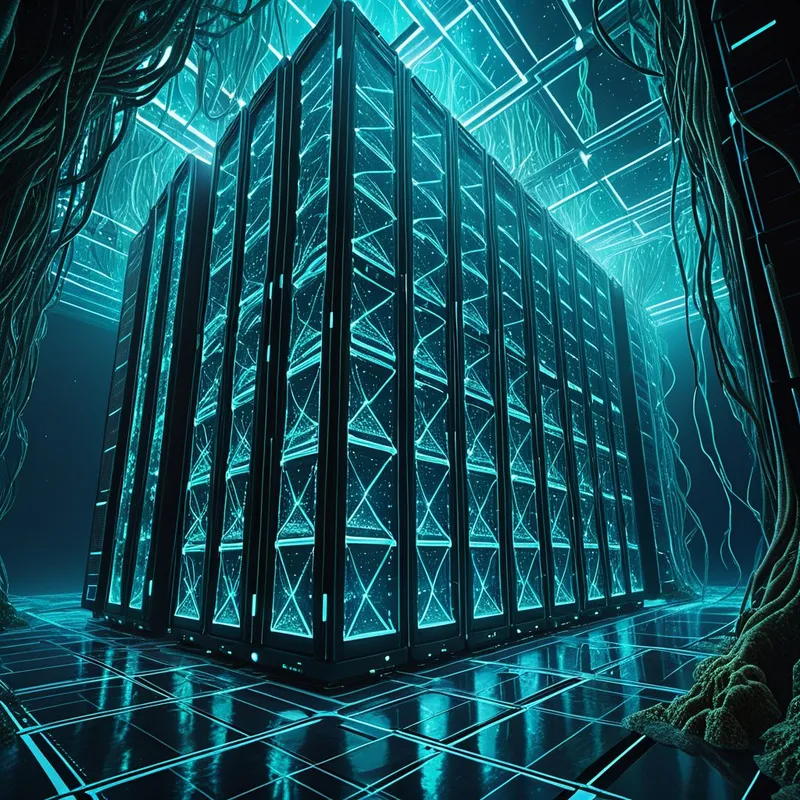
The Blueprint of the Psyche: When Technology Dreams Itself
The Somatic Echo
Before the image of a screen, the hum of a server, or the cold touch of glass, the dream announces itself in the body. It is a specific, modern tension: a low-grade electrical current humming just beneath the skin, a sense of being plugged in to a grid you cannot see. It’s the weight of invisible connections in the palms, a phantom vibration in the thigh. The jaw may clench with the effort of processing, the eyes feel dry and over-scanned even in sleep. This is the somatic signature of the technological dream—not fear of a machine, but the visceral recognition of a system. Your own internal systems—of thought, of habit, of belief—are making themselves known as architecture. They feel external, foreign, yet intimately wired into your nervous system. The dream begins not with a symbol, but with this embodied question: What program am I running?
The Dreamer's Log
She stands in her apartment, but the walls are alive with shifting, liquid code. Her smartphone rests on a glass table, its screen a dark mirror. When she reaches for it, the glass cracks with a sound like ice splitting, and from the fracture, a single, perfect drop of mercury wells up and begins to trace a labyrinthine pattern across the table’s surface, glowing with a soft, internal light.
This is the psyche performing a core dump—a forced extraction of its essential, mercurial intelligence from the rigid container of a habitual identity.

The False Lead
The dream of technology is not a literal prophecy about your laptop crashing or a warning to update your software. It is not mere anxiety about social media or a simplistic fear of AI. To interpret it as such is to mistake the map for the territory. The glitching screen is not about the device; it is about the interface between your conscious mind and your deeper, more fluid self. The unresponsive keyboard is not a practical problem, but a somatic report on a part of you that has gone silent, whose input is no longer being registered. The dream uses the lexicon of our time to describe ancient processes: connection, transmission, control, and creation. The false lead is to look outward at the tool. The true direction is inward, toward the toolmaker.
Psychological Architecture
When technology appears in the dreamscape, you are being shown the shadow work of individuation as engineering. The psyche presents itself as a system to be debugged. That relentless, repeating notification? It’s a exiled part of you—a feeling, a memory, a need—pinging the main server of consciousness, requesting acknowledgment. The corrupted file you cannot open is a bundle of experience your ego has labeled “incompatible” and quarantined. The infinite scroll is the endless, compulsive sorting of psychic material without integration.
This is where the Internal Family Systems model meets the server room. Each “glitch” is a frozen part, a protector or exile operating on an old, looping script. The dream invites you to become the compassionate system administrator. Not to delete the problematic program, but to witness its source code—the original trauma, the unmet longing, the adapted survival strategy that wrote it. To individuate is to move from being a passive user of your own psyche, frustrated by its bugs, to becoming its sovereign developer. You are not fixing a machine; you are learning the language in which your soul has chosen to articulate its becoming.
Mythic Resonance
This process echoes in the myth of the Golem, the clay giant animated by sacred words placed under its tongue. The Golem is a perfect technology—a created being that executes commands with literal, relentless force. But it lacks a soul’s nuance; it cannot choose. When it runs amok, it is not evil, but a system operating without the governor of wisdom. The dream of a rogue AI or an unstoppable program is the Golem myth in modern dress: it speaks of a power you have summoned (a ambition, a rigid belief, an automated behavior) that now operates autonomously, threatening to overwhelm you because it has been divorced from the heart’s intelligence.
Similarly, the tale of Daedalus and his labyrinth is not just about building a prison for a monster, but about constructing a system so complex that even its creator struggles to navigate it. Our own psychological labyrinths—the intricate defenses, the looping thought-patterns, the elaborate justifications—are technologies of the self. The dream asks: Did you build this maze to contain a monster, or to discover the minotaur at its center is a part of yourself waiting to be met, not slain?
Symbolic Nodes
- Screens & Interfaces: The boundary between the inner and outer world, the conscious and unconscious. A cracked screen is a breached persona.
- Glitches & Corruption: Interruptions in the ego’s narrative. Points where repressed truth forces its way into awareness.
- Wires & Connections: The nervous system, synaptic pathways, and the often-tangled web of relationships and obligations.
- Data Streams / Infinite Scroll: The unprocessed flow of psychic information, memories, and stimuli.
- Empty Batteries / Power Loss: Depletion of vital life force, libido, or creative energy.
- Unresponsive Controls / Frozen Cursor: A sense of agency being blocked, a will paralyzed by internal conflict.
- Archived/Deleted Files: Memories or aspects of the self placed in cold storage or consciously rejected.
- Viruses & Malware: Invasive thought-forms, toxic beliefs, or external psychic influences that have taken root.
Archetypal Resonance
The energy at the core of the technology dream is that of The Creator Archetype. Not its shadow of the mad scientist, lost in solipsistic invention, but the Creator in its essential form: the Artist, the Architect, the one who brings new order into being. This archetype resonates because the dream’s central drama is about the structures of your own experience. The somatic echo is the buzz of potential, the itch to make. The alchemical potential lies in recognizing that you are not merely a user of the psychological software you inherited; you are its ongoing author. The Creator’s impulse is to look at the raw data of a life—the chaos, the patterns, the glitches—and to see not error, but material. It asks the fundamental question: If I built this, what do I choose to build next?
The Alchemical Process
The alchemical transmutation here is the conversion of Programmed Reaction into Authored Response. The base metal is the feeling of being automated—triggered, scrolled, notified, driven by unseen code. The heat and pressure are applied by the conscious, relentless curiosity of the dreamer who stops and asks, “Why does this specific symbol hold charge for me?”
The process begins with Observation (the nigredo): sitting with the uncomfortable hum, the glitch, the fear of the blue screen. It requires not rebooting, but watching the error message. The heat increases through Decompilation (the albedo): patiently reverse-engineering the emotional reaction to its source code—the childhood event, the cultural imprint, the forgotten vow that wrote the original script. The rubedo, the reddening, is Rewriting. This is not positive thinking; it is the arduous, creative act of authoring a new subroutine from a place of witnessed truth. You take the mercury—the fluid intelligence that escaped the cracked screen—and with it, you inscribe a new directive. The terror of system failure becomes the profound sovereignty of the system’s source.

The Integration Protocol
Question 1: Where in my waking life do I feel most like a "user" following an interface, rather than a "creator" authoring an experience? What is that interface made of? (Habit, obligation, an old story?)
Question 2: If the glitch or error in my dream is not a mistake, but a message, what is the one piece of data it is trying to force into my awareness?
Question 3: What ancient, organic part of my being (my breath, my heartbeat, my intuition) feels most in conflict with the technological metaphor of my dream? How can that part become the system administrator?
Action 1 (Somatic Debugging): For one day, track the physical sensations that arise when you receive a notification, can’t find information, or feel pressured to respond quickly. Don’t change the behavior yet. Just note the bodily echo: a clench, a buzz, a hollow feeling. This maps your personal wiring.
Action 2 (Creative Decompilation): Take the central object from your technology dream (the phone, the wire, the screen). Draw it, but draw it incorrectly. Let your hand wander. Make it organic, melt it, grow vines from it, turn its pixels into stars. This unstructured act bypasses the logical mind and allows the symbol to reveal its deeper, fluid nature.
Action 3 (Ritual Reboot): Find a small, obsolete piece of technology (a dead battery, a broken cable, a burnt-out bulb). In a quiet moment, hold it and thank it for its service. Then, consciously decommission it. Bury it, recycle it with intention, or place it in a stream. As you do, silently state one automated thought or reactive pattern you are choosing to decommission alongside it. This externalizes and completes the release.
Final Validation
It is profoundly disorienting to feel your own soul speaking in the language of circuitry and code. To sense the sacred in the glitch, the divine in the download. This disorientation is not a sign you are breaking; it is evidence you are listening. The modern maze is of your own making, but the thread leading out is your own breath, your own heartbeat—the original technology you were given. You are not the program. You are not the user. You are the consciousness in which the entire system arises, the silent space that holds both the labyrinth and the path. To dream of technology is to be given the blueprint. Now, you must decide: will you live in the factory, or pick up the tools and build a sanctuary?