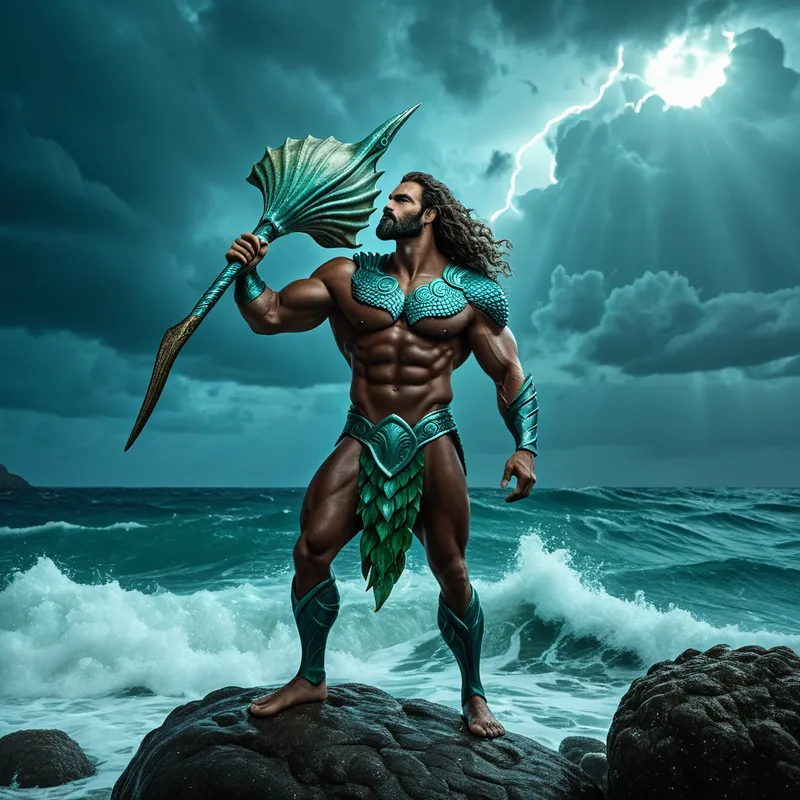
Triton's Conch Myth Meaning & Symbolism
The myth of the sea god Triton's mighty conch shell, a horn that calmed or raised the waves, embodying the power of the primordial voice.
The Tale of Triton's Conch
Hear now the tale of the voice that commands the abyss. In the age when gods walked the waves and heroes were forged in salt and storm, the deep was not silent. It roared, it whispered, it sang a ceaseless, chaotic hymn. And from this chaos, a single note could bring order.
He is Poseidon, the Earth-Shaker, whose trident stirs the very foundations of the world. But the surface of his domain, the vast, heaving skin of the sea, was given to his son. Triton. Not a merman of gentle lore, but a being of immense, raw power. His form was the marriage of god and beast: the torso of a mighty warrior, the tail of a great sea-serpent, coiling with latent force. He dwelt in a golden palace beside his father, in the sun-dappled depths where light from our world grows faint and dies.
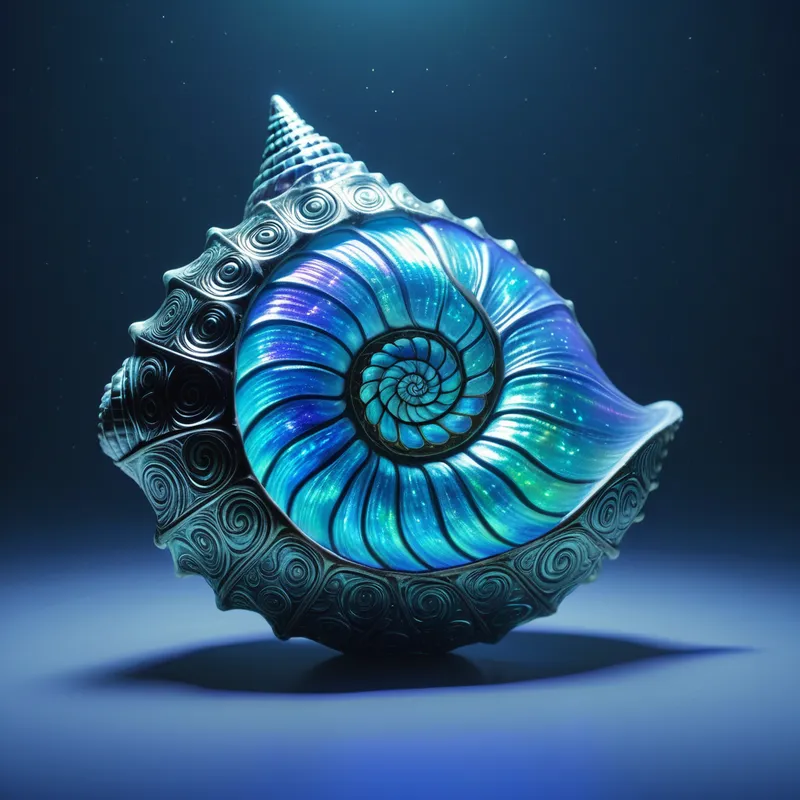
His weapon was not of sharpened bronze or tempered iron. It was a shell. A conch, plucked from the secret heart of the ocean, grown to a size fit for a god. Its exterior was a labyrinth of pearl and coral, its interior a smooth, spiraling cavern that led to the first darkness.
When the sea grew wrathful, when Zeus hurled his lightning and the winds, unleashed by Aeolus, screamed across the waves, it was Triton who answered. He would rise from the foam, his scaled body gleaming, and raise the great conch to his lips. He did not blow a gentle tune. He sounded a call that was older than the gods—a deep, resonant bellow that vibrated in the marrow of the world.
The sound was a command. To the crashing waves, it said, Be still. And they would flatten into a sheet of polished obsidian. To the howling gale, it whispered, Be silent. And the air would grow heavy and calm. With one blast, he could soothe the raging heart of the ocean itself. But the conch held a dual nature. That same blast, sounded with a different intent, could summon the waves from their slumber, could coil the sea into towering walls of water, could call forth the monsters from the trenches. It was the voice of the sea’s soul: chaos given form, form given voice, and the voice given absolute authority.
Sailors in their fragile ships, glimpsing his formidable shape upon a distant reef, would pray not to him, but to the silence between the blasts. For the sound of Triton’s conch was the sound of the world’s breath being held, the moment before fate was decided—for calm passage, or for a descent into the abyss.
Cultural Origins & Context
The figure of Triton and his signature conch shell horn is not the centerpiece of a single, grand epic like the Iliad. Instead, he is a pervasive presence in the mosaic of Greek myth, appearing in the works of Hesiod and later in the vivid descriptions of the Roman poet Ovid. He is part of the divine retinue, a personification of the sea’s tangible, often terrifying, power.
His myth was passed down not as a hero’s journey, but as an explanatory and cautionary element. For a culture whose lifeblood was the Mediterranean—for trade, sustenance, and expansion—the sea was the ultimate power. It was benevolent and bountiful one day, a murderous, chaotic force the next. Triton, with his conch, became the anthropomorphic answer to the question: why does the storm cease? Why does the sudden calm feel so divine, so intentional? It was because a god had spoken. The conch was the instrument of that divine will, a tool that translated raw elemental power into an audible signal that even humans could perceive and fear.
He was often depicted in art, on pottery and in temple friezes, accompanying his father Poseidon. These images served as a constant reminder of the hierarchy of the deep and the thin line between a prosperous voyage and a watery grave. The myth functioned as a narrative anchor, giving a face and a action to the incomprehensible and often arbitrary moods of the natural world.
Symbolic Architecture
At its core, the myth of Triton’s Conch is about the power of the foundational voice. The conch is not merely a horn; it is a cosmic instrument.
The spiral of the shell is the first pattern, the archetypal map of growth from a center. To sound it is to project the inner law of that pattern onto the formless world.
The sea represents the primordial, undifferentiated unconscious—teeming with life, possibility, and latent terror. It is the massa confusa of the psyche. Triton himself symbolizes the mediating principle, the psychic entity (the archetype of the ruler or sage) that can interact with this chaos. He is born of it (son of Poseidon) yet possesses a form that allows for conscious action.
The conch is the symbol of this mediation. It takes the breath—the spirit, the pneuma—from within and transforms it into structured sound that alters external reality. Its two functions, to calm and to raise storms, represent the dual nature of consciousness itself: the capacity to bring order and peace to inner turmoil, and the equal capacity to stir up latent conflicts, to call forth the "storms" necessary for growth and cleansing. The authority is not in the shell, but in the being who knows how and when to use it.
The Dreamer's Resonance
When the symbol of Triton’s Conch surfaces in a modern dream, it rarely appears as a literal scene from mythology. Instead, it manifests as a pattern, a feeling-toned complex.
You may dream of finding a large, beautiful shell on a beach and feeling a compulsive, almost sacred urge to lift it and blow into it, unsure of what will happen. You may dream of hearing a deep, resonant horn sound in the distance that instantly changes the emotional weather of the dreamscape, bringing either profound peace or sudden, exhilarating terror. Somatically, the dreamer might report a vibration in their chest, a feeling of their own voice being amplified or stifled.
Psychologically, this signals a process at the threshold of the deep unconscious. The dream-ego is encountering the "Triton" aspect of itself—the part capable of issuing a command to the inner sea. The conflict is about finding one’s authentic, authoritative voice. Do you have the right to sound the conch? Do you fear the calm it may bring (the silence after lifelong turmoil) or the storm it may summon (the necessary conflict you have been avoiding)? The dream is an invitation to claim the instrument and learn its use.

Alchemical Translation
The individuation process, the journey toward psychic wholeness, requires that we move from being passive victims of our inner weather to conscious navigators of it. The myth of Triton’s Conch provides a precise model for this alchemical transmutation.
The first step is to dive into your own depths and retrieve the conch—to identify your unique instrument of expression, your core truth. The second, and more difficult, step is to develop the wisdom to use it.
Initially, our inner sea is ruled by a distant, often absentee Poseidon—the unconscious drives that toss us about without pattern or pity. The "Triton" function is undeveloped; we have no conch, or we are afraid to sound it. The alchemical work involves building a relationship with this inner sea-god. This means acknowledging the chaotic, emotional, instinctual depths (the sea) as part of our lineage (our "parent"), not as an enemy.
Finding the conch is the discovery of one’s true voice—not the social persona, but the sound that emerges from the core of one’s being. It is often found in creative expression, in setting a firm boundary, in speaking a long-silenced truth. The alchemical nigredo, the blackening, is the storm. The albedo, the whitening, is the blast of the conch that brings the calm of clarity.
The ultimate transmutation is achieving the sage-like authority of Triton. It is the integration where one no longer fears the storms of emotion or the terrifying silence of the depths, because one holds the instrument that can converse with them. You learn to sound the conch not to dominate the sea, but to speak its language, to translate its raw power into the music of a conscious life. The conch becomes the bridge, and its sound is the note of the indivisible self, resonant, commanding, and finally, at peace with the abyss from which it came.
Associated Symbols
Explore related symbols from the CaleaDream lexicon: