Thunderbird/Great Hawk Myth Meaning & Symbolism
A colossal spirit of storm and sky whose flight brings thunder, rain, and renewal, embodying the terrifying, necessary power of the heavens.
The Tale of Thunderbird/Great Hawk
In the time before memory, when the world was raw and the mountains still young, the sky was a silent, empty vault. The people below looked up and saw only a pale, dry dome. The rivers grew thin, the earth cracked, and a great thirst settled upon all living things. It was a stillness that presaged death.
Then, from the far north where the world curves into mystery, a shadow began to grow. It was not the shadow of a cloud, but of something immense moving behind the sky. A sound came with it, a deep, resonant pulse that was not yet thunder but its promise. The people huddled, feeling the vibration in their bones. The animals fell silent.
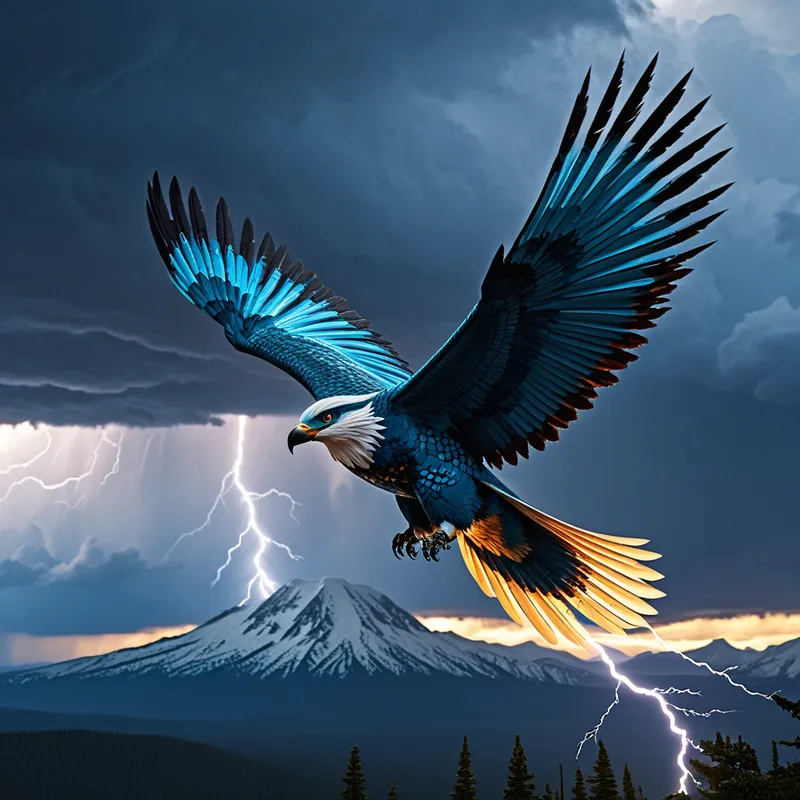
And then, it broke through. The Thunderbird—some call it the Great Hawk—unfurled its being. Its wings, when they stretched, were not measured in feet but in horizons. Each primary feather was a dark, iridescent blade, and with every mighty downstroke, the air itself shattered. The sound was not a crack, but a booming, rolling KWA-NEE that shook the roots of the mountains. Lightning was not merely its weapon, but the flashing of its furious, all-seeing eyes.
It did not come in peace, but in necessity. It saw the serpent of drought coiling around the land, the Great Horned Serpent or the spirit of stagnation lying in the deep lakes and rivers, hoarding the waters. The Thunderbird’s cry was a challenge that split the silent sky. It dove, not at the people, but through the fabric of the world, into the watery realms below. The battle was not of claw and fang as we know it, but of elemental wills. The Serpent rose, its scales slick with primordial slime, its breath a cold mist that sought to smother. The Thunderbird answered with a scream of pure electricity, searing the mist, and with talons that could grasp a lake, it wrestled the monstrous form from its den.
The struggle churned the waters into tidal waves, bent the trees flat, and turned the sky into a cauldron of black and violet. It was chaos, terror, destruction. But from the heart of this violence, a miracle was wrung. As the Thunderbird forced the Serpent to relinquish its hold, the waters it had hoarded were released. Rain, not a gentle sprinkle, but a torrential, life-giving deluge, began to fall from the wounds of the battle. The lightning that had seemed so violent struck the parched earth, and where it struck, not fire, but springs of fresh water bubbled forth.
Having restored the balance, the Thunderbird ascended, its form fading into the rolling thunderheads, leaving behind a world washed clean, quenched, and trembling with awe. It did not stay to be thanked. Its gift was the storm itself—the terrifying, purifying, absolutely necessary gift of upheaval and rain.
Cultural Origins & Context
The figure of the Thunderbird is not a single, monolithic character from one tribe, but a powerful, widespread archetype appearing across many Indigenous nations of North America, from the Kwakwaka'wakw and Coast Salish in the Pacific Northwest to the Lakota and Anishinaabe of the Plains and Woodlands. Its name, attributes, and specific adversaries vary, but its core nature as a sky sovereign of immense power is constant.
These stories were not mere entertainment; they were foundational teachings, passed down through oral tradition by elders and storytellers during long winter nights or at important gatherings. The myth served as a cosmological map, explaining the dramatic, life-sustaining weather patterns of the continent. It taught respect for the overwhelming power of nature, a power that could not be controlled, only acknowledged and appeased through ritual and right living. The Thunderbird’s battles symbolized the eternal cycle of seasonal change—the dry season’s stagnation overcome by the violent renewal of the stormy wet season. In societies deeply connected to ecological balance, the myth functioned as a sacred narrative reinforcing the necessity of cosmic and environmental order.
Symbolic Architecture
Psychologically, the Thunderbird represents the awesome, terrifying aspect of the Self—the total personality that encompasses both conscious and unconscious forces. It is not a gentle guide but a sovereign force of transformation that operates on a scale beyond personal comfort.
The Thunderbird does not ask permission to bring the storm; it is the storm. Its gift is not comfort, but the necessary cataclysm that breaks a drought of the soul.
The bird, master of the sky realm, symbolizes spirit, consciousness, and the higher perspective. Its adversary, the Great Horned Serpent or water monster, represents the chthonic, unconscious depths—the stagnant waters of unprocessed emotion, psychic inertia, or old, coiled traumas that hoard life energy. The myth thus dramatizes the critical, often violent-seeming psychic process where a dominant conscious attitude (the soaring spirit) must confront and integrate the powerful, shadowy contents of the unconscious (the watery depths) to release new energy and restore psychic balance.
The lightning is the brilliant, shocking insight that illuminates the darkness of the unconscious in a flash, a moment of terrifying clarity. The thunder is the profound somatic and emotional reverberation of that insight. The resultant rain is the released libido—the life-giving emotional and creative energy that had been trapped, now made available to nourish the entire psyche.

The Dreamer's Resonance
When the Thunderbird storms into modern dreams, it heralds a period of profound internal upheaval. The dreamer may experience this as anxiety before a life change, a sense of gathering pressure, or somatic sensations like a pounding heart (thunder) or sudden, nervous energy (lightning).
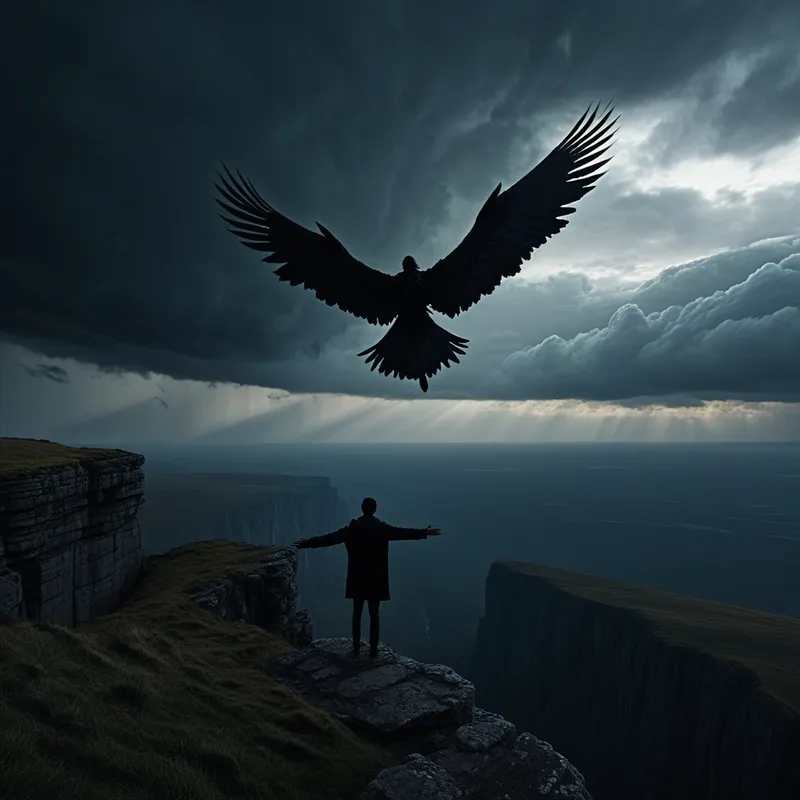
To dream of being pursued by the Thunderbird suggests a conscious ego fleeing from a powerful emerging truth or a necessary, but frightening, expansion of consciousness. To dream of witnessing its battle with the Serpent indicates the dreamer is observing, perhaps passively, a major conflict between their spiritual aspirations and their deep, instinctual fears or attachments. To dream of receiving a feather from the Thunderbird, however, is a potent symbol of being granted a measure of its authority—a call to embrace one’s own power and responsibility, however daunting.
The dream is an announcement: a psychic drought is ending. The old, stagnant ways of being are under assault from a force within the dreamer’s own psyche that demands balance, even if it must arrive with disruptive force.

Alchemical Translation
The myth of the Thunderbird is a perfect allegory for the alchemical and Jungian process of individuation. The initial state is the drought: a life that has become arid, repetitive, spiritually and emotionally parched. This is the nigredo, the blackening, a state of depression or stagnation.
The Thunderbird’s descent represents the forceful eruption of the unconscious into conscious life—a crisis, a breakdown, a shocking event that shatters the dry, brittle shell of the old personality. This is the violent separatio, the dividing of the stagnant waters (the unconscious complex) from the land (the conscious ego). The battle is the coniunctio oppositorum (the conjunction of opposites), not a gentle merging but a fierce struggle between spirit and instinct, height and depth.
The lightning strike is the moment of illumination where the ego sees, truly sees, the contents of its own shadow. This is the albedo, the whitening, a moment of searing clarity.
The release of the rains symbolizes the rubedo, the reddening. The liberated energy—now conscious and integrated—flows back into the psyche, bringing vitality, creativity, and emotional richness. The individual is not the same as before; they have been tempered by the storm. They have learned that personal sovereignty (the Thunderbird’s rulership) is not about control, but about the capacity to contain and channel these immense inner forces, to become a vessel for both the terrifying lightning and the nurturing rain. The myth teaches that true power lies in engaging the necessary storm, for on the other side of that upheaval lies not ruin, but profound renewal.
Associated Symbols
Explore related symbols from the CaleaDream lexicon: