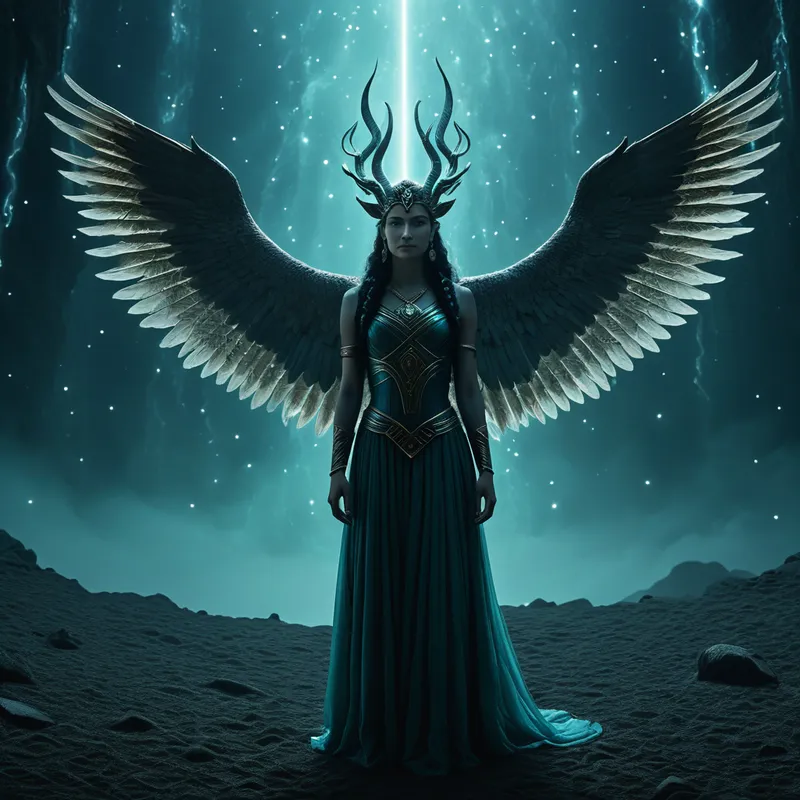
The Swan Princess
A Slavic tale of a princess who transforms into a swan, exploring themes of identity, enchantment, and the boundary between human and animal realms.
The Tale of The Swan Princess
In a kingdom of deep forests and silver rivers, there lived a princess of unearthly grace. Her days were spent in the gilded cage of court, a life of prescribed ritual that never touched the longing in her soul. She was an orphan of circumstance, her true parents lost to the mists of time or tragedy, leaving her a jewel in a crown that did not feel her own. Often, she would wander to the edge of the great lake, its waters a dark mirror to the sky, and feel a pull as ancient as the moon on the tide.
One twilight, as the veil between worlds grew thin, an old crone—a Baba Yaga in a gentler guise, or perhaps a keeper of older, wilder gods—appeared at the water’s edge. She saw the orphaned spirit in the princess’s eyes. Without a word, she offered not a curse, but a key: a shift in perception. She bestowed upon the princess a garment of purest white, woven from moonlight and mist. “Wear this,” she whispered, her voice like reeds in the wind, “and know your other self.”
As the princess donned the feathered cloak, a profound alchemy unfolded. Her human form dissolved not into pain, but into a release. Bones became hollow and light, arms lengthened into powerful wings, and her sorrowful song transformed into the haunting, melodic cry of a swan. She was not turned into a bird; she was remembered as one. With a beat of her majestic wings, she took to the air, leaving the silent castle behind for the boundless freedom of the lake and the sky. Here, in her swan form, she found her true sovereignty—a queen of the liminal spaces where water meets air, night meets day.
Yet, the enchantment was a circle, not a one-way path. With the dawn, or when she shed the feathered cloak upon the shore, she would return to her human shape, carrying the lake’s chill and the sky’s vastness in her bones. This dual existence became her life: a princess by day, a creature of elemental grace by night. Her fate often intertwines with a seeker—a prince or a humble hunter—who witnesses her transformation. He is captivated not just by her beauty, but by the profound integrity of her dual nature. The test is never to capture or possess her, but to recognize and love both her forms, to safeguard her feather-cloak not as a trophy but as a sacred trust, the key to her wholeness. In doing so, he does not “rescue” her from enchantment; he meets her within it, and together they navigate the mystery of a love that spans two realms.
Cultural Origins & Context
The Swan Princess is a migratory myth, her story nesting in various forms across the Slavic world, from Russian volshebnye skazki (wonder tales) to Polish and Ukrainian folklore. She is a close cousin to other avian maidens like the Baba Yaga’s geese-swans or the Firebird, but distinct in her nobility and the poignant psychology of her transformation. This myth blooms in a cultural landscape deeply animistic, where lakes, forests, and marshes are alive with rusalki (water spirits) and vila (forest nymphs). The swan itself was a creature of potent symbolic weight, often associated with purity, melancholy, and poetic inspiration, but also with marital fidelity and otherworldly journeys.
Her tale is fundamentally one of dvoeverie—the “double faith” or dual belief system where ancient pagan understandings coexisted with, and were woven into, later Christian frameworks. The transformation echoes shamanic traditions of shape-shifting, where the soul travels in an animal form. The princess’s orphan status is crucial; it signifies a dislocation from conventional lineage and social role, making her a vessel for a more primal, pre-cultural identity. She is not a goddess, but a human touched by the numinous, embodying the Slavic soul’s deep connection to a natural world that is both beautiful and perilously enchanted.
Symbolic Architecture
The myth constructs a profound architecture of liminality. The princess is a permanent inhabitant of the threshold. She is the living bridge between the human world of order (the castle, society, names) and the animal world of instinct (the lake, the sky, flight). Her transformation is not a punishment but a revelation of a more complete self that civilization has forced into a single, cramped form.
The swan cloak is the visible form of the soul’s potential. To wear it is to accept one’s own mysterious, wild, and non-human dimensions. The “curse” is the human perspective that sees this wholeness as a fragmentation.
Her dual existence challenges the very notion of a fixed identity. She poses a radical question: What if our true self is not a singular, static entity, but a dynamic relationship between complementary, even opposing, natures? The human princess and the swan are not enemies; they are a necessary pair, like breath in and breath out. The enchantment is the mechanism that allows this dialogue to become literal, forcing a consciousness that can hold “princess” and “swan” simultaneously. The seeker who loves her must perform this same psychological feat—to see the animal in the human and the human in the animal, thus healing the false dichotomy between nature and culture within his own psyche.
The Dreamer's Resonance
To dream of the Swan Princess is to encounter an aspect of the self that feels orphaned from its own source. She represents the part of the psyche that is elegant, sorrowful, and trapped in roles or environments that feel alien, longing for a elemental freedom that seems just out of reach. Her transformation speaks directly to anyone who feels a profound disconnect between their inner reality and their outer life.
Psychologically, she maps onto the journey of individuation—the process of becoming one’s true, unique self. The “orphan” archetype she embodies is the initial stage, where one feels disconnected from the collective norms. The transformation is the discovery of the personal unconscious, the vast, instinctual realm (the lake) that holds the key to authenticity. Integrating her two forms is the work of bringing this unconscious, wild beauty into conscious life without destroying its essence. In modern terms, she is the person who must leave the “castle” of familial expectation or social media persona to discover their authentic voice, only to learn they must navigate both worlds to be whole.
Alchemical Translation
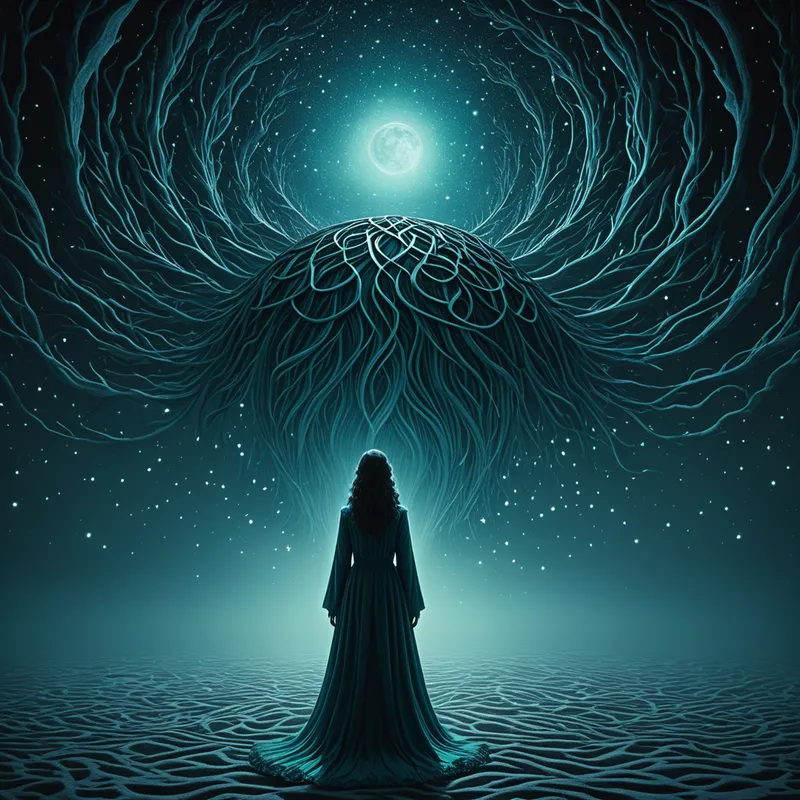
The myth is a perfect allegory for the alchemical opus, the great work of transformation. The princess is the prima materia—the orphaned, base substance of the soul, feeling itself incomplete. The feathered cloak is the agent of transformation, the aqua permanens or philosophical mercury that dissolves fixed forms. The lake is the vas or alchemical vessel, the contained space where the transformation safely occurs.
The cyclical shift from human to swan and back is the solve et coagula—dissolve and coagulate—the core rhythm of alchemy. The self is repeatedly broken down into its elemental nature (the swan) and reconstituted into a conscious form (the princess), each cycle infusing the human with more of the divine animal’s qualities.
The successful union with the seeker symbolizes the coniunctio oppositorum, the sacred marriage of opposites: conscious and unconscious, human and animal, earth and air. This produces not a static “happily ever after,” but the living, breathing lapis philosophorum—the philosopher’s stone. In psychological alchemy, this is the fully integrated Self, capable of moving gracefully between different states of being without losing its core integrity. The enchantment, therefore, is not a problem to be solved, but the very process of soul-making.
Associated Symbols
Explore related symbols from the CaleaDream lexicon:
- Swan Feather — The tangible remnant of transformation, a symbol of grace, purity, and the soul’s ability to traverse different realms of existence.
- Transformation Cocoon — The liminal state of metamorphosis itself, where old identity dissolves so a new, more integrated form can emerge.
- Water — The unconscious mind, the realm of emotion, intuition, and the hidden depths from which transformed selves arise.
- Mirror — The surface of the lake as a reflector, representing self-recognition, duality, and the moment one sees their true, other nature.
- Forest — The threshold wilderness, a place of testing, mystery, and encounter with the untamed aspects of the self and the world.
- Bridge — The princess as a living connection between the human and animal kingdoms, consciousness and instinct.
- Orphan — The initial state of disconnection from source or role, which becomes the catalyst for the quest for authentic identity.
- Identity — The central mystery the myth explores: not as a fixed label, but as a dynamic, fluid dialogue between multiple states of being.
- Dance — The elegant, fluid movement between forms, representing the harmony possible when opposites are embraced in a rhythmic whole.
- Moon — The celestial body governing cycles, change, intuition, and the feminine principle that guides the princess’s transformations.
- Key — The feathered cloak or the act of recognition, which unlocks the prison of a singular, limited self-concept.
- Circle — The cyclical nature of her transformation, symbolizing wholeness, completion, and the eternal return inherent in the process of growth.