The Soul-Bird Myth Meaning & Symbolism
A warrior's soul, lost in grief, is guided back to life by a mystical bird, revealing the Celtic understanding of the soul's journey and psychic wholeness.
The Tale of The Soul-Bird
Listen now, by the hearth-fire’s glow, to a tale not of flesh and bone, but of spirit and shadow. In the days when the oak was king and the mist clung to the hollow hills, there lived a warrior named Artair. His strength was sung of in every hall, but his heart belonged to one: Aisling, whose laughter was the first bird-song of spring.
But the wheel of seasons turns, and winter comes for all. A fever, swift and cruel, took Aisling from the world of light. Artair’s victory cries turned to a silence so deep it swallowed the sun. He laid her to rest beneath a rowan tree, but it was not her body that was lost—it was his own soul. In his consuming grief, a part of his very essence, his anam, tore loose like a cloak caught on a thorn and fled into the Sídhe.
He became a hollow man, walking the borders of the tribe’s lands, staring with unseeing eyes into the bogs and the tangled woods. His people said he was buile, his soul wandering in the lands of mist. One twilight, as he stood by a black pool, he saw it—a faint, phosphorescent glimmer beneath the peat-dark water. It was not a reflection. It pulsed with a weary, lonely rhythm he knew in the marrow of his bones. It was his own soul-fragment, trapped and drowning in the waters of despair.
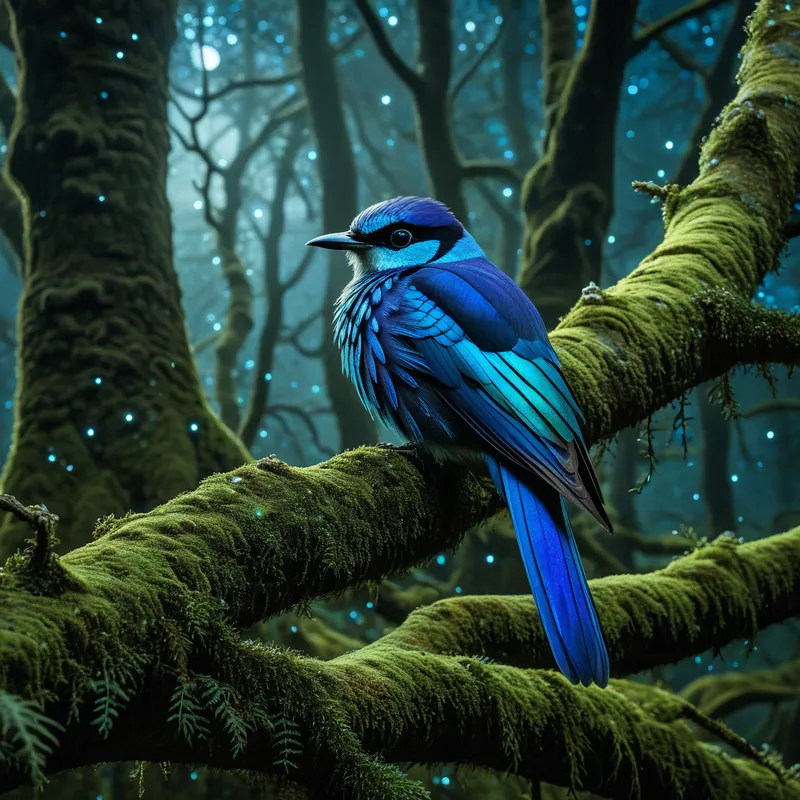
For three days and three nights, he tried to reach into the pool, but his hands passed through the light like smoke. He was separate from himself. On the fourth dawn, as a cold fog wreathed the alders, a sound pierced the silence—a single, clear, liquid note. On a branch above the pool sat a bird such as he had never seen. Its feathers held the grey of dawn and the blue of deep twilight, and its eyes were pools of calm, ancient knowing. It was the Soul-Bird.
It did not speak in words, but in a language of images that blossomed in Artair’s mind: the high, airy freedom of the mountain pass; the deep, rooted strength of the oak; the hidden, glittering path of the salmon in the river. The bird took flight, not away, but in a slow, deliberate circle above the pool. Artair understood. This was a guide, not to lead him to his soul, but to lead his soul back to him. He had to walk the path it showed.
His journey was the myth. He followed the bird over the high, wind-scoured passes where his breath was stolen and his pride was stripped bare (the realm of Air). He waded through rushing, icy rivers that numbed his limbs and cleansed his grief (the realm of Water). He crawled through dark, root-choked caves where he faced the shapeless terror of his own emptiness (the realm of Earth). And at last, he stood before a great, crackling bonfire on a sacred hill (the realm of Fire). The Soul-Bird circled the flames, and in their heart, Artair saw the glimmer from the pool, now bright and strong.
The bird’s song changed, becoming a call—a binding melody. Artair, standing at the confluence of the four realms, empty of everything but need, simply opened his arms. He did not grasp. He did not command. He invited. The luminous fragment from the fire streamed across the space between them and entered his chest. There was no blast of light, only a deep, resonant warmth, like a hearth-fire rekindled in a long-cold house. The Soul-Bird gave one final, satisfied trill and vanished into the rising sun. Artair fell to his knees, not in weakness, but in wholeness. He wept for Aisling, but the tears were now of love, not of barren loss. He had not retrieved a thing, but had reunited with a part of himself. He returned to his people, his strength tempered by a sorrow that had been alchemized into depth, his hollow silence filled with the quiet song of a soul made complete.

Cultural Origins & Context
The motif of the Soul-Bird is not a singular, standardized myth from a specific Celtic text, but a profound archetypal pattern woven through the broader tapestry of Insular Celtic (particularly Irish and Welsh) belief. It emerges from a worldview where the soul was not a monolithic entity, but could be perceived as having parts or aspects—like the coimeád or the anam. The soul could wander in sleep, in trance, or through trauma.
This story would have been the province of the filí and bards, told not as simple entertainment but as a seanchas—a narrative that preserves and transmits cosmological truth. Its societal function was therapeutic and instructive. In a culture deeply familiar with battle-loss, clan feud, and the harshness of life, the myth provided a map for a specific kind of suffering: soul-loss. It offered a model for reintegration, teaching that profound grief or trauma could cause a psychic fragmentation that required a guided, elemental journey to mend. The bird, as a creature of the air, was a natural psychopomp, a guide between the worlds of the living and the Tír na nÓg, capable of seeing the path the earth-bound human could not.
Symbolic Architecture
At its core, the myth is a symbolic drama of dissociation and the quest for integrity. The warrior’s lost soul-fragment in the watery bog represents a part of the psyche that has been split off by unbearable emotion—here, grief. It is not evil, but lost, submerged in the unconscious.
The Soul-Bird does not carry the soul home; it teaches the hollowed self how to walk the path so the soul can find its way back.
The Bird itself is the symbol of the transcendent function, the mediating principle that arises from the unconscious to bridge a seemingly un-crossable gap in the psyche. Its association with all four classical elements (air-its nature, water-the pool, earth-the journey, fire-the final union) signifies that wholeness requires engaging with every aspect of existence—thought, emotion, the body, and the transformative spirit.
The journey through the four realms is the process of recognition. The hero must re-experience his own being in its stripped-down, elemental forms. The high pass (Air) is the intellect stripped of illusion; the river (Water) is the raw flow of feeling; the cave (Earth) is confrontation with the embodied shadow and mortality; the fire (Fire) is the alchemical crucible where the separated elements are purified and reunited. The final act is not an aggressive retrieval, but a receptive invitation, symbolizing that the ego must relinquish its desperate control and make space for the return of the exiled self.
The Dreamer's Resonance
When this myth pattern stirs in the modern dreamer, it signals an active process of soul-recovery. To dream of a lost, glowing object in deep water, pursued but unreachable, often mirrors Artair’s initial state. The somatic experience is one of profound emptiness, fatigue, and disconnection—a clinical "depression" that is, at a deeper level, a psychic injury.
The appearance of a guiding bird—especially one of striking beauty or unusual calm—in such dreams marks a turning point. It represents the emergence of an inner, guiding wisdom from the Self, the psyche’s central organizing principle. The dream-ego’s subsequent journey, perhaps over strange landscapes or through symbolic trials, is the unconscious orchestrating the necessary stages of re-integration. The dreamer may wake not with a clear solution, but with a subtle, somatic shift—a sense of orientation, or a quietening of inner panic. The process is underway. The myth becomes active, showing that the psyche itself knows the path to healing, even when the waking mind feels utterly lost.
Alchemical Translation
For the individual, the Soul-Bird myth is a precise model of Jungian individuation—the process of becoming psychologically whole. The initial "soul-loss" is what Jung called a complex: an autonomous, split-off cluster of thoughts, feelings, and memories (here, centered on traumatic grief) that has taken on a life of its own, draining energy from the conscious personality. The hollow warrior is the ego identified with this state of depletion.
The alchemical work begins with the nigredo, the blackening: the confrontation with the loss in the black pool. The Bird’s arrival is the first hint of the albedo, the whitening—the emergence of a reconciling symbol. The guided journey is the arduous labor of separatio and circumambulatio, breaking down the rigid stance of the ego and engaging with the neglected aspects of the psyche (the elements).
The final reunion at the fire is the coniunctio oppositorum—the sacred marriage of the conscious and unconscious, the ego and the lost soul-part.
The transformed hero returns not with something added, but with a contradiction resolved. His grief is not gone; it has been transmuted from a paralyzing force that split him apart into a depth of feeling that now resides within his renewed being. The modern seeker walking this path learns that healing from profound trauma is not about "getting over it" or retrieving a lost past self, but about undertaking an inner pilgrimage. One must follow the strange, instinctual guide (the Bird/Self) through the landscapes of one’s own pain, to finally stand at the center of one’s own life-fire, open and ready to be made whole again. The myth assures us that the guide exists within, and the path, though elemental and severe, leads always back to the hearth of the Self.
Associated Symbols
Explore related symbols from the CaleaDream lexicon: