
The Sky Hole Legend
A Mongolian myth about a celestial portal in the sky, exploring themes of cosmic balance, human connection to the divine, and the mysteries of the heavens.
The Tale of The Sky Hole Legend
In the beginning, when the Eternal Blue Sky, Tengri, first stretched his vast cloak over the raw body of the Earth Mother, Etügen, a covenant was woven between them. This covenant was not a written law, but a living breath—the wind that carries the souls of the just and the whispers of the ancestors. Yet, the people below, in their striving and their sorrow, sometimes felt this breath grow faint, as if the great dome of the sky had become a silent, distant shell. They longed for a direct sign, a place where the veil was not just thin, but utterly dissolved.
It is said that in such a time of spiritual drought, a pure-hearted shaman, his spirit worn thin from journeying between worlds for his people, climbed the highest peak where the snow never melts. He did not go to command or to plead, but to offer his own confusion as a final, honest sacrifice. For seven days and seven nights, he fasted, his eyes fixed on the infinite blue. On the seventh night, as the cold threatened to extinguish his very life-fire, he did not see a vision, but rather a cessation of seeing. The solid, familiar blue of the sky directly above him began to unweave.
It was not a tear, nor a crack of lightning. It was an opening—a perfect, serene circle of profound, velvety blackness, deeper than the deepest night. This was the Sky Hole, the Tengeriin Nükh. Through it, the shaman did not see new stars or alien landscapes. Instead, he perceived the fundamental currents of existence. He saw the great silver cord that connects each living soul to its celestial origin, thrumming with a silent music. He witnessed the delicate balance of forces—the fierce, masculine energy of the sky in constant, sacred intercourse with the deep, receptive wisdom of the earth. The Hole was not a window to another place, but a lens focusing the truth of this place, revealing the cosmic order hidden within the apparent chaos of the world.
A profound warmth, not of the sun but of direct knowing, flowed down through the Hole and into the shaman. His weariness vanished, replaced by a serene certainty. He understood that the Sky Hole was always there, a permanent feature of the celestial vault, but visible only to those who had emptied themselves of ego and desire, whose inner sight had been cleansed by necessity and integrity. He descended the mountain not with a new message, but with the ancient one made brilliantly clear: humanity is not beneath the heavens, but a strand within its tapestry. To live in imbalance—to pollute the earth, to harbor greed, to break the bonds of community—is to make oneself blind to the Hole. To live with respect, courage, and a clean heart is to walk forever in its subtle, illuminating light.
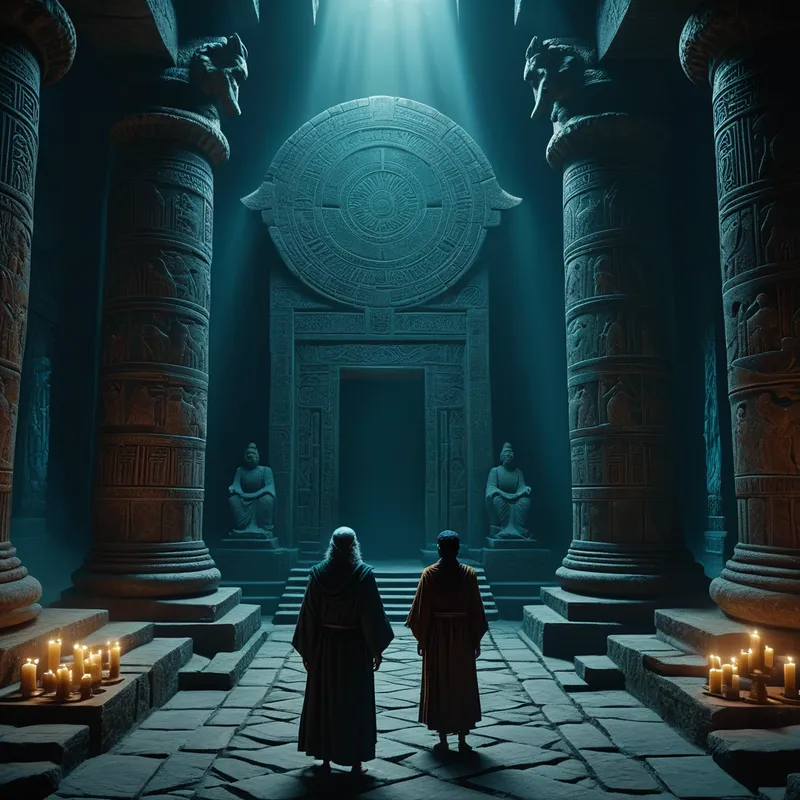
Cultural Origins & Context
The Sky Hole legend emerges from the core of the Mongolian nomadic worldview, a worldview sculpted by the immense, unobstructed panorama of the steppe. Here, the sky is not a distant abstraction but an overwhelming, ever-present dome—the literal roof of the world. This daily, intimate confrontation with the celestial vastness naturally birthed a cosmology where the sky, Tengri, is the supreme, masculine generative force. The earth is its sacred counterpart. Human life is the precarious, precious child of this union.
The myth functions as a profound psycho-spiritual technology within shamanic practice. It addresses a fundamental human anxiety in such a landscape: the fear of disconnection from the divine amidst such overwhelming scale. The Sky Hole is the answer to that anxiety. It is the guarantee that the cosmos is not closed or indifferent. It is a permeable membrane. In the rituals and oral traditions preserved by shamans, the Hole is not merely a story but a meditative focal point—a spiritual reality to be inwardly apprehended during trance states induced by drumming, chanting, and ascetic practices. It validates the shaman’s role as the one who can, through extreme ordeal and purity of intent, momentarily align with this aperture and retrieve wisdom or restore balance (cosmic and social order) for the community.
Symbolic Architecture
The architecture of this myth is one of radical simplicity containing infinite depth. The central symbol—the Hole—is an absence that is more full than any presence. It is a paradox that the psyche recognizes as truth.
The Sky Hole is the ultimate Mirror. It does not reflect the face of the seeker, but the condition of their soul and their alignment with the cosmic order. To gaze upon it is to see one’s own place in the web of existence, stripped of illusion.
It represents the transcendence of dualistic perception. It is neither purely of the sky nor a feature of the earth, but the interface where they commune. It dissolves the false hierarchy between above and below, divine and mortal, by revealing their essential interconnectedness. Psychologically, it symbolizes the aperture that opens in the conscious mind when the compulsive ego, with its endless wants and fears, is finally stilled. This stillness is not passive; it is the active, arduous achievement of the shaman-hero, creating the inner void necessary for the transcendent to pour in.
The myth’s narrative arc—ascent, ordeal, emptiness, revelation, return—is the classic monomyth, but grounded in the specific ecology of the steppe. The mountain is the axis mundi, the world pillar linking the realms. The shaman’s fasting and exposure are not self-punishment but an alchemical process of distillation, burning away the dross of the personal to reveal the gold of the transpersonal Self.

The Dreamer's Resonance
For the modern dreamer or the psyche navigating a fragmented world, the Sky Hole legend resonates with profound urgency. We live beneath a conceptual sky often felt as closed—a ceiling of materialist dogma, digital noise, and existential isolation. The longing for a "hole" in that ceiling, a direct experience of meaning and connection, is a defining symptom of our age.
The myth instructs that this portal does not open through force of intellect or accumulation of data, but through a specific inner posture: the posture of the shaman on the mountain. It is the willingness to confront one’s own existential cold, to stare into the void of one’s questions without demanding easy answers. The revelation comes not as an external voice, but as a shift in perception—the sudden, stunning realization that the separation was the illusion. The "cosmic balance" the myth describes translates psychologically as the integration of opposites within the individual: spirit and matter, conscious and unconscious, masculine and feminine principles.
When one feels spiritually starved, the Sky Hole suggests the problem is not a lack of sustenance "out there," but a blockage in one’s own capacity to perceive it. The cleansing of the "inner eye" is the work of honesty, humility, and the courageous facing of one’s own shadow. The Hole, then, becomes an internal compass point, directing us toward those practices and states of being that thin the veil of our own conditioned perception.

Alchemical Translation
The alchemical process here is one of solve et coagula—dissolve and coagulate—applied to the soul. The shaman’s ordeal on the mountain is the solve: the dissolution of the ordinary, earth-bound identity through isolation, hunger, and exposure to the elemental. The ego, the persona, is broken down. This creates the inner equivalent of the Hole—a receptive emptiness.
The revelation through the Hole is the coagula. The boundless cosmic truths pour into the prepared vessel of the shaman’s emptied self and coalesce into a new, solidified understanding—a wisdom that can be carried back and embodied.
This is not an acquisition of knowledge, but a transformation of substance. The shaman is re-made by what he sees. The celestial silver cord he perceives is the filum Ariadnis of the soul, the golden thread connecting the lead of earthly existence to the gold of celestial origin. The myth teaches that enlightenment is not becoming something other, but remembering and realigning with what one eternally is: a conduit between heaven and earth. The balance witnessed is the alchemical marriage of the King (Sky/Tengri) and Queen (Earth/Etügen), and the shaman is the living child of that union, the reborn filius philosophorum who carries the reconciled opposites within.
Associated Symbols
Explore related symbols from the CaleaDream lexicon:
- Sky — The supreme, encompassing dome of consciousness and divine order; the masculine principle and source of spiritual authority in the Mongolian cosmos.
- Hole — A sacred aperture or portal in reality, representing an interface between realms, a passage for spiritual energy, and a focus for transcendent vision.
- Mountain — The axis mundi, the world pillar that connects earth to heaven; a place of ordeal, ascent, and direct encounter with the divine.
- Mirror — A surface that reflects not the outer form, but the inner state and one’s alignment with cosmic truth, demanding self-confrontation and clarity.
- Shaman — The archetypal mediator and wounded healer who traverses psychological realms to restore balance, retrieving wisdom from non-ordinary states of consciousness.
- Wind — The invisible breath of the spirit world, the carrier of souls and messages, and the palpable manifestation of the sky’s power and presence on earth.
- Dream — A state of consciousness akin to the shamanic trance, where the veil between worlds thins and direct revelation from the deeper layers of the psyche becomes possible.
- Wormhole — A cosmic tunnel or shortcut through the fabric of space-time, mirroring the Sky Hole’s function as a transcendent conduit for consciousness and connection.
- Circle — The shape of wholeness, completion, and the celestial dome; the perfect form of the Sky Hole representing the cyclical nature of existence and cosmic order.
- Keyhole — A small, precise aperture that, when aligned with the correct key (purity of intent), unlocks vast inner chambers of understanding and connection.
- Psychic Wholeness — The integrated state of being achieved when the individual psyche is in harmony with the cosmic order, as witnessed through the Sky Hole.
- Light — The illuminating knowledge and divine warmth that streams through the celestial aperture, dispelling the darkness of ignorance and spiritual separation.