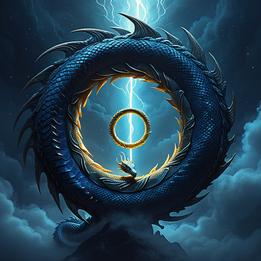
Ouroboros
An ancient symbol depicting a serpent or dragon eating its own tail, representing cyclicality, eternity, self-sufficiency, and the unity of opposites.
Ouroboros Dream Meaning
An ancient symbol depicting a serpent or dragon eating its own tail, representing cyclicality, eternity, self-sufficiency, and the unity of opposites.
Interpretive Themes
Mythological Resonance
Mehen
EgyptianSerpent deity encircling the sun god Ra in the underworld, protecting him through the night in a cycle of death and rebirth.
Leviathan
GnosticCosmic serpent encircling the world, symbolizing the totality of material existence and the cycle of soul transmigration.
Cultural Lenses
Global/Universal Perspective
View Context →Appears in ancient Egypt, Greece, Norse mythology, and alchemy as a symbol of cyclical time, cosmic order, and the unity of all things, often linked to creation myths and philosophical concepts of infinity.
Jungian Perspective
View Context →Represents the archetype of wholeness and the individuation process, symbolizing the integration of conscious and unconscious, and the self's journey toward psychological completeness and self-realization.
Freudian Perspective
View Context →May symbolize oral fixation, narcissism, or the death drive (Thanatos), reflecting unconscious desires for self-consumption, regression to infancy, or conflicted impulses toward self-destruction and renewal.
Gestalt Perspective
View Context →Seen as a symbol of holistic perception, where the whole (the loop) is greater than its parts, emphasizing the dreamer's need to view life patterns as interconnected and self-contained systems.
Cognitive Perspective
View Context →Interpreted as a mental schema for understanding cyclical processes, such as habits or thought patterns, reflecting the brain's tendency to create recursive narratives and self-referential models of experience.
Evolutionary Perspective
View Context →Viewed as an ancient meme representing survival themes like regeneration, adaptation to cycles (e.g., seasons), and the human instinct to perceive patterns of renewal and continuity in nature.
East Asian Perspective
View Context →In Chinese and Japanese contexts, associated with dragons symbolizing power, wisdom, and the cyclical nature of yin-yang, often used in art and philosophy to depict harmony and eternal change.
South Asian Perspective
View Context →Linked to Hindu and Buddhist concepts like samsara (cycle of rebirth) and kundalini energy, representing spiritual awakening, the endless wheel of life, and the pursuit of moksha (liberation).
Middle Eastern Perspective
View Context →In ancient Mesopotamian and Persian traditions, seen as a protective symbol against chaos, representing divine eternity, the ouroboros guarded sacred spaces and symbolized cosmic order in Zoroastrianism.
European Perspective
View Context →Prominent in medieval alchemy and Hermeticism as a symbol for the philosopher's stone, prima materia, and the alchemical process of solve et coagula, denoting transformation and unity.
Modern Western Perspective
View Context →Adopted in psychology, literature, and media to symbolize self-reference, infinity (e.g., in mathematics), environmental cycles, or existential themes, often stripped of religious connotations for broader philosophical use.
African Perspective
View Context →In some African mythologies, similar serpent symbols represent fertility, ancestral wisdom, and the cycle of life-death-rebirth, often used in rituals to honor continuity and community bonds.
Historical Authorities
Want a deeper analysis?
Get a personalized interpretation of your entire dream including this symbol.
Interpret My DreamThe Oracle's Prediction
Combine multiple symbolsA profound insight into your life's cyclical patterns will dawn.
Timeframe
Seasonal (~3 Months)
Intensity
Deep
Risk of becoming stuck in a repetitive loop without progress.
Timeframe
Immediate (Next 48h)
Intensity
Deep
Common Appearances & Contexts
| Context | Emotion | Interpretation |
|---|---|---|
| Context Serpent glowing | Emotion Awe | Interpretation Spiritual awakening insight. |
| Context Tail dissolving | Emotion Fear | Interpretation Fear of self-destruction. |
| Context Loop speeding | Emotion Anxiety | Interpretation Feeling trapped in cycles. |
| Context Serpent smiling | Emotion Peace | Interpretation Acceptance of life's cycles. |
| Context Breaking the loop | Emotion Hope | Interpretation Desire for change. |
| Context Multiple ouroboroi | Emotion Confusion | Interpretation Overwhelming life patterns. |
| Context Ouroboros as jewelry | Emotion Pride | Interpretation Personal empowerment symbol. |
| Context Serpent in water | Emotion Calm | Interpretation Emotional renewal process. |
| Context Loop unraveling | Emotion Relief | Interpretation Ending a difficult phase. |
| Context Ancient temple setting | Emotion Reverence | Interpretation Connection to ancient wisdom. |
| Context Serpent biting hard | Emotion Pain | Interpretation Self-inflicted suffering awareness. |
| Context Golden light emission | Emotion Joy | Interpretation Enlightenment or achievement. |
Interpret Your Full Dream
Beyond this symbol, every dream carries a unique story. Share your dream for a personalized AI-powered interpretation.