Ginnungagap Myth Meaning & Symbolism
Before worlds existed, there was only Ginnungagap—a yawning, silent void where fire and ice met, birthing the first giant and all creation.
The Tale of Ginnungagap
Listen. Before the eagle’s cry, before the wolf’s howl, before the very notion of sound… there was the Gap.
It was not a place, for there were no places. It was not a thing, for there were no things. It was the Ginnungagap—a name that echoes in the hollow of the soul, meaning the “yawning void.” A breath held for an eternity. An absolute, perfect, and terrible potential.
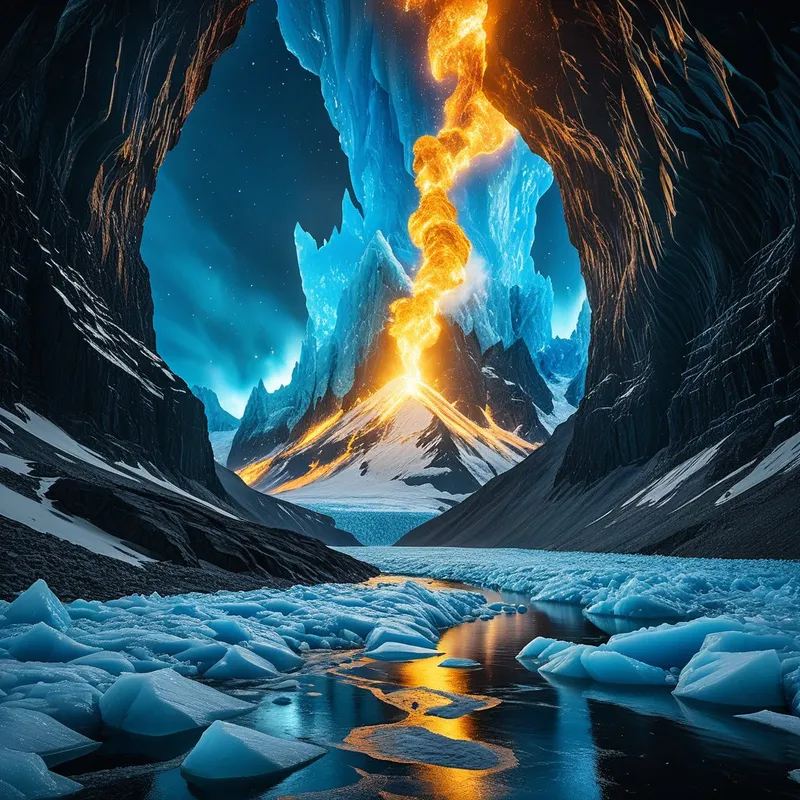
To the North of this nothingness lay Niflheim, a wellspring of freezing rivers named Élivágar. Their icy breath flowed into the Gap, forming vast, glittering sheets of rime, a hoar-frost that whispered of stillness and sleep. To the South blazed Muspelheim, a realm of spark and flame. From its borders flew embers and warm winds, a golden, searing breath that reached across the abyss.
And in the center of the Gap, where the breath of fire met the breath of ice… something happened. Not a bang, but a sigh. The meeting was a caress and a conflict. The rime melted, but not entirely. It dripped and steamed, and in that resonant friction—the hiss of being against non-being—the drops began to quicken. They stirred with the mingled essence of heat and cold, of action and inertia. From this dynamic, aching tension, life coagulated.
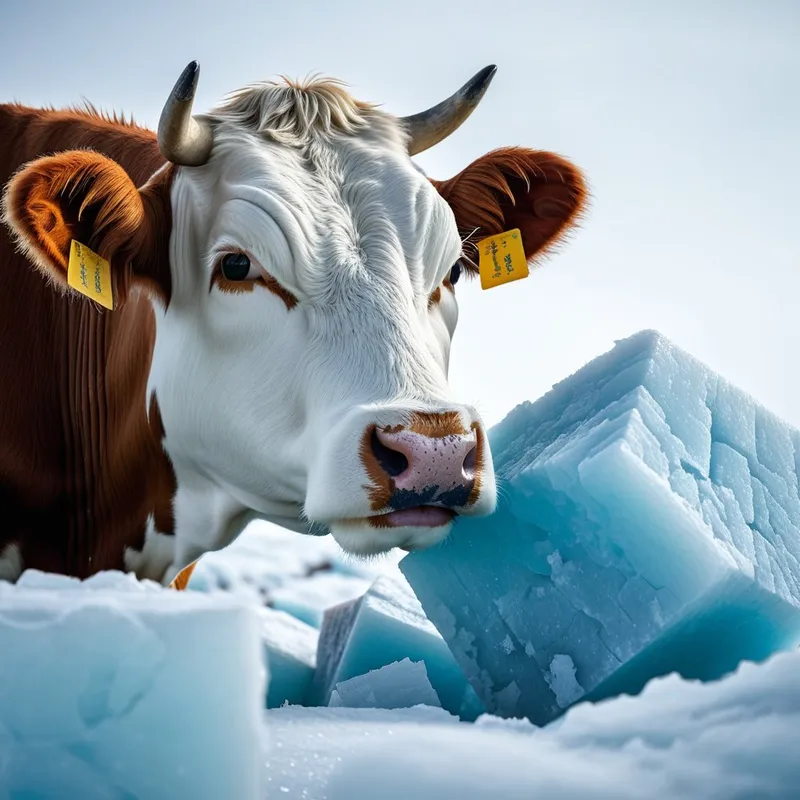
The first form to rise from the dripping rime was not a god, but a giant. Ymir, the primordial hermaphrodite, slept and sweated. And from his sweat, more giants were born. Yet the void was not done. As Ymir slept, nourished by the milk of the primordial cow Audhumla, who herself had formed from the melting ice, another creation unfolded. Audhumla licked the salty ice-blocks. Her warm, patient tongue worked for three days. On the first, hair appeared in the ice. On the second, a head. On the third, an entire man, powerful and whole, stepped forth. This was Buri, grandfather of the gods.
From Buri’s line came Borr, and from Borr came three brothers: Óðinn, Vili, and Vé. They looked upon the teeming, sleeping Ymir and the chaos of the Gap, and they knew a world could be made. So they did what creators must sometimes do: they slew the primordial being. From Ymir’s fallen body, they fashioned the world. His flesh became the earth, his blood the seas, his bones the mountains, his skull the sky, and his brains the clouds. They took the embers from Muspelheim and set them as stars in the vault of heaven. They built a fortress from Ymir’s eyebrows to protect the land they called Midgard from the surviving giants.
And so, from the silent, yawning potential of the Gap, through the meeting of opposites and a necessary, terrible act, the Nine Worlds were hung upon the branches of Yggdrasil. The first note had been sung into the silence.
Cultural Origins & Context
This profound narrative of cosmic genesis comes to us primarily from two 13th-century Icelandic texts: the Prose Edda of Snorri Sturluson and the earlier poetic fragments of the Poetic Edda. Snorri, a Christian scholar writing in a post-pagan era, systematized the old stories, but the core myth of the void is deeply archaic. It was not a scripture, but a living cosmology passed down through skalds (poets) and storytellers, a map of reality that explained the world’s inherent tension, its origins in conflict, and its cyclical nature.
The myth served as an anchor. In a culture facing the harsh, unpredictable elements of the North Atlantic, the idea that the very ground beneath one’s feet was fashioned from the body of a slain giant gave the world a sacred, storied substance. It explained the presence of chaos (the giants) as integral to creation itself, not as an external evil but as a foundational element. The story of Ginnungagap was the ultimate origin point, the answer to the question of what existed before the familiar struggles of gods and men. It established a worldview where order (Æsir) is not a given, but a hard-won construct built upon and against a primordial, chaotic potential.
Symbolic Architecture
Ginnungagap is the ultimate symbol of the potential state. It is not mere emptiness, but a pregnant void, a state of pure latency that precedes and makes possible all form. Psychologically, it represents the unformed psyche before the dawn of consciousness, the blank page before the first word, the silent mind before the first thought.
The void is not an absence, but a womb. It is the necessary precondition for any act of creation, holding all possibilities in perfect, undifferentiated tension.
The two poles, Niflheim (Ice) and Muspelheim (Fire), are the archetypal opposites whose dynamic interaction generates life. Ice symbolizes stasis, inertia, potential locked in formlessness, the unconscious in its frozen, latent state. Fire symbolizes energy, dynamism, the driving force of libido and conscious will. The myth tells us that creation—whether of a world, a self, or an idea—requires this tension. Too much fire leads to dissolution; too much ice leads to eternal sleep. It is in their meeting, their conflict, and their reconciliation (the melting, steaming drops) that the first stirrings of life emerge.
Ymir, born from this mingled essence, represents the primordial, undifferentiated Self—a totality containing all contradictions (hermaphroditic, self-generating). The act of the brothers (Óðinn, Vili, Vé) slaying Ymir is a brutal but necessary symbol of differentiation. To create a structured world (a conscious ego), the undifferentiated whole must be broken apart. It is the painful process of analysis, of distinguishing self from other, order from chaos.
The Dreamer's Resonance
When the archetype of Ginnungagap stirs in the modern dreamer, it often manifests as dreams of vast, empty spaces: standing at the edge of a bottomless canyon, floating in the silent void of space, or staring into a perfectly black mirror. These are not dreams of terror, but of profound, unsettling potential. The somatic feeling is one of suspension—the breath held, the body weightless.
Psychologically, this dream pattern signals a pre-creative or pre-transformative state. The old structures of the dreamer’s life or identity may have dissolved, or a long-held goal has been achieved, leaving a sense of “what now?” The dreamer is in the Gap. The conflict of fire and ice may appear as warring emotions—a burning ambition meeting frozen fear, or passionate love confronting cold isolation. The dream is presenting the raw materials. The appearance of a figure like Audhumla, patiently licking shape from chaos, suggests the need for nurturing, instinctual persistence to bring the new form to light. Such dreams ask the dreamer to tolerate the void, to resist the urge to prematurely fill the silence, and to await the inevitable, creative friction of emerging opposites.
Alchemical Translation
The journey from Ginnungagap to Midgard is a perfect map for the alchemical process of individuation—the psychic transmutation of the undifferentiated self into a conscious, whole individual. The alchemical prima materia, the worthless starting substance, is the Ginnungagap itself: the felt sense of inner emptiness, confusion, or latent potential.
The first and most difficult operation is not action, but a conscious entry into the void, a voluntary confrontation with the nothingness that holds everything.
The fire and ice are the opposing forces within the psyche that must be acknowledged and contained. This is the coniunctio oppositorum—the sacred marriage of opposites. The fiery, logical, striving consciousness must engage with the icy, intuitive, shadowy unconscious. Their conflict, initially experienced as inner turmoil, depression, or creative block, is the necessary friction that generates the “quickened drops”—the first insights, symbols, or feelings that signal a new psychic synthesis is beginning.
The slaying of Ymir is the critical, often painful, stage of separatio. It is the dismantling of old, outworn complexes and identifications (the primordial, unconscious “giant” that has ruled the inner world) to use its substance to build a new, more conscious structure. The ego (the brother gods) must perform this act to create a habitable inner world (Midgard). The final stage is not an end, but an establishment of order within the greater, still-living cosmos of the unconscious, represented by the ongoing presence of the giants and the enduring embrace of Yggdrasil. The individual realizes they are not the void, nor are they solely the constructed world, but a living process born from and forever connected to both.
Associated Symbols
Explore related symbols from the CaleaDream lexicon: