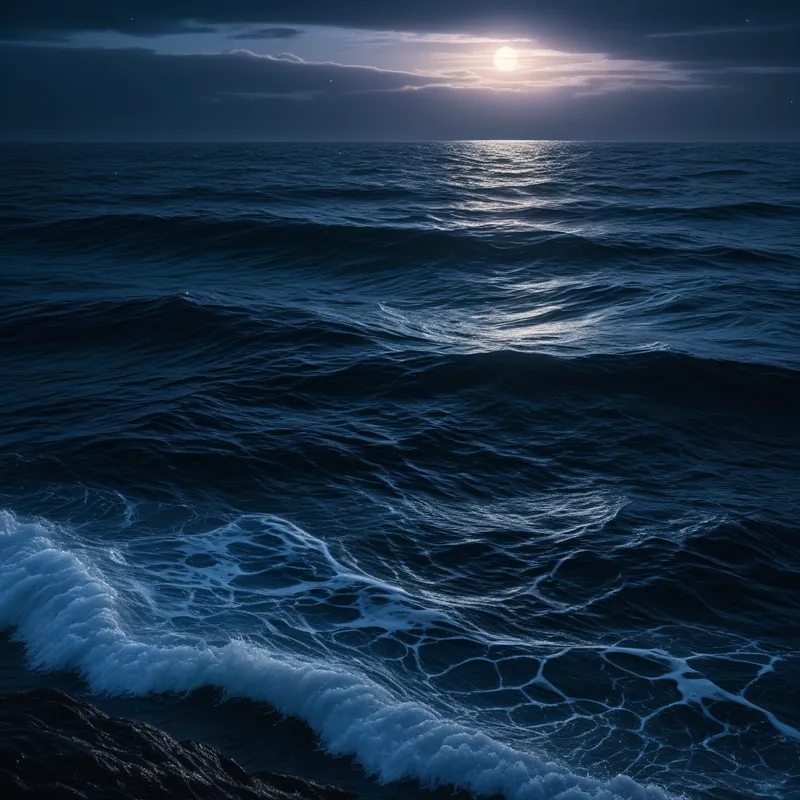
The Sea Myth Meaning & Symbolism
The story of Pontus and Thalassa, the first Sea, born from Chaos, embodying the primal, generative, and terrifying unconscious from which all life emerges.
The Tale of The Sea
In the beginning, there was a gaping void—Chaos. It was not emptiness, but a seething, formless potential, a breath held before the first word. And from that breath, the first entities were drawn forth. Gaia, the solid, nurturing land, came first, broad and steady. But alongside her, from the same unknowable source, arose the first Waters.
He was Pontus, the deep, abyssal sea, the male principle of the watery depths. He was not a god of shores or waves, but of the profound and silent dark beneath. She was Thalassa, the female face of the salt-sea, the shimmering skin of the ocean that meets the air, capricious and ever-changing. Together, they were the Sea—not yet ruled, not yet named by later gods, but simply being: vast, fertile, and terrifying.
This was the Sea before time. It cradled no islands, for Gaia was new. It knew no winds, for Ouranos had yet to be stretched above. In that primeval silence, the Sea was the womb. From the union of Pontus and Gaia, the first ancient sea-beings were born: Nereus, the truthful old man of the sea; Phorcys and his sister-consort Ceto, from whom a brood of monsters would spring—the Harpies, the serpent-haired Gorgons, and the dragon Ladon. The Sea gave life, but it gave life in all its forms—the beautiful and the horrific, the nurturing and the ravenous.
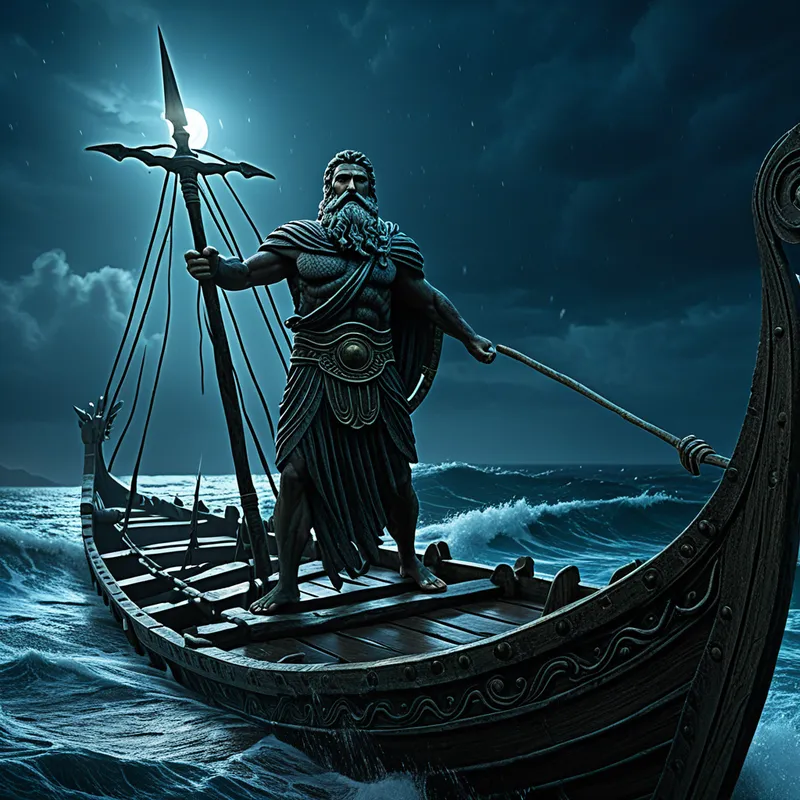
Later, when the Titan Oceanus encircled the world with his fresh-water river, and when the Olympian Poseidon won dominion over the salt-waves with his trident, the Sea gained a ruler and a personality. It became a realm to be crossed, a power to be appeased. Sailors felt the lash of Poseidon's wrath in the storm and his favor in the following wind. The Sea was now a character in every hero's journey—the chaotic barrier Odysseus struggled against for ten years, the mysterious path Jason and the Argonauts navigated, the final, peaceful rest for those whose ashes were cast upon its waves. It remained the source of all life, the great unknown from which Aphrodite herself was born in foam, and the final, swallowing mystery to which all things eventually return.
Cultural Origins & Context
The myth of the primordial Sea is not a single story with a plot, but a foundational layer of the Greek cosmological understanding, recorded most systematically in Hesiod's Theogony around the 8th century BCE. This was not scripture, but a poetic compilation of oral traditions passed down by bards and storytellers for generations. Its function was to explain the origin and nature of the world (cosmos) out of disorder (chaos).
For a culture defined by its proximity to the Aegean and Mediterranean, the Sea was the ultimate reality. It was the source of livelihood through fishing and trade, and the source of annihilation through storms and shipwrecks. It was both highway and barrier, womb and tomb. By personifying it first as primordial forces (Pontus, Thalassa), then as a Titan (Oceanus), and finally as an Olympian god (Poseidon), the Greeks engaged in a profound act of relationship-building. They gave the uncontrollable a face, a lineage, and a temperament, making it something that could, in theory, be understood, prayed to, and negotiated with through sacrifice and ritual. The Sea's myth was their way of mapping the greatest external unknown onto a familial, divine framework.
Symbolic Architecture
Psychologically, the myth of the Sea maps perfectly onto the depths of the unconscious. Pontus represents the collective unconscious—the dark, impersonal, foundational layer of psychic life from which archetypal forms emerge. Thalassa represents the personal unconscious—the surface layer of memory, emotion, and complex that interacts directly with the air of consciousness.
The Sea is the unconscious mind in its totality: the silent, fertile darkness where all psychic life originates, and the turbulent surface of mood and emotion that we navigate daily.
The monstrous children of Phorcys and Ceto symbolize the terrifying, "unacceptable" contents that can erupt from these depths—repressed traumas, irrational fears, and shadow aspects of the self. Conversely, Nereus and his Nereids represent the wisdom and benevolent potential that can also be drawn from the deep. The later rule of Poseidon symbolizes the ego's attempt to control and command these unconscious forces, to impose order (the trident) upon the chaos of inner life, though the sea-god's famous wrath reminds us that this control is always tenuous.
The Dreamer's Resonance
When the primordial Sea appears in modern dreams, it signals an encounter with the foundational layers of the psyche. Dreaming of a calm, deep, dark ocean often points to a connection with the fertile, creative potential of the unconscious—a sense of vast, untapped resources within. Dreaming of being on a stormy sea, battling waves, reflects a period of intense emotional turbulence where surface-level consciousness (the boat of the ego) is at the mercy of powerful unconscious forces.
A dream of monstrous forms rising from the deep—serpents, multi-limbed creatures, or shadowy figures—indicates the emergence of repressed shadow material. This is not a nightmare to be merely feared, but a somatic signal of a necessary, if difficult, psychological process: the contents of the personal and collective unconscious are demanding recognition and integration. The dream-sea is asking the dreamer to acknowledge what they have cast into their own depths.

Alchemical Translation
The alchemical journey mirrored in this myth is the Nigredo, the descent into the black, chaotic waters of the prima materia. For an individual, this is the process of confronting one's own inner chaos—the unresolved pain, the un-lived life, the fragmented aspects of the self symbolized by the Sea's monstrous offspring.
Individuation begins not with building a perfect persona, but with the courageous dissolution of the old self in the salty waters of truth.
The myth models that one must first acknowledge and be born from this Sea (acknowledge one's unconscious origins) before any ruling order (a cohesive sense of self) can be established. Poseidon's trident is not a weapon of suppression, but a symbol of focused consciousness that can, at best, navigate and channel these immense forces. The ultimate goal is not to conquer the Sea, but to learn its rhythms, respect its power, and, like the ancient Greeks, build a relationship with it. To become whole, we must sail our own Argo across these internal depths, encountering both monsters and guiding nymphs, integrating all we find into the vessel of the self, until the Sea within is no longer a feared abyss, but the source of our deepest creativity and the medium of our soul's journey.
Associated Symbols
Explore related symbols from the CaleaDream lexicon: