The Dream of Origins: Reclaiming Your Source Code
The Somatic Echo
Before the images form, the body knows. It is a deep, tectonic ache, a gravity you cannot locate. It feels like a hollow resonance in the marrow, a phantom limb for a time you never knew. Your breath catches, not on a memory, but on the shape of a memory—the negative space where a foundational story should be. There is a vertigo, not of height, but of depth, as if you are standing on a floor you’ve just realized is glass, and beneath it stretches an abyss of un-told beginnings. This is the somatic echo of Origins: the body’s intelligence sensing a crack in the personal myth, a discontinuity between the story you live and the source from which you sprang. It is the quiet, cellular hum of a question: What is my true ground?
The Dreamer's Log
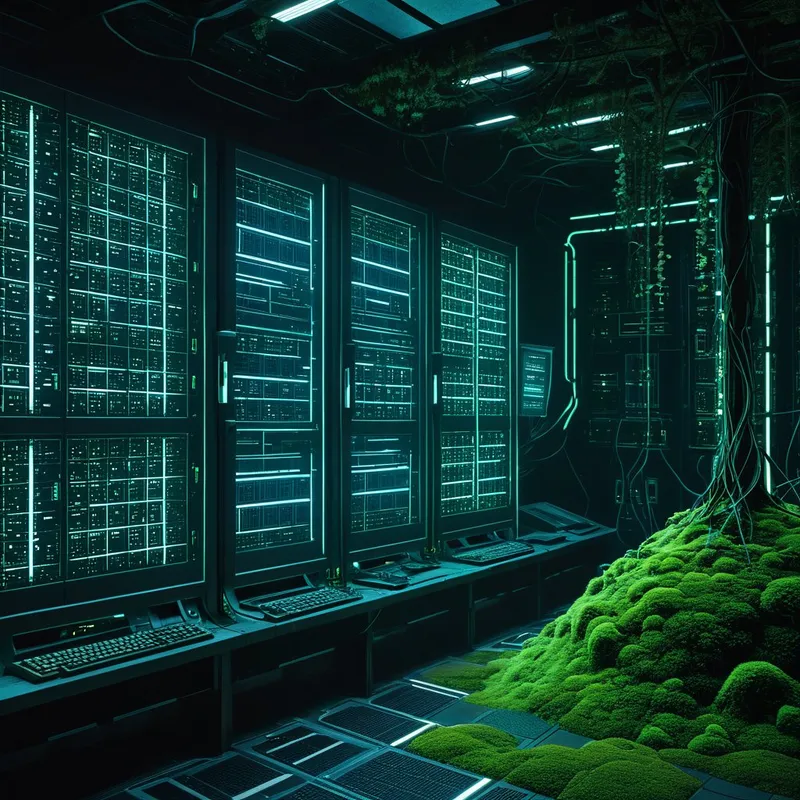
I am in a derelict server farm, a cathedral of dead machines. Vines of glowing data-cable have cracked through the concrete, and in the central chamber, a single terminal screen flickers. It displays one line, over and over: ERROR: SOURCE DIRECTORY CORRUPTED. PROCEED WITH MANUAL REBUILD (Y/N)? My finger hovers over a key made of tarnished brass and bone.
This dream is not a request for information, but a summons to the forge. The alchemical question is not "What happened?" but "Will you consent to become the architect of your own genesis?"
The False Lead
The dream of Origins is not a nostalgic trip. It is not a passive, melancholic yearning for a simpler past, nor is it a forensic investigation to assign blame for present wounds. To mistake it for mere reminiscence is to stand at the mouth of a volcano and comment only on the interesting rocks. This theme is structural, not sentimental. It concerns the load-bearing walls of the psyche, not the wallpaper. A dream of a childhood home collapsing is not about the house; it is about the ground shifting beneath the entire settlement of your identity. The terror here is ontological—it questions the very fact of your being—and thus demands an ontological response.
Psychological Architecture
To work with Origins is to engage in the most profound Shadow work: the reconciliation with your own pre-history. This is the Individuation process in its foundational phase. You are not merely integrating repressed traits or healing childhood wounds (though that occurs). You are meeting the psychic entities that formed in the primordial soup of your early consciousness—the internal family systems that were born not from trauma, but from necessity. The Part that had to be the quiet diplomat before you could speak. The Part that learned to map emotional terrain through silence. The Part that constructed a world-view from the scattered fragments of adult meaning.
This architecture is often invisible, the water in which you swim. The dream of Origins pulls you out of that water and asks you to look at its composition. The process is one of re-membering—not recalling events, but literally re-assembling the members of your inner council, understanding why each was elected, and deciding, from your current sovereignty, which constitutions still serve. The grief that surfaces is not just for what was lost, but for the sheer effort of that initial construction, the brilliant, desperate creativity of a young psyche building a world to survive in.
Mythic Resonance
This journey echoes in the bones of our oldest stories. Consider the Sumerian goddess Inanna’s Descent. She does not journey to a foreign land, but down, through the seven gates of the underworld, stripped of every emblem of her power and status, until she hangs lifeless on a hook. Her return is not a reversal, but a resurrection—she ascends with the knowledge of the depths, now integrated into her sovereignty. The underworld is not a place of punishment, but of source. Similarly, the Orphic myths tell of the soul’s origin in the divine, its fall into embodiment, and its yearning to remember its celestial home. The myth is not about escaping the world, but about carrying the memory of that origin into the world, transforming the mundane through its light. These are not tales of external quests, but of vertical voyages into the personal and collective substratum.
Symbolic Nodes
- Foundations & Cellars: Basements, roots, archaeological digs, cornerstones.
- Primordial Elements & States: Deep water, caves, fertile mud, embryonic shapes, unformed clay, cosmic eggs.
- Archival Spaces: Libraries with forgotten books, corrupted data drives, sealed vaults, family albums with missing pages.
- Generational Objects: Heirlooms, worn tools, ancestral jewelry, a lone suitcase.
- Genetic & Cosmic Imagery: Twisting ladders (DNA), star nurseries, seedling breaking stone, umbilical cords of light.
Archetypal Resonance
The energy here is fundamentally that of The Sage Archetype, particularly in its deep, introspective phase before it speaks its wisdom. The Sage does not seek new lands, but new understandings of the fundamental code. Its quest is for the foundational truth, the first principle. The somatic echo—that deep, resonant ache for source—is the Sage’s compass, pointing not outward, but inward and downward. Its alchemical potential lies in its ruthless commitment to truth over comfort; it is willing to dismantle the entire operating system if it discovers the core program is based on a borrowed or corrupted file. The Shadow Sage here is not the dogmatic teacher, but the eternal, paralyzed researcher—the one who believes the truth is always one more scroll, one more dig, one more memory away, forever deferring the terrifying and liberating act of writing the synthesis.
The Alchemical Process
The transmutation of Origins is the Nigredo—the blackening—of the soul’s journey. It is the dissolution of the composite self. The heat is applied by the simple, devastating act of questioning your own bedrock: Is this feeling truly mine, or is it an heirloom? Is this belief my wisdom, or a ghost in my neural architecture? The pressure is the weight of existential loneliness that comes when familiar, inherited identities begin to crumble. You are not refining gold here; you are reducing the ore of the personality back to its essential, unrecognizable elements.
This process feels like a death because it is. It is the death of the self-as-given, the self-as-inherited. The alchemical fire burns away the narrative you were handed, not to leave you with nothing, but to reveal the prima materia—the raw, authentic, and often chaotic psychic substance from which a conscious, self-authored life can be forged. The sovereignty gained is not dominance over others, but absolute authorship over your own central myth. You become the source.
The Integration Protocol
Question 1: When you feel that deep, somatic echo of "origin," what is the very first, wordless sensation in your body? Where does it reside? Is it a hollow, a weight, a pull, or a vibration?
Question 2: What is one foundational "truth" about yourself, your family, or the world that you have never genuinely questioned, not because you believe it, but because it has always simply been the water you swim in?
Question 3: If you could speak to the intelligence that built your earliest coping strategies—the architect of your childhood psyche—what gratitude would you offer, and what amendment to the blueprint would you respectfully suggest?
Action 1 (Somatic Grounding): For one week, upon waking, place both feet flat on the floor. Before you think, feel. Sense the literal ground through the floors. Breathe into the soles of your feet and whisper, internally, "I am here. This is my ground now." Build the feeling of present-tense foundation.
Action 2 (Creative Excavation): Without planning, draw your "source code." Use any medium. Let it be abstract—a tangle of lines, a collision of colors, a shape. Do not make it representational. Let your hand move from the somatic echo. Then, write three words that the image emits, not describes.
Action 3 (Ritual Re-Sourcing): Find a small stone. Hold it as you consciously review one inherited narrative you are ready to transmute (e.g., "I am not enough"). Pour all the old story into the stone. Then, take it to a crossroads—a stream, a park, a significant corner—and leave it there. Walk away without looking back, physically enacting the leave-taking of an old origin point.
Final Validation
This work is not for the faint of heart. To question your origins is to risk the vertigo of free-fall, to feel the grief of the orphan who must, at last, parent themselves. It is terrifying to realize the ground can move. But within that terror lies an unparalleled liberation: if the ground can move, then you are not trapped by it. You are being invited—no, summoned—to become the cartographer of your own depths, the author of your own genesis. The dream of Origins is not a look backward; it is the first, primal instruction from your future, sovereign self, calling you home to the source you are destined to become.