The Labyrinth of Crete Myth Meaning & Symbolism
A hero enters a maze built to contain a monstrous secret, confronting the beast within to reclaim his own life and liberate others.
The Tale of The Labyrinth of Crete
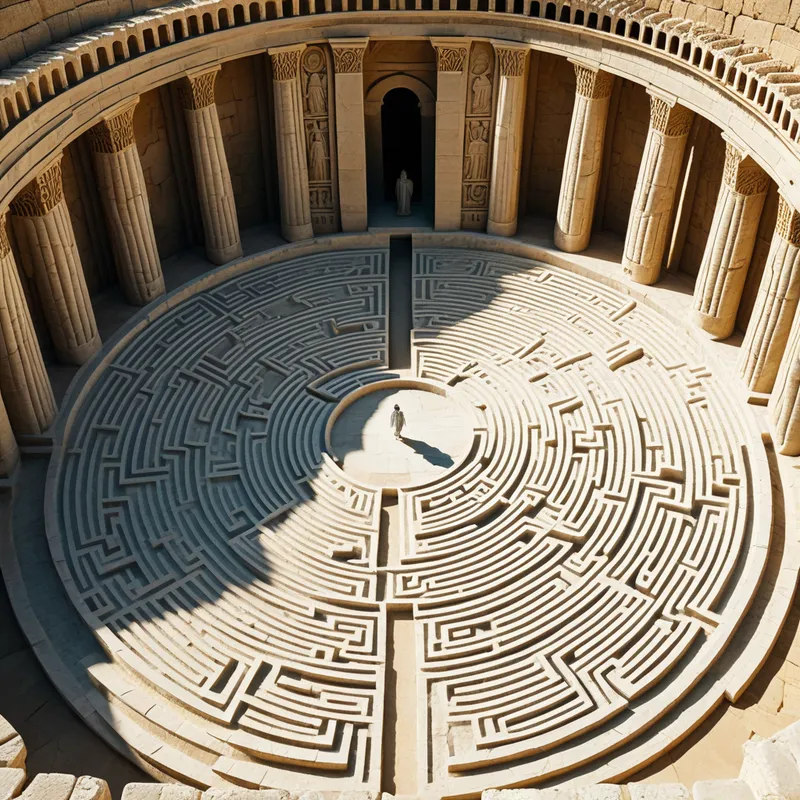
Hear now the tale of the maze beneath the sun, a story of stone, sorrow, and a secret too terrible to behold. In the age when gods walked close to men, on the isle of Crete, a king’s pride built a prison for a king’s shame.
King Minos, favored by Poseidon, was sent a bull of purest white from the foaming sea, a sign of his divine right to rule. But consumed by greed, Minos broke his vow and kept the magnificent creature for himself. In wrathful punishment, the sea god coiled a cruel desire in the heart of Minos’s queen, Pasiphaë. Consumed by a passion not of this world, she coupled with the great bull. From this unholy union was born a creature of nightmare: a being with the body of a powerful man and the head and tail of a raging bull. They named him the Minotaur, the “Bull of Minos.”
His roars echoed the king’s disgrace. To hide his wife’s transgression and contain his stepson’s fury, Minos summoned the legendary artisan Daedalus. “Build me a holding place,” commanded the king, “a prison from which there is no escape. A place so complex, so winding, that to enter is to be lost forever.” And so Daedalus, with a heavy heart, designed the Labyrinth. Not a mere cage, but a twisting, turning masterpiece of stone, a brain carved into the earth, a puzzle with a monster at its core. Into its heart the Minotaur was thrust, and there it remained, fed on a grim tribute.
For Minos, victorious in war against Athens, demanded a blood price: every nine years, seven Athenian youths and seven maidens were to be sent into the Labyrinth, a sacrificial offering to the beast within. The stone halls drank their terror; the monster feasted on their flesh.
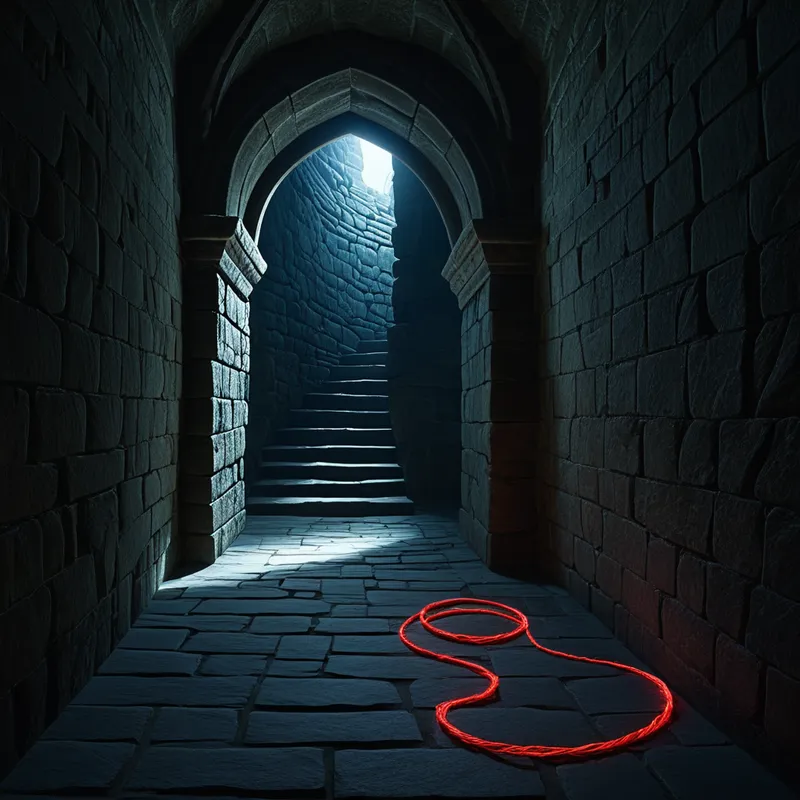
Then came the third tribute, and with it, a prince. Theseus, son of the Athenian king, volunteered to be among the victims. His purpose was not to die, but to kill. To end the cycle of fear. As his black-sailed ship landed on Crete, the king’s daughter, Ariadne, saw his noble bearing and was stricken with love—and with a cunning plan. She sought out Daedalus, the maze’s creator, and learned its secret. That night, she met Theseus in secret, pressing into his hand a ball of gleaming thread and a sword. “Tie this to the stone at the entrance,” she whispered, her voice trembling with hope and dread. “Unwind it as you go. It will be your breath back to the world of light. And this,” she said, touching the sword’s hilt, “is for the heart of the darkness.”
Into the mouth of stone Theseus descended. The air grew cold and still, thick with the smell of damp earth and old blood. The only sounds were the scuff of his sandals, the whisper of the unspooling thread, and, from the impenetrable blackness ahead, a deep, guttural breathing. He followed the thread deeper, his own heartbeat loud in his ears. The corridors doubled back on themselves, a maddening geometry designed to unravel the mind.
Then, in a chamber wider than the rest, he found it. The Minotaur, a mountain of muscle and rage, its eyes glowing in the gloom. The fight was not of skill, but of primal survival—man against the embodiment of bestial shame. With a final, desperate lunge, Theseus drove the sword home. The beast’s roar faded into a sigh, and the labyrinth fell silent.
Following the lifeline of thread, now stained with blood, Theseus retraced his steps, leading the other terrified Athenians out of the stone belly and into the blinding Cretan sun. He had walked into the secret heart of a king and a kingdom and had cut out its cancerous core. But the story does not end with a simple escape; the labyrinth’s shadow is long. In his haste and triumph, Theseus forgot his promise to his father, sailing home under the black sail of mourning instead of the white sail of victory, an oversight that would lead to a king’s death. The maze had claimed its price, even in victory.
Cultural Origins & Context
This potent myth originates from the Bronze Age Minoan civilization of Crete (c. 3500–1100 BCE), filtered through later Mycenaean and Classical Greek storytelling. It is a foundational narrative of the Hellenic world, most comprehensively recorded by authors like Hesiod and the tragedians, and later synthesized in sources such as Ovid’s Metamorphoses and Plutarch’s Life of Theseus.
The myth functioned on multiple societal levels. For the Athenians, it was a charter myth explaining their historical (and perhaps mythic) subjugation to Minoan power, transformed into a tale of heroic liberation. It reinforced ideals of civic duty, cunning intelligence (metis), and the triumph of civilized order (Theseus/Athens) over chaotic, monstrous tyranny (Minotaur/Crete). The telling of it around fires and in symposia served to bind communities to their heroic past, define their identity against the “other,” and explore the terrifying boundaries of the human and the bestial, the natural and the unnatural.
Symbolic Architecture
The Labyrinth is not merely a building; it is a living symbol of the unconscious psyche. It represents the convoluted, often terrifying journey into the depths of the self, where our unintegrated traumas, shames, and primal instincts—our personal Shadow—are imprisoned.
The Minotaur is the shameful secret at the center of the family and the self, the hybrid child of a broken taboo, fed by sacrifice and hidden by intricate lies.
Theseus embodies the conscious ego that must voluntarily descend into this chaos. He does not go blindly; he is guided by Ariadne’s thread—a symbol of connection to the anima (the inner feminine principle of relatedness and intuition) and to consciousness itself. The thread is the slender, vital link to reality, logic, and the promise of return. Without it, the hero is merely another lost soul, consumed by the monster. The sword is the penetrating power of conscious discrimination, the will to confront and integrate the shadow, rather than be destroyed by it.
King Minos and Daedalus represent the paradoxical creators of our inner prisons: the king, whose pride and refusal to acknowledge fault builds the need for the maze; the artisan, whose brilliant intellect can devise the most perfect traps for the soul, often becoming trapped within them himself (as seen in the later tale of Daedalus and Icarus).
The Dreamer's Resonance
When the labyrinth appears in modern dreams, it signals a profound process of inward navigation. The dreamer is not lost in a random place; they are in the architecture of their own psyche, facing a core complex or a repressed aspect of the self.
Somatically, this can manifest as dreams of claustrophobia, of being trapped in endless hallways, basements, or caves. There is a palpable feeling of anxiety, of a puzzle that must be solved, of a looming presence just out of sight. The dreamer may be searching for something—a center, an exit, an answer. This is the psyche’s way of modeling the process of confronting what has been walled away. The monster may not appear as a bull-headed man, but as a feared authority figure, a wild animal, a pursuer, or simply an overwhelming sense of dread. The dream is an invitation to stop running, to turn and face what is there, and to find the “thread”—often a sudden insight, a memory, or a supportive figure in the dream—that provides a way through.
Alchemical Translation
The myth of the Labyrinth is a perfect map for the Jungian process of individuation. It models the necessary descensus ad inferos—the descent into the underworld of the psyche.
The first alchemical stage is the nigredo, the blackening. This is the voluntary entry into the labyrinth, the acknowledgment that one’s life is dictated by a hidden, monstrous pattern (the tribute cycle). One must consent to be a “sacrifice” to the process, to feel lost and disoriented.
The confrontation with the Minotaur is the mortificatio, the killing of the old, autonomous complex. It is not murder, but a dissolution of the power the shadow holds when it is kept in darkness and fed by fear.
The use of the sword and thread together symbolizes the union of opposites needed for transformation: the masculine principle of focused action (sword) and the feminine principle of connecting wisdom (thread). This leads to the albedo, the whitening or purification, represented by following the thread back to the light.
However, the alchemy is incomplete. Theseus’s failure with the sails shows that integration is a lifelong process. The liberated hero can still be haunted by the patterns of the past. True mastery comes not from a single victory, but from remembering the thread—the connection to the deeper self—in all aspects of life. The labyrinth, therefore, is not a one-time challenge, but an eternal structure within. We are always both Daedalus, the builder; Theseus, the hero; and the Minotaur, the secret self waiting to be met, not with a sword of destruction, but with the courageous awareness that transforms monsters into mentors.
Associated Symbols
Explore related symbols from the CaleaDream lexicon:
- House
- Line
- Basement
- Path
- Track
- Maze
- Cement
- Site
- Secret Tunnel
- Endless Hallway
- Overgrown Pathway
- Subconscious Maze
- Endless Labyrinth
- Illusive Pathway
- Abstract Spiral
- Twisted Vines
- Twisted Roots
- Labyrinth of Trees
- Velvet Tatzelwurm
- Illusive Labyrinth
- Maze of Colors
- Narrative Labyrinth
- Abandoned Roller Coaster
- Cardboard Box Labyrinth
- Concrete Jungle
- Winding Maze
- Labyrinth Room
- Intricate Puzzle Room
- Winding Path
- City Skyline
- Worn Path
- Labyrinthine Path
- Labyrinth of Thought
- Pathway of Choices
- Enigmatic Labyrinth
- Labyrinth
- Winding Roads
- Interwoven Paths
- Pebble Pathway
- Timber Thicket
- Stone Path
- Dungeon
- Karst