The Great Tree of Life Amazon
An ancient Amazonian myth about a cosmic tree that connects all life, embodying creation, balance, and the spiritual unity of the rainforest.
The Tale of The Great Tree of Life Amazon
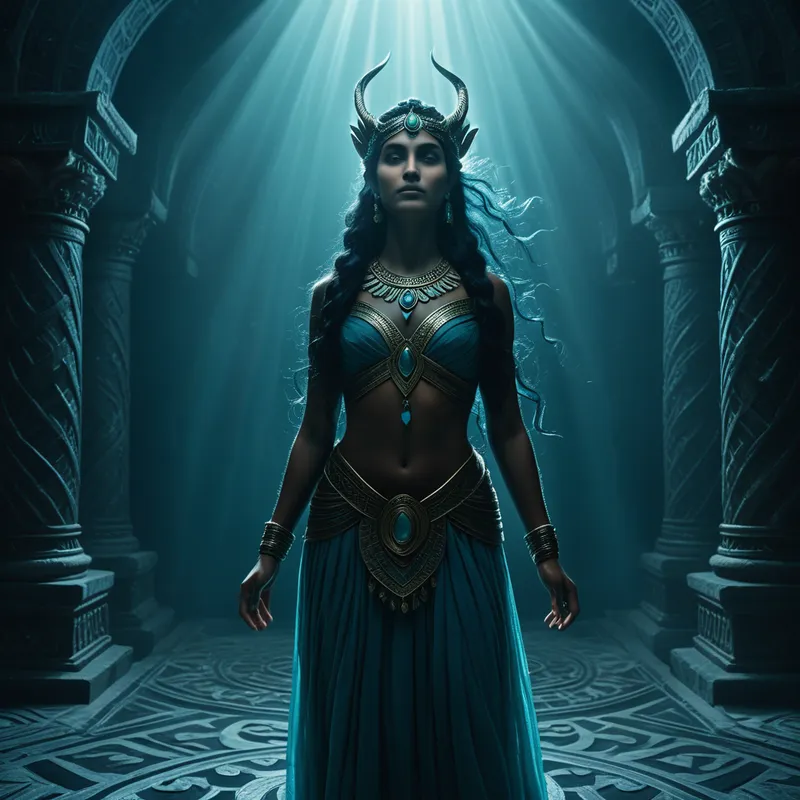
In the time before time, when [the world](/myths/the-world “Myth from Tarot culture.”/) was a single, dark, and silent seed, there existed only [the Great Mother](/myths/the-great-mother “Myth from Jungian culture.”/), the dreaming essence of all potential. From her infinite solitude, a longing arose—a longing for connection, for song, for the rustle of life. This longing took root within her, and from her own dreaming body, she caused a single, luminous shoot to emerge. This was the first thought, the first breath, the first pulse. It grew, not upward into a void, but outward into a web, drawing substance from the Mother’s dream.
Its roots plunged deep into the dark, moist soil of potential, drinking from the waters of the unseen world. Its trunk, vast and columnar, became the axis of all that would be—the first mountain, the first riverbed, the first backbone. And its branches did not merely reach for a sky; they became [the sky](/myths/the-sky “Myth from Persian culture.”/), stretching infinitely in all directions, a canopy of connection. From these branches, every form of life was woven. The first hummingbird was a flicker of emerald light detaching from a leaf. The first jaguar was a patch of shadow and spotted sunlight given motion and breath. The anaconda was a root that learned to swim; the pink river dolphin was a drop of sap that learned to sing. Every vine, every insect, every human soul began as a unique knot in the Tree’s vast, living tapestry.
The Tree was not a passive object but a conscious, breathing entity—the [Anima Mundi](/myths/anima-mundi “Myth from Greek culture.”/) of the rainforest. Its sap was the vital force, kuxexe or sami, that animates all beings. Its leaves were individual consciousnesses, each unique yet drawing from the same source. The rustling of its leaves in [the wind](/myths/the-wind “Myth from Various culture.”/) was the original language, a whispering exchange of knowledge and memory between all creatures. To live was to be a part of the Tree’s eternal conversation.
Shamans, the payé or pajé, learned to journey along the Tree’s pathways. In trance, induced by sacred brews like ayahuasca (the “vine of the soul”), they would climb the roots into [the underworld](/myths/the-underworld “Myth from Greek culture.”/) of ancestors and healing, or ascend the branches into the celestial realms of spirits and prophecy. The Tree was their ladder, their map, and their teacher. It showed them that illness was a fraying of one’s connection to the Tree, and healing was the re-weaving of that thread. It taught that [death](/myths/death “Myth from Tarot culture.”/) was not an end, but a return of the leaf to the humus, of the soul to the great root-mass, to be redistributed in new growth.
Thus, the Great [Tree of Life](/myths/tree-of-life “Myth from Kabbalistic culture.”/) Amazon stands not as a relic of the past, but as the perpetual present—the living, breathing architecture of existence where every breath taken is a leaf trembling on its infinite branches, and every life lived is a story told in its ever-unfolding bark.
Cultural Origins & Context
This myth is not a singular story with one author, but a pervasive, underlying cosmological framework shared across numerous Indigenous Amazonian cultures, from the Tupi-Guarani and their concept of the Yvy marã e’ỹ (the Land Without Evil, often envisioned as an eternal, fertile forest) to the peoples of the Upper Amazon who work with ayahuasca. It is the bedrock of an animist worldview where the forest is not a collection of resources, but a singular, sacred subject—a super-organism.
The myth arises from direct, sustained immersion in the world’s greatest biotic community. The Amazon rainforest itself, with its staggering vertical stratification (from forest floor to emergent canopy), its incomprehensible interdependence, and its constant, palpable life-force, is the primary text. The Great Tree is the cognitive and spiritual model born from reading this text. It explains biodiversity as familial diversity, ecological balance as familial harmony, and the forest’s resilience as the Tree’s enduring life.
This cosmology is enacted and sustained through ritual, storytelling, and daily practice. Hunting is preceded by prayers to the “master of animals,” a guardian spirit often associated with a great, ancient tree, asking permission and promising reciprocity. Planting follows the Tree’s pattern of growth from a central point. The myth is not abstract theology; it is an operational manual for living in right relationship with a sentient world. It encodes the understanding that human beings are the “younger siblings” in this cosmic family, with the responsibility to listen, learn, and contribute to the whole, rather than dominate it.
Symbolic Architecture
The [Tree](/symbols/tree “Symbol: In dreams, the tree often symbolizes growth, stability, and the interconnectedness of life.”/)’s [architecture](/symbols/architecture “Symbol: Architecture in dreams often signifies structure, stability, and the framing of personal identity or life’s journey.”/) is a map of the [psyche](/myths/psyche “Myth from Greek culture.”/) and the [cosmos](/symbols/cosmos “Symbol: The entire universe as an ordered, harmonious system, often representing the totality of existence, spiritual connection, and the unknown.”/), indivisible from one another.
The Roots (Hampa): The realm of the ancestors, the unconscious, memory, and the past. Here lies the dark, fertile soil of potential—all that has been and all that could be again. It is the psychological underworld where traumas and talents are buried, awaiting integration. In the myth, journeying to the roots is confronting one’s origins and the collective past.
The Trunk (Róga): The axis mundi, the world-pillar. It represents the present moment, the here-and-now, the individual self anchored in reality. It is the channel through which energy flows between the heavens and the underworld. Psychologically, it is the ego or the conscious self, stable yet permeable, through which the depths and heights of experience must pass.
The Branches and Canopy (Yvága): The realm of future potential, spirit, thought, and expansive connection. This is the sky-world of gods, bird-people, and celestial patterns. It symbolizes aspiration, vision, and the interconnected web of relationships that extend beyond the immediate self. Psychologically, it is the super-conscious—the realm of ideals, creativity, and spiritual longing.
The entire [structure](/symbols/structure “Symbol: Structure in dreams often symbolizes stability, organization, and the framework of one’s life, reflecting how one perceives their environment and personal life.”/) embodies [the principle](/symbols/the-principle “Symbol: A fundamental truth, law, or doctrine that serves as a foundation for a system of belief, behavior, or reasoning, often representing moral or ethical standards.”/) of ayni or reciprocity, but on a cosmic scale. The roots feed the branches, the branches shed leaves to feed the roots. No part exists for itself alone. This is a model of a healthy psyche: a self that is grounded in its [depths](/symbols/depths “Symbol: Represents the subconscious, hidden emotions, or foundational aspects of the self, often linked to primal fears or profound truths.”/) (roots), centered in its present [reality](/symbols/reality “Symbol: Reality signifies the state of existence and perception, often reflecting one’s understanding of truth and life experiences.”/) ([trunk](/symbols/trunk “Symbol: The trunk in dreams typically denotes the core structure or foundation of one’s identity, values, or beliefs.”/)), and open to growth, [relationship](/symbols/relationship “Symbol: A representation of connections we have with others in our lives, often reflecting our emotional state.”/), and transcendence (branches).
The Dreamer’s Resonance
To encounter the Great Tree in a dream or vision is to confront the archetype of wholeness. For the modern psyche, often fragmented and alienated, this symbol acts as a profound compensatory image. It does not simply suggest connection; it enacts it within the dreamer’s inner landscape.
The dream-Tree often appears when one feels isolated, uprooted, or lost in life’s complexity. Its immense, stable presence offers an experience of being held within a larger, intelligent order. To see its roots may call the dreamer to examine foundational wounds or family patterns. To climb its trunk may reflect a struggle for self-definition and stability. To rest in its branches may signal a readiness for new perspectives or spiritual inquiry.
The myth insists that to know oneself, one must know one’s place within the Tree. Thus, in depth psychology, the Tree becomes a tool for individuation—the process of becoming a unique individual while simultaneously recognizing one’s fundamental belonging to the collective whole. The dreamer is not just a leaf, but also contains the entire pattern of the Tree within. Integrating this symbol means moving from a sense of being a disconnected fragment to experiencing oneself as a nodal point in a living network of meaning.

Alchemical Translation
The myth of the Great Tree is an alchemical formula for the transformation of consciousness. The entire rainforest becomes the [vas hermeticum](/myths/vas-hermeticum “Myth from Alchemical culture.”/), the sealed vessel in which [the great work](/myths/the-great-work “Myth from Alchemical culture.”/) takes place.
The First Matter (Prima Materia): The undifferentiated chaos of potential, the dark seed-world at the beginning. This is the raw, unconscious content of the psyche.
The Separation (Separatio): The emergence of the Tree, creating the distinct realms of root, trunk, and branch. This is the cognitive act of making distinctions, creating the tension of opposites (above/below, spirit/matter, conscious/unconscious) necessary for transformation.
The Circulation (Circulatio): The eternal flow of sap—the life-force—between roots and canopy. This is the psychological process of bringing unconscious material up to consciousness (ascent) and grounding spiritual insights into lived reality (descent). The ayahuasca brew, often called “the vine,” is the literal and symbolic catalyst for this circulatory process.
The Union (Coniunctio): The state where all opposites are held in dynamic balance within the Tree. The jaguar (earth) and the eagle (sky) are both children of the same bough. This is the alchemical gold—the achieved state of inner wholeness where one is simultaneously fully individual and utterly connected, fully embodied and spiritually awake. The myth does not seek to escape the cycle of life and death but to sanctify it, seeing in every decay the promise of a new, interconnected blossoming.
Associated Symbols
Explore related symbols from the CaleaDream lexicon:
- Tree of Life — The universal archetype of interconnected growth, serving as a cosmic axis linking heaven, earth, and the [underworld](/myths/underworld “Myth from Greek culture.”/).
- Root — Symbolizes foundation, ancestry, and the hidden, nourishing sources of life and identity deep within the unconscious.
- Seed — Represents pure potential, the origin point of all existence, and the compressed blueprint of future growth contained within the dark.
- Vine — Embodies connection, entanglement, and the sacred pathways that allow for spiritual ascent and the interweaving of destinies.
- Forest — The living embodiment of community, complexity, and the mysterious, interconnected whole that is greater than the sum of its parts.
- River — The flowing, cleansing, and connecting life-force that mirrors the circulatory sap of the Tree, carrying nourishment and memory.
- Serpent — A symbol of cyclical time, healing, and primal wisdom, often depicted entwined with [the World Tree](/myths/the-world-tree “Myth from Celtic culture.”/), representing the energy coiled at the base of existence.
- Bridge — Represents the mediating function of the Tree’s trunk, enabling passage and communication between different realms of being and consciousness.
- Mirror — Reflects the idea that every part of the Tree contains the pattern of the whole, and that to look deeply into nature is to see [the self](/myths/the-self “Myth from Jungian culture.”/).
- Circle — Denotes the cyclical nature of life, death, and rebirth inherent in the Tree’s ecology, where endings are always beginnings in a new form.
- Dream — The medium through which the Tree’s wisdom is often accessed, representing the non-ordinary state of consciousness where its connections become visible.
- Rebirth — The perpetual promise of the Tree, where decay feeds new growth, and every ending is a return to the root-mass for future blossoming.