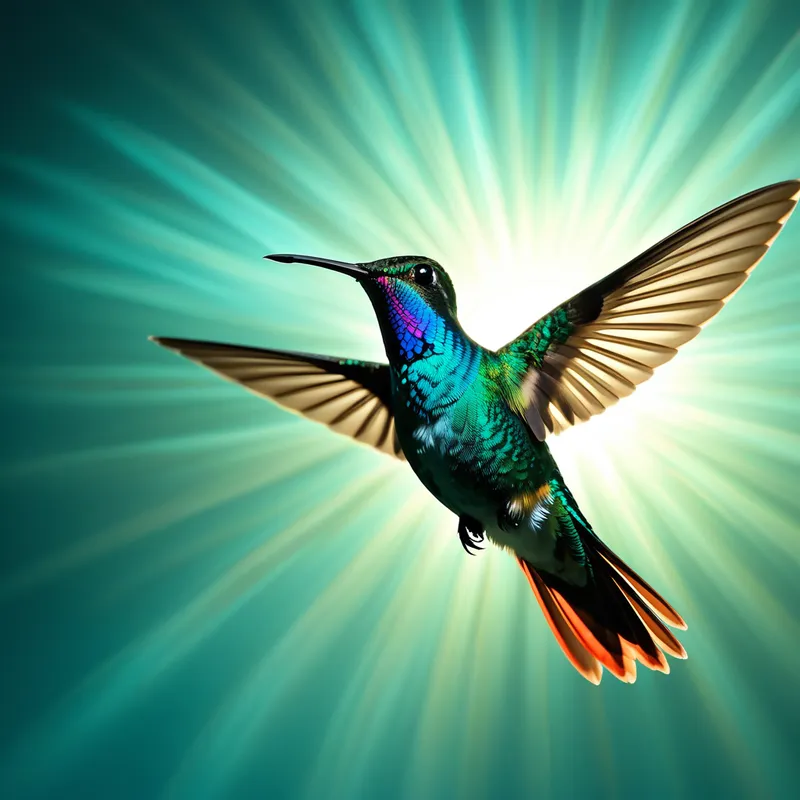
Hummingbird Myth Meaning & Symbolism
A tiny, desperate bird journeys to the house of the Sun to plead for rain, becoming the living bridge between the parched earth and the life-giving sky.
The Tale of Hummingbird
In the time before memory, when the world was younger and the colors of the earth were sharper, a great thirst fell upon the land. The sun, Tawa, had turned his face away in a stern mood. The rivers shrank to silver threads, then to dust. The corn stalks, once green and whispering, became brittle skeletons that rattled in a hot, dry wind. The people of the mesas grew thin, their prayers rising like smoke that vanished into the vast, empty blue.
All the animals gathered in the shadow of the great kiva. The bear spoke with a low rumble, the eagle with a sharp cry, but their strength was for naught against the sky’s refusal. Despair, thick and heavy, settled over all. Then, from the edge of the circle, came a sound like the vibration of a plucked sinew—a tiny, fierce buzzing.
It was Dzit Dit Gaii, the Hummingbird. Its feathers, once flashing like captured rainbows, were dull with dust. “I will go,” it hummed, its voice a mere whisper against the silence. “I will go to the house of the Sun and ask for his mercy.”
A ripple of disbelief passed through the council. The journey was impossible—across the scorched earth, over the spine of the world, and into the sky itself. But the Hummingbird’s eyes held a black fire. It had no strength of claw or tooth, only the relentless will of its wings.
And so it began. The tiny bird became a speck of desperate life moving against the copper bowl of the sky. The heat rose in waves, a visible shimmer that threatened to dissolve its form. It flew until its heart was a frantic drum against its hollow bones, until the world below was a blur of ochre and pain. It did not stop. It drank from dried blossoms, finding not nectar but only the memory of sweetness.
It flew through the day and into the terrifying expanse of the night, guided only by the cold pinpricks of stars, shivering in the void. It passed the moon, a silent observer. Finally, as the eastern horizon began to bleed light, it saw it: the house of the Sun, built of turquoise and coral, resting on the far edge of the world. The light that poured from its doorway was not the gentle dawn of earth, but a blinding, purifying fire.
With the last tremor of its being, Hummingbird shot forward, a living arrow aimed at the heart of the light. It passed through the doorway and hovered, a vibrating shadow, before the immense, radiant presence of Tawa himself.
“Who dares enter my house?” the Sun’s voice was the sound of a thousand rocks splitting in the heat.
“It is I, the smallest one,” hummed the bird, its voice almost lost. “The earth is dying. The people and all your children are dying of thirst. I have come to ask for rain.”
The Sun was silent, his gaze like molten gold. He saw the dust on the bird’s feathers, the frantic pulse in its throat, the absolute exhaustion held at bay only by spirit. He saw the truth of the journey etched into its tiny body.
“You are small,” Tawa said, his voice softening to a warm glow. “But your heart has traveled the greatest distance of all. For your courage, and for the love that propelled you, I will send the rain.”
From a vessel of cloud, Tawa took a single, perfect drop of water. He placed it upon Hummingbird’s throat. “Carry this promise home. Let it be your sign and your gift.”
Transformed, glowing with the captured light of the Sun’s house, Hummingbird turned and began the journey back. As it flew, the drop on its throat flashed with all the colors of the rainbow. And from that spot on its body, a new, iridescent plumage grew—a living fragment of the sky’s promise. By the time its shadow fell again on the parched earth, the first cool winds were gathering, and the distant rumble of thunder was the sound of the world healing.

Cultural Origins & Context
This narrative finds its home among the Pueblo peoples, whose world is architecturally and spiritually oriented around the arid, majestic landscape of the high desert. Here, water is not merely a resource; it is the physical manifestation of life, prayer, and cosmic balance. Myths are not mere stories but are hózhǫ́ǫ́g—maps of how to live in beauty and harmony.
The Hummingbird myth was traditionally told not from a written page, but from the memory of elders and storytellers, often during the winter months or in the context of teaching children about perseverance, community responsibility, and the interconnectedness of all life. Its societal function is multifaceted: it is a lesson in courage disproportionate to size, an etiological tale explaining the bird’s brilliant plumage, and, most profoundly, a spiritual technology. It reinforces the Pueblo understanding that the cosmos responds not to brute force, but to sincere sacrifice and the focused intent of even the smallest being acting on behalf of the whole.
Symbolic Architecture
At its core, the myth presents Hummingbird as the archetypal emissary. It embodies the principle that the bridge between the human realm (the parched earth) and the divine realm (the house of the Sun) is not built by power, but by willing vulnerability and relentless motion.
The true journey is not across landscape, but across the vast interior distance from despair to petition, from isolation to intercession.
Psychologically, Hummingbird represents the focused, directed aspect of the psyche—the libido in its most concentrated form. Its long, specialized beak is a symbol of precise focus, able to penetrate to the essential nectar, the core truth. Its impossible flight—hovering, moving backwards and forwards—mirrors the mind’s ability to suspend itself in contemplation, to examine a problem from all angles without landing on a fixed, and potentially limiting, conclusion. The bird’s transformation, receiving its iridescent gorget from the Sun’s tear, symbolizes the individuated Self that is forged only by directly facing the supreme source of both life and scorching truth.

The Dreamer's Resonance
When the myth of Hummingbird activates in the modern dreamscape, it often signals a profound psychic drought. The dreamer may be in a period of creative sterility, emotional desiccation, or spiritual exhaustion where the usual wells of meaning have run dry. To dream of a hummingbird struggling, flying a desperate, endless journey, or hovering before a blinding light is to experience somatically the soul’s own frantic search for sustenance.
This is not a call to grandiose action, but to the mobilization of a specific, focused energy. The psyche is identifying a tiny but crucial part of the Self that must undertake a perilous journey—perhaps to carry a deeply felt but fragile emotion (the plea) to a neglected or feared aspect of one’s own inner authority (the Sun). The exhaustion felt upon waking is real; it is the residue of the ego identifying with the bird’s monumental effort. The dream is a map for the soul’s pilgrimage from a state of lack to the source of renewal, emphasizing that the journey itself, fueled by love for one’s own inner “people” or potential, is what transmutes the seeker.

Alchemical Translation
The alchemical process mirrored in this myth is the nigredo transformed into the albedo through the agency of the conjunctio. The parched earth is the nigredo—the dark night of the soul, the feeling of being calcified and lifeless. Hummingbird is the mediating Mercurial spirit, the active, seeking intelligence of the psyche that refuses to accept annihilation.
Individuation is often the work of the smallest, most persistent part of us, willing to fly into the core of our own brilliance to retrieve the waters of feeling.
The journey to the Sun represents the necessary, terrifying confrontation with the Self archetype in its most potent and potentially destructive form—our own inner authority, brilliance, or fiery consciousness that we may have been avoiding. To plead before it is to acknowledge our dependence on this greater psychic reality. The gift of the water-drop is the conjunctio: the marriage of the tiny, committed ego with the immense, life-giving Self. The resulting iridescence is the albedo—the emergence of a new, authentic personality, marked by the encounter and now capable of reflecting a spectrum of previously unseen possibilities. For the modern individual, the myth instructs: Your renewal lies not in waiting for rain, but in mustering the courage to become the messenger, to carry your specific thirst directly into the heart of your own luminous, demanding truth.
Associated Symbols
Explore related symbols from the CaleaDream lexicon: