
The Fisher King's Grail Myth Meaning & Symbolism
A wounded king, a wasteland kingdom, and a sacred vessel await a hero's compassionate question to heal the land and the soul.
The Tale of The Fisher King's Grail
Listen, and hear a tale of a wound that became a world.
In the heart of the land of Logres, a sickness had taken root. The rivers ran slow and thick, the fields yielded only thistle and dust, and the very air hung heavy with a sigh of perpetual twilight. This was the Wasteland. And at its heart, in a castle of grey stone that seemed to grow from the sorrowful earth itself, sat its lord: the Fisher King.
He was once a mighty guardian, a keeper of profound mysteries. But a grievous wound, a spear thrust through both thighs, had felled him. He could not ride, could not rule, could only sit by the waters that no longer teemed with life and fish with a silent, patient despair. His only solace was the mysterious procession that passed through his hall each evening. A strange, luminous light would precede it, and then would come maidens bearing a bleeding lance, and finally, a maiden of unearthly grace carrying the Holy Grail itself. It glowed with a light that promised sustenance, healing, and the answers to all sorrows. Yet for the King, it passed by, a torment of nearness that could not cure his ache.
Into this blighted realm came a youth, Perceval, of the Welsh marches. Green in the ways of knighthood but pure of heart, he wandered lost, guided by fate or folly. He came upon the Fisher King in his boat on a stagnant mere. The old king, his face etched with pain, invited the knight to his castle.
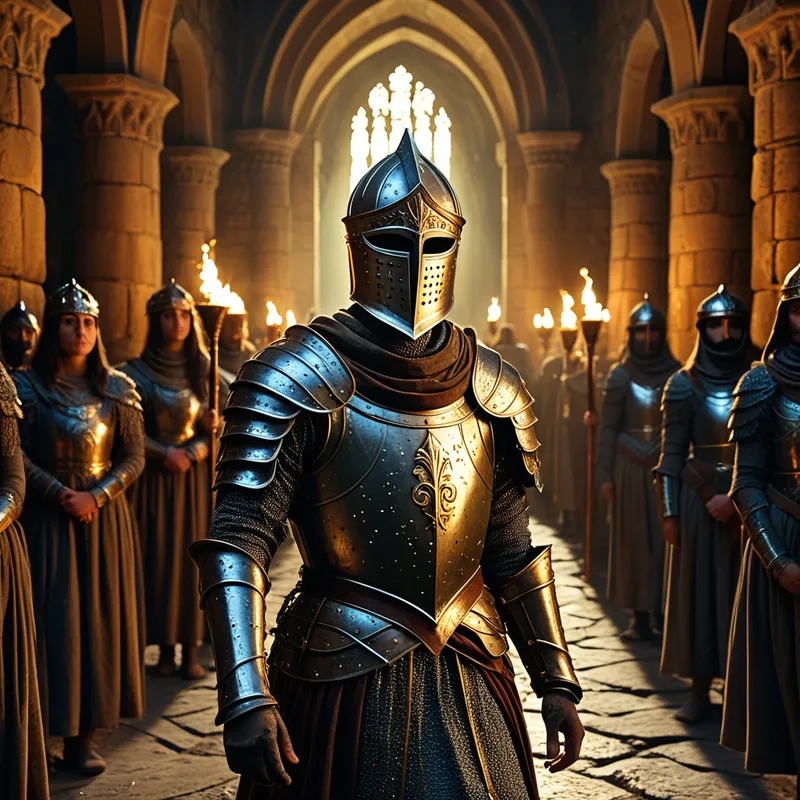
In the great hall, under the flicker of torches that cast long, dancing shadows, Perceval was feasted. But it was a feast of ghosts, the food tasteless, the wine like water. Then, the light came. The procession entered. Perceval watched, his breath caught in his throat, as the Grail passed before him. It radiated a warmth that touched his very soul. He saw the King’s pallor deepen, a spasm of agony cross his face as the sacred vessel moved through the hall and vanished.
A question burned in Perceval’s chest, simple and urgent: Whom does the Grail serve? But he had been taught that a knight speaks not out of turn, that silence is a virtue. The words died on his lips. He held his peace.
He awoke at dawn to a castle empty, silent, and deserted. The gates stood open to the Wasteland. As he rode out, a maiden met him on the path, her face streaked with tears. “Oh, fool!” she cried. “Had you but asked the Question, the King would have been healed, and the land made whole! Now the curse deepens, and you are lost.”
And so Perceval rode on, not as a guest, but as an exile, the weight of his unasked question now the heaviest part of his armor. The Wasteland sighed, and waited.
Cultural Origins & Context
The myth of the Fisher King and the Grail is not a single, fixed story, but a powerful current that flowed through the later streams of Arthurian Romance. Its most famous early tellings come from the 12th and 13th centuries, in the works of Chrétien de Troyes (Perceval, or the Story of the Grail) and Wolfram von Eschenbach (Parzival).
This was an era of cultural fusion and spiritual seeking. The Crusades had brought contact with Eastern mysticism, and Celtic myths of magical cauldrons of plenty merged with Christian symbolism of the Chalice of the Last Supper. The story was told in courts by troubadours and written by clerks, serving as both entertainment and profound spiritual allegory. It functioned as a narrative mirror for a society grappling with concepts of spiritual knighthood, the nature of divine grace, and the connection between the ruler’s virtue and the health of the realm. It asked its audience: What wound do you carry? And what question are you afraid to ask?
Symbolic Architecture
The myth is a perfect symbolic map of a profound psychological condition. The Fisher King is not merely a wounded man; he is the archetype of the wounded masculine principle, the ruling function of the psyche that has been incapacitated. His thigh wound, rendering him impotent and immobile, symbolizes a deep injury to vitality, generative power, and the ability to move forward in life.
The Wasteland is the external reality perfectly mirroring an internal state. A soul that cannot feel, cannot create, cannot connect, projects a world that is barren, repetitive, and devoid of meaning.
The Grail represents the transcendent function, the potential for wholeness and healing that exists within the wounded psyche itself. It is not external salvation, but the latent, nourishing spirit. Perceval is the nascent consciousness, the ego that enters the realm of the unconscious (the castle). His failure is the failure of conscious awareness to engage compassionately with the wound. He observes the mystery but does not relate to it. The prescribed, polite silence of his training is the defense mechanism that prevents authentic engagement with the depths.

The Dreamer's Resonance
When this myth stirs in modern dreams, it rarely appears as knights and castles. Instead, one might dream of a powerful but incapacitated boss or parent figure in a decaying office; of a beautiful, glowing object in a neighbor’s house that you long to ask about but feel it’s not your place; of wandering through a familiar neighborhood now rendered empty and lifeless.
Somatically, this pattern resonates with a feeling of chronic stagnation, a "stuckness" where life has lost its juice. There is a pervasive low-grade depression, a sense of being a passive observer in one’s own story. The psychological process is one of confronting a core, perhaps forgotten, wound—often related to shame, trauma, or a severed connection to one’s own creative or spiritual source. The dream signals that the conscious attitude (Perceval) is on the threshold of the wounded Self (the Fisher King), and the healing question is formulating in the unconscious.

Alchemical Translation
The alchemy of this myth is the transmutation of passive suffering into active questioning, and of the wound into the vessel. The quest is not to find the Grail, but to become the one who can ask for it.
The first stage is nigredo: the recognition of the Wasteland, both inside and out. This is the dark night, the depression, the feeling of sterility. The Fisher King’s castle is the vas hermeticum, the sealed container where this work occurs.
The second stage is the albedo, the whitening, sparked by the simple, compassionate question: “What ails you?” or “Whom does this serve?” This question is not intellectual curiosity; it is an act of empathy that bridges the gap between the observing ego and the suffering Self. It acknowledges the wound.
The healing is not in the answer, but in the asking. The question itself is the lance that draws out the poison. It re-establishes relationship where there was only silent observation.
Finally, the rubedo, the reddening: the Grail, once a distant symbol, becomes active. The King is healed, and the land flowers. Psychologically, this is individuation—the wounded complex is integrated, the ruling function of the psyche is restored, and life energy (the waters) flows again. The Grail serves the healed king, meaning the transcendent function now serves the integrated personality. The Wasteland was not cursed; it was waiting for the right question to be born.
Associated Symbols
Explore related symbols from the CaleaDream lexicon: