The Champion's Portion Myth Meaning & Symbolism
A mythic contest for the finest cut of meat becomes a brutal, magical trial to determine the supreme hero, exposing the shadow behind glory.
The Tale of The Champion's Portion
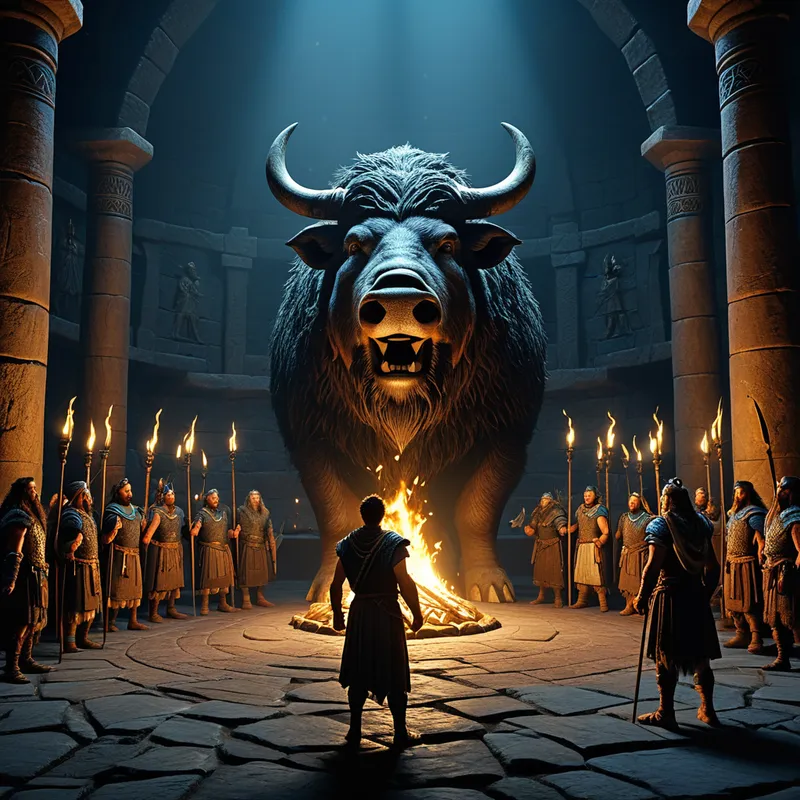
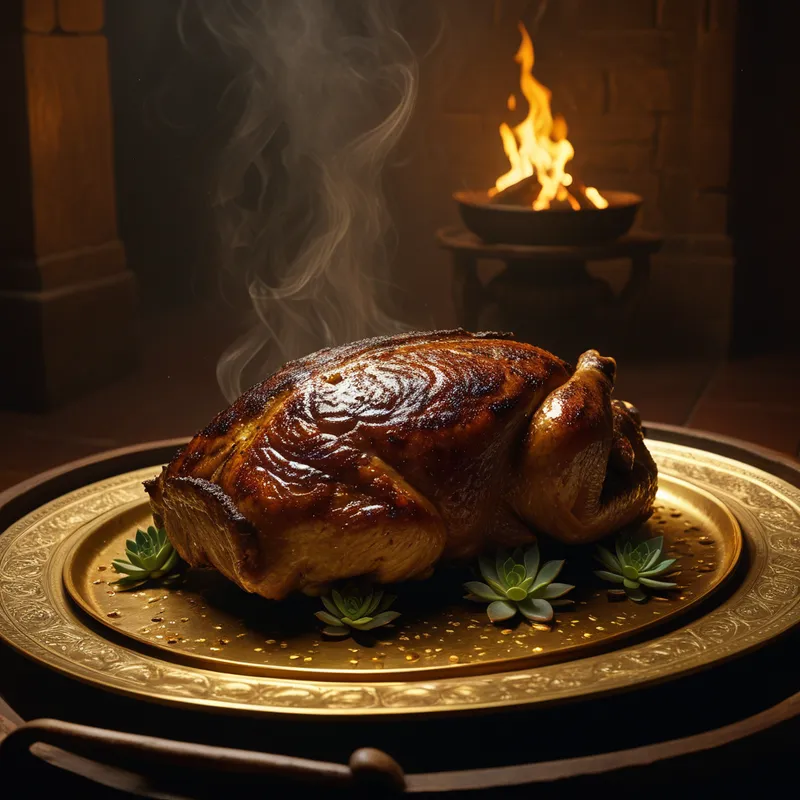
Hear now the tale of the fiercest cut, the portion that divides the mighty from the merely strong. In the hall of Mac Da Thó, a king whose hospitality was a weapon and whose wealth was a challenge, the air was thick with the scent of roasting flesh and the simmering heat of pride. In his possession was a hound, a beast of legend—Cú Chulainn himself bore its name as an epithet—and a boar, a titan among swine, fed for seven years on the milk of sixty cows. From this boar, a haunch was carved, a portion so vast and rich it could feed a hundred men, yet it was destined for one alone. This was the Curath-mír, the Champion's Portion.
The men of Ulster and the men of Connacht sat on opposite sides of the fire, their eyes not on their own plates, but on that single, steaming cut of meat placed in the center of the hall. No law declared the champion; the portion itself was the declaration. It called to the warrior's spirit, whispering of undying fame and the silent admission of all rivals. The boasting began, a thunderous storm of past deeds. Cet mac Mágach of Connacht rose, his voice a challenge. He claimed the portion by right of his spear, which had slain more Ulstermen than any other. One by one, Ulster's heroes stood to counter him, and one by one, Cet silenced them with a tale of how he had bested each in battle, humiliated each father. The hall grew heavy with Ulster's shame.
Then, as the fire seemed to dim with their despair, a youth entered. He was not yet fully a man, but the air around him crackled with a terrible potential. This was Cú Chulainn, the Hound of Ulster. He had been absent, following the disciplines of his training. He walked to the portion, and with a calm that was more terrifying than any shout, he claimed it. Cet roared his familiar challenge: "And what have you done, boy, to claim what your elders cannot?"
Cú Chulainn did not speak of the past. He spoke of the now. He invited Cet to contest the portion not with old stories, but with fresh combat. And as he spoke, the ríastrad, the warp-spasm, began to seize him. His body contorted into a monstrous, divine weapon. One eye sucked deep into his skull, the other bulged monstrously wide. His hair stood in violent spikes, with a drop of blood on each tip. From his crown, a column of dark blood and light shot upward like a furious fountain. Seeing this living storm, this incarnation of battle-joy made flesh, Cet mac Mágach, the proud champion, did what no tale had recorded him doing before. He stepped back. He yielded. The Champion's Portion was Cú Chulainn's, not by recounted deed, but by the palpable, terrifying truth of his present being. The feast could begin, the hierarchy settled by the silent language of ultimate capability.
Cultural Origins & Context
This myth is preserved in the early Irish narrative Scéla Muicce Meic Da Thó, a central tale in the Ulster Cycle. These stories, committed to vellum by Christian monks between the 8th and 12th centuries, are windows into a much older, pre-Christian world of warrior ethos and sacred kingship. The tale of the Champion's Portion is not mere entertainment; it is a social and psychological blueprint performed in the feasting hall, the very heart of early Irish aristocratic society.
The feast (fled) was a microcosm of the cosmos, where social order was both celebrated and contested. Seating was hierarchy, distribution of food was politics, and storytelling was law. The Curath-mír was the ultimate symbol of this system. It was a sacred, tangible prize for the curad, the champion, whose prowess directly reflected on the honor and sovereignty of his people. The contest was a ritualized, potentially lethal form of social calibration. Bards were the custodians of this myth, reciting it not just to glorify heroes like Cú Chulainn, but to remind every warrior in the hall of the fluid, performative nature of status. Your glory was only as good as your last feat, and your right to the finest cut was eternally subject to challenge.
Symbolic Architecture
At its core, the Champion's Portion is not about meat, but about essence. It represents the distilled prize of identity—the right to be recognized as the supreme self within a collective.
The portion is the visible prize for the invisible contest: the lifelong struggle to integrate one's latent, often terrifying, totality.
The boar, a creature of both immense vitality and destructive rage, symbolizes the raw, untamed life force from which the prize is carved. The rival claimants—Cet and the Ulster heroes—represent the ego's catalog of past achievements, the curated resume of the self. They bargain with history. Cú Chulainn, by contrast, especially in his distorted ríastrad state, embodies the unmediated present of the psyche. He is the eruption of the shadow and the Self simultaneously, a force of nature that cannot be argued with, only acknowledged. His victory signifies that true primacy comes not from what you have done, but from what you are in the moment of crisis—all of it, even the monstrous.
The hall itself is the theater of consciousness, where the various internal "warriors" or sub-personalities (pride, shame, ambition, memory) vie for dominance. The act of claiming the portion is the act of claiming one's own central, authoritative identity, a act that requires facing down the internalized voices of doubt and past failure (Cet's taunts).
The Dreamer's Resonance
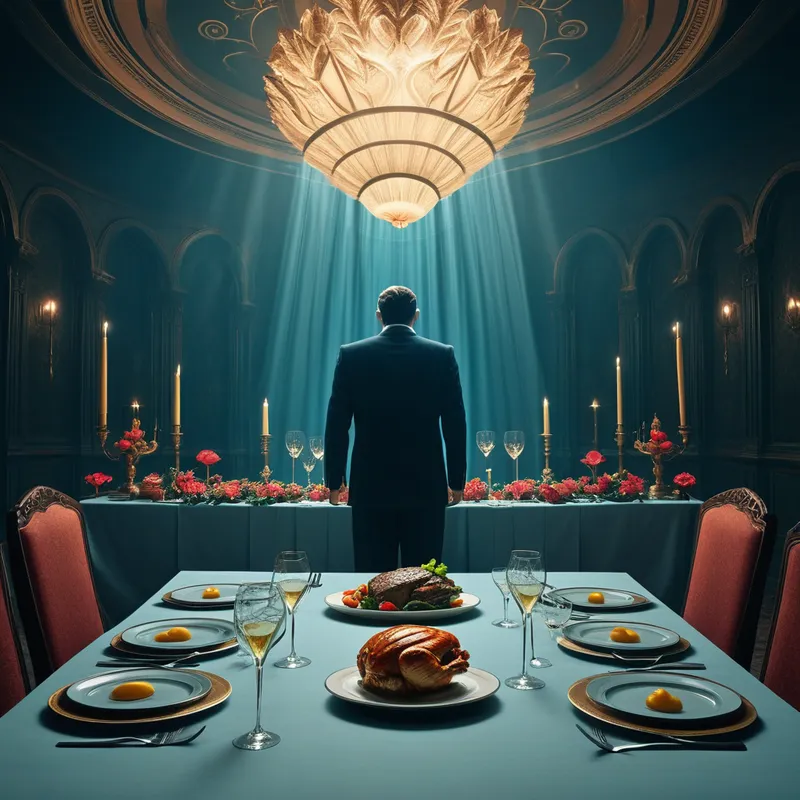
When this myth stirs in the modern unconscious, it often manifests in dreams of profound competition or judgment. You may dream of being at a crucial meeting, a family gathering, or an audition where a specific, coveted object or recognition is at stake. The somatic feeling is one of tense anticipation, a knot in the stomach—the "feast" that is also an arena.
To dream of the Champion's Portion is to feel the psyche preparing for a necessary confrontation, not with an outer rival, but with the parts of oneself that claim you are not enough.
The rival in the dream, the one who stands to deny you the prize, often wears the face of a critical authority, a successful colleague, or a nebulous, judging crowd. Psychologically, this is the "Cet" complex: an internalized chorus that recites your failures and limitations. The dream tests whether you will back down in the face of this internal boasting, or whether you can access a more fundamental, perhaps unsettling, power (the Cú Chulainn potential). The resolution—or lack thereof—in the dream mirrors your waking readiness to step into a larger, more authentic, and more responsible version of yourself, accepting the terrifying and glorious transformation that comes with it.
Alchemical Translation
The alchemical journey modeled here is the transmutation of potential into acknowledged essence. The base matter is the unremarkable warrior among many (the latent self). The conflict and heat of the challenge are the nigredo, the darkening, where the old identity (relying on past deeds) is humiliated and dissolved. Cet's victories represent the burning away of ego-attachments to former glory.
Cú Chulainn's arrival and transformation are the albedo and citrinitas—the whitening and yellowing. He embodies a state beyond ego, where the conscious personality is subsumed by a greater archetypal force. The ríastrad is not a pretty process; it is the chaotic, violent stage of psychic reorganization where opposites (beauty and monstrosity, boy and god) clash and combine. Finally, claiming and consuming the portion is the rubedo, the reddening. It is the integration of this transformative experience into a new, solidified, and sovereign identity.
The individual does not simply win the prize; they become the person for whom the prize is the natural emblem.
For us, the "Champion's Portion" is the wholeness we fear to claim. The modern ritual is to enter our own "feasting hall"—be it a boardroom, a creative project, or a personal relationship—and, instead of listing our qualifications, to embody our full capacity, shadows and all. It is to accept that true authority comes with a terrifying transformation, and that the finest cut of life is reserved for those willing to be forged, not just in the fires of competition, but in the deeper fire of becoming.
Associated Symbols
Explore related symbols from the CaleaDream lexicon: