The Banshee's Knock Myth Meaning & Symbolism
A tale of a king who hears three knocks from a spectral woman, foretelling his death and forcing a confrontation with fate and legacy.
The Tale of The Banshee's Knock
Listen now, by the hearth’s dying ember, to a whisper carried on the peat-smoke wind. It is not a tale for the bright of day, but for the hour when the veil between the worlds grows thin as a moth’s wing.
There was a king, Ard Rí, who ruled from a fort of stone atop a green hill. His name was Conall, and his reign was marked by justice, his arm by strength, and his hall by the music of harps. Yet in his blood ran the old lines, the Fir Bolg and the Tuatha Dé Danann, and with such blood comes a certain… attention from the other side.
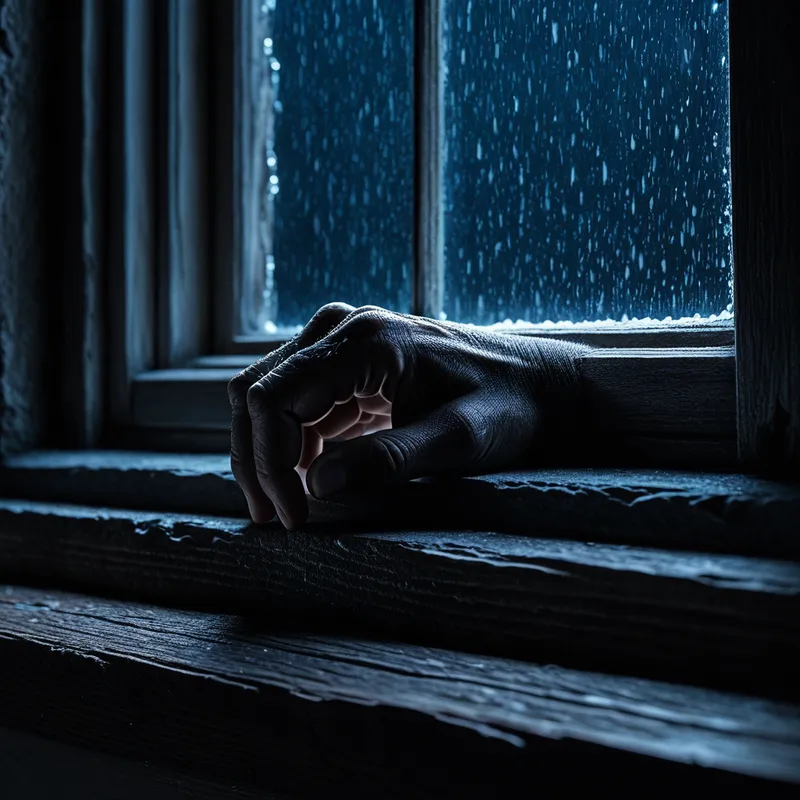
One autumn night, as a gale howled from the west, Conall sat alone in his chamber. The fire spat and hissed. The tapestries stirred. He felt a chill that had nothing to do with the wind—a cold that seeped from the marrow of the stones themselves. Then it came. Knock. Knock. Knock.
Three blows upon his heavy oak door, measured and grim, not of fist but of something softer, more final. He called out, but no guard answered. He rose, his hand on the hilt of his sword, and swung the door wide. The torch-lit corridor was empty, save for the dancing shadows. Only a scent lingered—of wet earth, of crushed haws, and of sorrow so profound it was a taste on the tongue.
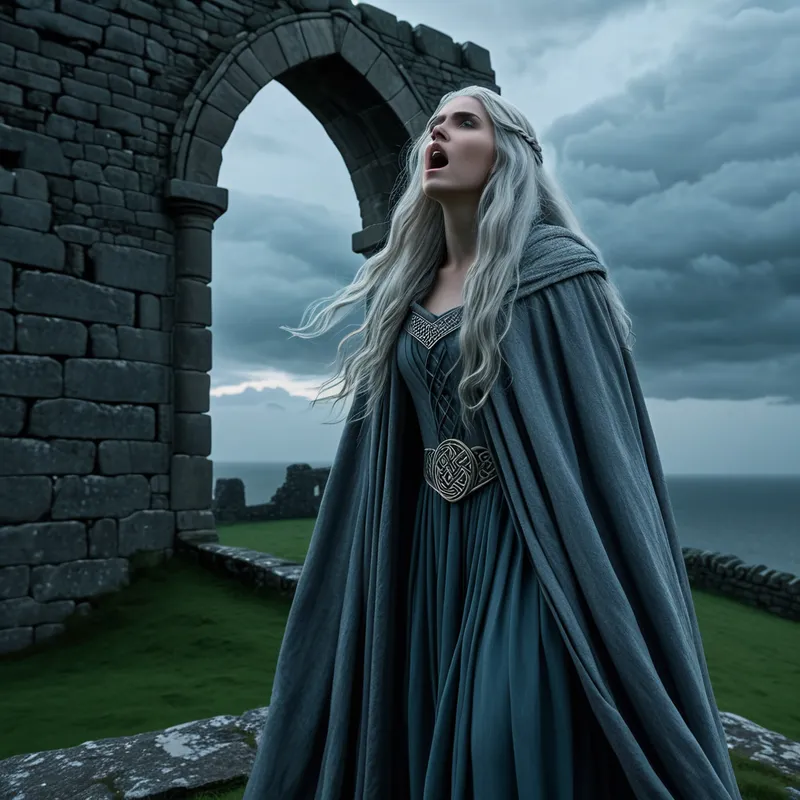
The next night, the gale persisted. The chill returned, deeper. And again, through the roar of the storm: Knock. Knock. Knock. This time, at his window shutter. Conall flung it open, peering into the tempest-lashed darkness. For a heartbeat, he saw her. A woman, tall and wraithlike, her hair like pale seaweed streaming in the gale, her gown the colour of rain-lashed slate. Her eyes held the emptiness of a deep well. She lifted a hand—not to him, but to her own face—and let out a sound that was not heard with the ear, but felt in the hollow of the chest: the Banshee’s keen, a vibration of pure loss. Then she was gone, dissolved into the storm.
On the third night, a terrible stillness fell. The wind died. The fire burned low and blue. Conall knew. He did not wait in his chamber. He walked to the great hall, donned his cloak, and sat upon his Lia Fáil. He stared at the main door of his hall. He did not have to wait long.
Knock. Knock. Knock.
Not loud, but absolute, as if the sound originated within the very heart of the oak. Conall, his face a mask of grim acceptance, spoke into the silence. "I hear you. My blood hears you. Enter, and name your purpose."
The doors did not open. They became insubstantial. And through them she glided, the Bean Sídhe</ab- br>. She did not look at him with malice, but with an ancient, weary grief. She pointed a long, pale finger not at his throat, but at the great tapestry behind him, woven with the deeds of his line. Her finger passed through the threads, and where it touched, the vibrant colours bled away to gray, the threads unraveling into dust.
Conall did not raise his sword. He bowed his head. "So it is time." The Banshee nodded once, a gesture of terrible respect. Then she faded, and with her, the last of the light from the hall's central fire. In the morning, they found the king seated upon his stone, his eyes closed, a look of profound peace upon his face, as cold as the dawn. The only sound was the cawing of a single crow on the rampart, and the memory of three knocks echoing in the silent stone.
Cultural Origins & Context
The myth of the Banshee’s Knock is not a single, codified story but a potent folkloric motif woven into the fabric of Gaelic Ireland and Scotland. It belongs not to the grand mythological cycles of gods and heroes, but to the domestic and ancestral sphere—the Sídhe as it intersects with family lines. This tale was not sung by bards in kingly halls for glory, but whispered by cailleachs and grandmothers by the hearth, a secret knowledge passed down through certain families, particularly those of ancient Gaelic stock like the O'Briens, O'Neills, or MacCarthys.
Its societal function was profound and practical. It served as a narrative container for the existential reality of death, framing it not as a random, meaningless event, but as a ritualized transition announced by the ancestral world. The Banshee was not merely a ghost, but a fetch or familial spirit. Her knock was a call to order, a summons from the tuath of the living to the tuath of the dead. It reinforced the Celtic worldview of a continuous, reciprocal relationship with the ancestors and the land, where death was a change of state, not an annihilation. The story prepared the community, allowing for the settling of affairs, the passing of wisdom, and the maintenance of the family’s sacred continuity.
Symbolic Architecture
The myth’s power lies in its stark, tripartite symbolism. The three knocks are the core—a trinity of warning, confrontation, and acceptance. They represent the irrevocable law of fate, the geis that binds even kings.
The knock is the sound of the soul’s own boundary being tested; it is not an invasion from without, but a recognition from within.
The Banshee herself is the embodiment of the anima as psychopomp—not a lover, but a guide to the threshold. She is the personified sorrow of the lineage, the accumulated grief and love of all who came before, now tasked with collecting their latest descendant. Her keen is the voice of the unconscious itself, a sound beyond words that communicates pure emotional truth. King Conall’s journey from alarm to investigation to resigned acceptance maps the human psyche’s progression when faced with its own mortality or any profound, unavoidable change. He moves from egoic defiance ("Who goes there?") to a final, sagacious surrender, acknowledging a authority higher than his temporal rule.
The Dreamer's Resonance
When this myth pattern stirs in the modern dreamer, it rarely manifests as a literal banshee. Instead, one may dream of three distinct, unexplained sounds in a familiar house—a doorbell, a phone ringing, a tap on glass. The setting is often liminal: a childhood home, a hotel corridor, a place that feels both known and eerily alien. The somatic experience is key: a deep, resonant vibration in the chest cavity, a chill, a feeling of being addressed by something vast and impersonal.
Psychologically, this dream signals that a deeply rooted structure within the psyche—a long-held identity, a career, a relationship, a foundational belief—has reached its terminus. The "knock" is the call of the Self, the central archetype of wholeness, demanding the "death" of an outmoded way of being. The dreamer is in a process of profound interior dissolution. The fear is not of an external monster, but of the impending silence after the knock, the unknown state of being that follows the end of a known world. The dream is an initiatory warning: prepare, gather your essence, for a transition you cannot avoid is upon you.

Alchemical Translation
The alchemical process mirrored here is nigredo—the blackening, the confrontation with the primal matter of one’s own shadow and fate. Conall’s three nights are the stages of this work.
The first knock is the shock of realization, the cracking of the persona. The second is the descent into the melancholy of understanding, the tristitia. The third is the conscious, willing submission to the process.
The modern individual’s "kingdom" is their constructed identity—their achievements, roles, and self-narrative. The Banshee’s Knock announces that this kingdom must fall for the true, indestructible Self to be acknowledged. The alchemical translation is the move from resistance to sacred hospitality. Conall’s final act is not to fight, but to sit upon his sovereign stone and invite the messenger in. This is the ultimate act of psychic sovereignty: to claim authority over one’s own dissolution. The transmutation occurs in that acceptance. The leaden weight of mortal fear is turned into the gold of existential peace. The individual does not merely die to their old self; they become the conscious steward of the transition, uniting the role of the king and the psychopomp within their own soul. They learn to hear the knock not as a threat, but as the solemn, respectful call of their own deeper destiny, knocking from the inside, asking to be let out.
Associated Symbols
Explore related symbols from the CaleaDream lexicon: