The Art of Memory Myth Meaning & Symbolism
A myth of a forgotten art where the soul builds a palace of memory to house the cosmos, bridging the mortal mind with divine wisdom.
The Tale of The Art of Memory
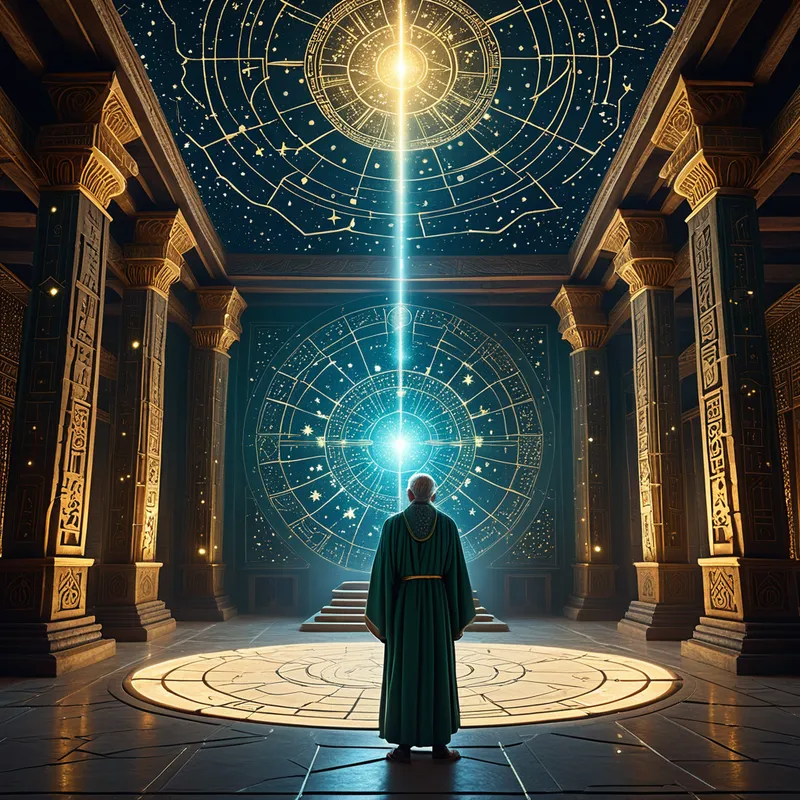
In the time before time was counted, when the world was a younger echo of the divine mind, there lived not a hero of muscle and sword, but a sage of silence and thought. His name was lost to the ages, remembered only as the First Rememberer. He walked the earth when the gods still whispered directly into the hearts of stones and streams, and he listened not with his ears, but with the vast, empty chamber of his soul.
He saw that humanity, newborn and trembling, was a vessel with holes. Experiences poured in—the terror of the thunder, the sweetness of the first berry, the love for a child—only to leak out into the void of forgetting. Life was a series of brilliant, disconnected flashes, leaving people wandering in a perpetual present, orphaned from their own becoming. The First Rememberer wept for this poverty. He retreated to a high, barren place, a plinth of rock beneath the naked sky. There, he sat. He did not eat from the earth, but from the light of the stars. He did not drink from streams, but from the well of his own breath.
His conflict was not with a monster, but with the formless, whispering chaos of unrecorded experience. The rising action was the slow, agonizing birth of an idea from the womb of potential. He gazed at the perfect, unchanging dance of the celestial bodies—the Seven Governors tracing their eternal paths. He observed the fixed and orderly nature of the constellations. And he understood: the cosmos itself was a memory. A perfect, divine memory.
So, he began to build. Not with stone and mortar, but with imagination and will. In the theater of his mind, he constructed a Memory Palace. He laid its foundations with the four cardinal directions. He raised pillars carved from the virtues: Discipline, Attention, Order, and Reverence. He created vast halls, one for each of the Governors, and in each hall, he placed a statue—a living, symbolic image. The fiery lion of the Sun stood in the central atrium. The silver crescent of the Moon held a hall of shifting, reflective pools. In the hall of Mercury, a winged caduceus whispered secrets to a scroll.
Then came the resolution, the great work. He began to walk the world anew. When he witnessed a great truth, he did not merely note it. He took the essence of that truth and forged it into a vivid, symbolic image—a talking owl, a burning book, a key made of light. He would then carry this image back in his mind and place it in a specific room, on a specific shelf, next to a specific statue. A law of justice was placed in the Hall of Saturn, as a set of perfect, unyielding scales. A poem of love was left in the Hall of Venus, as a rose that never wilted. His palace filled. It became a microcosm, a perfect reflection of the macrocosm. He had not just remembered the world; he had re-membered it—put it back together, whole and holy, within himself. The art was born. He descended from the mountain, his eyes holding the quiet light of one who carries a universe within, ready to teach humanity how to build their own inner heavens.
Cultural Origins & Context
This myth is not a single story from a sacred text, but the foundational allegory woven through the entire Hermetic corpus, particularly texts like the Corpus Hermeticum and later medieval grimoires. It finds its historical roots in the syncretic culture of Hellenistic Egypt, where Greek philosophy met Egyptian temple wisdom and Near Eastern astrology. The "Art of Memory" (Ars Memoriae) was a real and highly prized technique, passed down from master to initiate in secretive circles.
Its societal function was dual. Exoterically, it was a powerful mnemonic tool for orators, philosophers, and magicians to hold vast amounts of information—speeches, laws, planetary correspondences, and magical formulae. Esoterically, and more profoundly, it was a spiritual technology. The myth was told to illustrate that the mind is not a passive receiver but the active creator of its own reality. By constructing an ordered inner world, the initiate could achieve Gnosis, understanding the famous axiom "As above, so below; as within, so without." The myth served as a map for the journey of consciousness from fragmentation (forgetting) to integration (divine remembrance).
Symbolic Architecture
The myth is a profound blueprint of the psyche's potential structure. The First Rememberer represents the awakened Self, the archetypal Senex who turns inward to confront the primal chaos of the unconscious.
The palace is not a storage unit for facts, but the anima mundi—the world soul—made personal. It is the individuated psyche in its potential perfection.
The act of "placing" memories is the act of conscious integration. A raw, traumatic, or ecstatic experience (the thunder, the berry) is too potent and formless to be held by the conscious ego. By transforming it into a symbolic image (the talking owl, the burning key), the psyche metabolizes it. The image becomes a stable, knowable entity that can be visited, understood, and related to other truths. The specific halls and statues represent the archetypal structures of the collective unconscious—the planetary principles that govern different facets of existence (Saturn for structure and time, Venus for love and beauty, Mercury for communication). To place a memory within this architecture is to understand its cosmic context, to see the personal event as part of a universal pattern.
The Dreamer's Resonance
When this myth stirs in the modern unconscious, it often manifests in dreams of architecture and lost knowledge. A dreamer may find themselves in an endless, unfamiliar library where the books are written in a forgotten language, or wandering through a vast, beautiful mansion they somehow "own" but have never seen. They may discover a secret room in their own home, filled with strange and significant objects.
These dreams signal a psychological process of recollection in the deepest sense—a gathering of the scattered fragments of the Self. The somatic feeling is often one of awe mixed with anxiety: the awe of discovering vast inner resources, the anxiety of being overwhelmed by them. The labyrinthine corridors represent the complexity of the personal history; the locked doors, repressed memories or untapped potentials. To dream of actively cleaning, repairing, or expanding such a space indicates a conscious engagement in inner work, an attempt to bring order to psychic chaos and reclaim lost parts of the personality.
Alchemical Translation
The myth models the alchemical Magnum Opus for the modern individual. The initial state of forgetting is the nigredo, the blackening, the fragmented and leaden state of an unexamined life. The First Rememberer's retreat to the mountain is the albedo, the whitening, a purification through withdrawal and introspection—making the mind a blank slate (tabula rasa).
The construction of the palace is the central work of citrinitas, the yellowing, where the light of consciousness is applied to the raw material of experience. Each symbolic image forged is a minor transmutation, turning base emotional lead into spiritual gold—meaning.
The ultimate goal is not a perfect catalog of the past, but the creation of a living, internal cosmos. The Self becomes the Philosopher's Stone—the stable, eternal center that can hold and transmute all experience.
For us, the "Art" is any disciplined practice of self-reflection that creates inner structure: journaling, therapy, active imagination, or meditation. It is the conscious effort to not let life simply happen to us, but to actively "place" our experiences within a framework of personal meaning. The triumph is not omniscience, but coherence. The resolved myth shows us that individuation is the process of building a durable, beautiful, and inhabited Memory Palace of the Soul, where every joy, every grief, and every insight has its rightful place, contributing to the majesty of the whole. We become, like the First Rememberer, the sovereign of an inner kingdom that mirrors the harmony of the stars.
Associated Symbols
Explore related symbols from the CaleaDream lexicon: