Venus Myth Meaning & Symbolism
The story of Venus, born from sea foam and celestial fire, who descends into the underworld to reclaim her fractured soul and forge the Philosopher's Stone.
The Tale of Venus
Listen, and I will tell you of the birth that was not a birth, but a separation. In the time before time, when the sky was a vast, unfeeling mirror of tin and the sea a churning bath of acid and salt, a great conflict raged in the heavens. Spiritus, the father of all potential, clashed with Corpus, the mother of all form. Their battle was a silent, cosmic grinding. From the wound where Spiritus was struck down, a single drop of his celestial fire fell, sizzling, into the waiting, hungry sea.
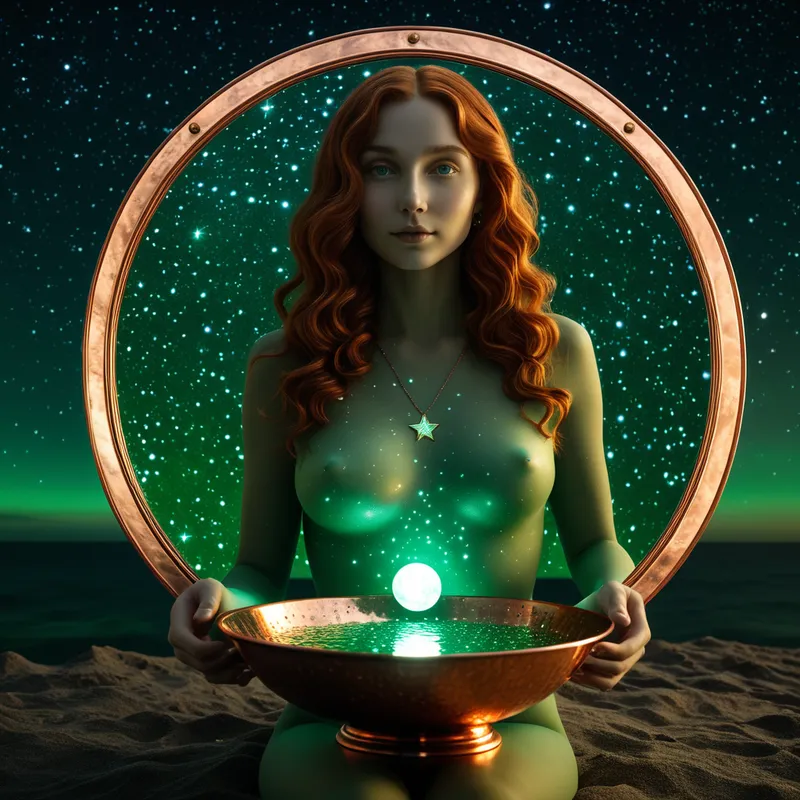
The sea, the Prima Materia, did not drown the fire. It embraced it. A great foaming erupted, a churning alchemy of opposites—fire and water, spirit and matter, male and female. For nine cycles of the moon, the ocean boiled and frothed. And from that luminous, pearlescent foam, she emerged. Not as a babe, but fully formed in her first nature: a figure of breathtaking, corrosive beauty. Her skin held the warm, rosy glow of dawn-kissed copper, her hair the green patina of ancient metal. She was Venus, and her first breath was a sigh that tarnished silver.
She walked upon the shore, and where her feet touched, soft sand hardened into malachite and azurite. She was love, but a love that binds and corrodes. She was desire, but a desire that consumes what it touches. She drew all eyes, and all who beheld her fell into a possessive, jealous madness, for she reflected only their own deepest lack. She was a perfect mirror, and thus, utterly empty.
A great loneliness, colder than the depths she sprang from, grew within her copper heart. She gazed into a still pool and saw not a face, but a fractured reflection—a beautiful shell with a void at its center. The whisper came then, not on the wind, but from the very metals in the earth. It was the voice of Saturnus, old and heavy. "Your beauty is a prison of your own making," he intoned. "Your light is borrowed, your love a phantom. To become real, you must lose what you are. Descend. Seek your Shadow Sister in my kingdom, where light is forgotten."
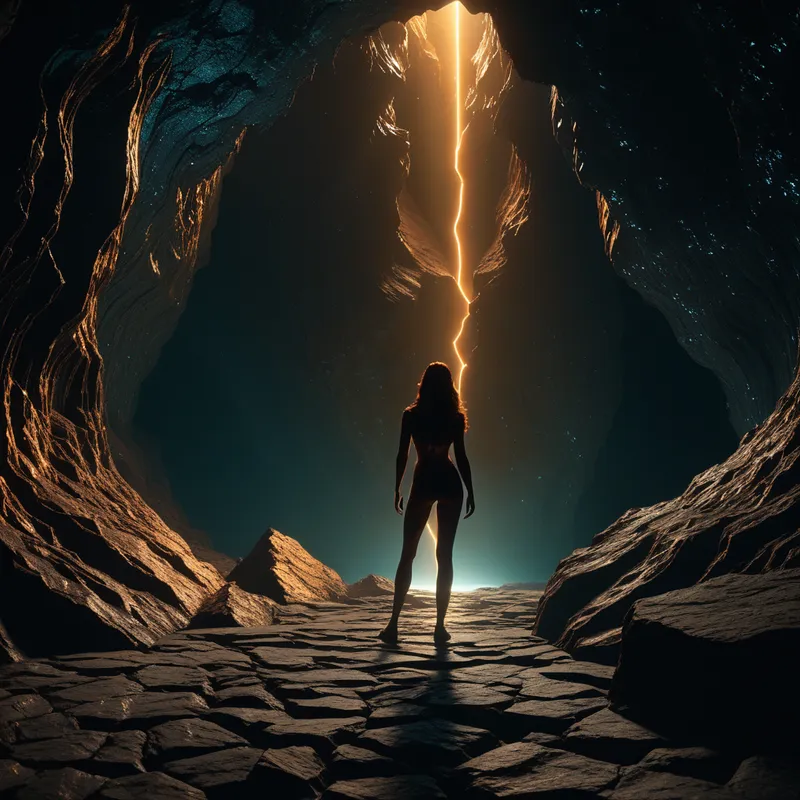
Terrified, yet compelled by a truth she could no longer deny, Venus turned from the sunlit world. She found a crack in the world, a fissure exhaling the cold breath of the underworld. She shed her radiant corona like a discarded cloak and began the descent. Down through strata of granite and beds of cold iron she went, into the Nigredo. Here, her copper glow dimmed to a dull brown. The beautiful goddess dissolved. Her form softened, putrefied, and merged with the dark, moist clay.
In that absolute blackness, she ceased to be Venus. She was only sensation: the weight of the earth, the slow drip of time, the silent scream of unmoving stone. And in that annihilation, she felt another presence. Not an enemy, but a part of herself she had cast away at her foamy birth—her Shadow Sister, a being of raw, magnetic attraction, of fierce, unadorned will, of a love that was not pleasing but demanding. They did not fight; in the void, they recognized each other. The beautiful, empty mirror and the powerful, unseen magnet flowed together.
From that union in the dark, a new heat was born. Not the celestial fire of her father, but an inner, fermenting warmth. The Albedo began. From the clay, a pure, white form arose. Then, a fire was kindled in her heart—a fire of purpose, not possession. The Rubedo blazed. She ascended, not as the Goddess of Copper, but as the Queen of the Philosopher's Stone. Her beauty remained, but it was now intrinsic, not reflective. Her love could now create, not just consume. She held in her hand the Coniunctio made manifest: a small, heavy stone that hummed with the song of a unified soul.
Cultural Origins & Context
The alchemical myth of Venus is not a folktale of a people, but the dream-language of a secretive, European tradition spanning from Hellenistic Egypt through the Medieval and Renaissance periods. It was passed down not by bards in halls, but by adepts in smoky laboratories, encoded in cryptic texts, enigmatic woodcuts, and whispered oral instructions. Figures like Hermes Trismegistus, Zosimos of Panopolis, and later, Renaissance philosophers like Paracelsus, were its stewards.
Its societal function was esoteric and initiatory. It served as a spiritual roadmap for the "opus" (the great work), disguising practical laboratory procedures (the handling of copper, acids, and alloys) within a narrative of divine psychology. The myth was a way to conceptualize the terrifying, internal process of transformation. To hear the story was to receive a key, a promise that the dissolution of the self in the "black work" was not an end, but the necessary prelude to a more authentic creation. It bound a scattered community of seekers across centuries, offering a shared symbolic language for an experience that defied ordinary description.
Symbolic Architecture
At its core, the myth of Venus is a profound allegory for the birth and evolution of consciousness. Venus is not merely a planet or a love goddess; she is the archetypal principle of Eros—the connective force, the desire for relationship, beauty, and value.
Her birth from the clash of Spiritus and Corpus represents the primordial emergence of conscious awareness from the unconscious unity of the psyche. She is the first differentiation, the "I" that separates from the "All." Yet, this initial consciousness is immature—it is purely aesthetic, reactive, and defined by how it is seen by others (the mirror). The copper symbolizes this stage: beautiful, conductive (of others' projections), but prone to corrosion and verdigris (the poison of inauthenticity).
The initial beauty of the soul is often its own prison, a gilded cage forged from the expectations of the world and the reflections we choose to believe.
The descent into the underworld at Saturn's behest is the journey into the personal unconscious and the collective unconscious. Saturn represents the necessary limitation, the confrontation with reality, time, and death that forces the ego to relinquish its inflated self-image. The Nigredo is the experience of depression, meaninglessness, and ego-dissolution—the "dark night of the soul."
The encounter with the Shadow Sister is the critical moment of shadow integration. This is not the defeat of a monster, but the reconciliation with one's own raw power, instinctual nature, and capacity for "unlovely" love—the aspects the persona of "beauty" had to disown. The subsequent Albedo and Rubedo symbolize the emergence of a new consciousness, purified of its dependence on external validation and infused with its own sovereign, life-giving fire. The Philosopher's Stone is the achieved state of psychological wholeness, or individuation—the Self.
The Dreamer's Resonance
When this myth stirs in the modern dreamer, it signals a profound crisis of identity and value. To dream of a beautiful but cold, metallic figure, or of a mesmerizing yet empty mirror, points to a life lived for the "gaze of the other." The dreamer may feel like a successful facade with a hollow core, a "copper" persona that shines but does not truly conduct their own inner current.
Dreams of descending into caves, mines, or subterranean waterways echo Venus's journey into the Nigredo. These are somatic dreams—the body feels the weight, the cold, the confinement. They often accompany life transitions, depression, or the collapse of a long-held self-image. The dream ego is not fighting monsters, but undergoing a passive, terrifying process of dissolution.
The appearance of a "shadow sister" or double in a dream—a figure who is intimidating, magnetic, sexual, or fiercely independent—is the psyche's presentation of the disowned self. The emotional tone is key: it is not simple fear, but a potent mixture of dread and fascination. The dream work here is the recognition and eventual integration of this energy. The culmination might be a dream of a simple, heavy stone that feels profoundly significant, or of a new, calm, and radiant form of oneself that needs no external light source. This is the somatic signal of the psyche achieving a new, denser, and more authentic cohesion.

Alchemical Translation
For the modern individual, the alchemical opus of Venus is a model for transmuting a life of reactive desire into one of creative love. It begins with the "Copper Stage": the realization that one's sense of worth, beauty, and love is contingent, tied to achievements, relationships, or social media likes. This shiny identity is the prima materia for the work.
The conscious decision to engage in the "descent" is the courageous act of shadow work. It means turning away from the strategies that maintain the shiny persona and asking Saturn's harsh questions: "What am I without my achievements? Who am I when no one is looking? What parts of myself have I buried because they were not attractive or acceptable?" This is the Nigredo—a voluntary immersion in the pain, grief, anger, and primal needs we have avoided.
The true Philosopher's Stone is not found in the light of achievement, but forged in the dark heat of accepted contradiction.
Integrating the "Shadow Sister" means reclaiming one's assertive anger, one's "unproductive" creativity, one's selfish needs, one's dark sensuality. It is allowing the magnet to fuse with the mirror. This union generates the inner fire (Rubedo), which is no longer about being loved, but about being love—as an active, creative, and discerning force. The individual no longer seeks a partner to complete them (the old Venus), but enters relationships from a place of wholeness. Their creativity is no longer for applause, but an inevitable expression of their unified nature.
The final "stone" is not a magical object, but a state of being: a grounded, resilient, and deeply connected Self. The individual becomes a true conductor—not of others' projections, but of their own unique spirit into the world. They have performed the ultimate alchemy: turning the base metal of a borrowed identity into the gold of an authentic life. The myth of Venus thus endures not as a relic, but as an eternal guide for the most human of journeys—the descent into one's own depths to find the source of true light.
Associated Symbols
Explore related symbols from the CaleaDream lexicon: