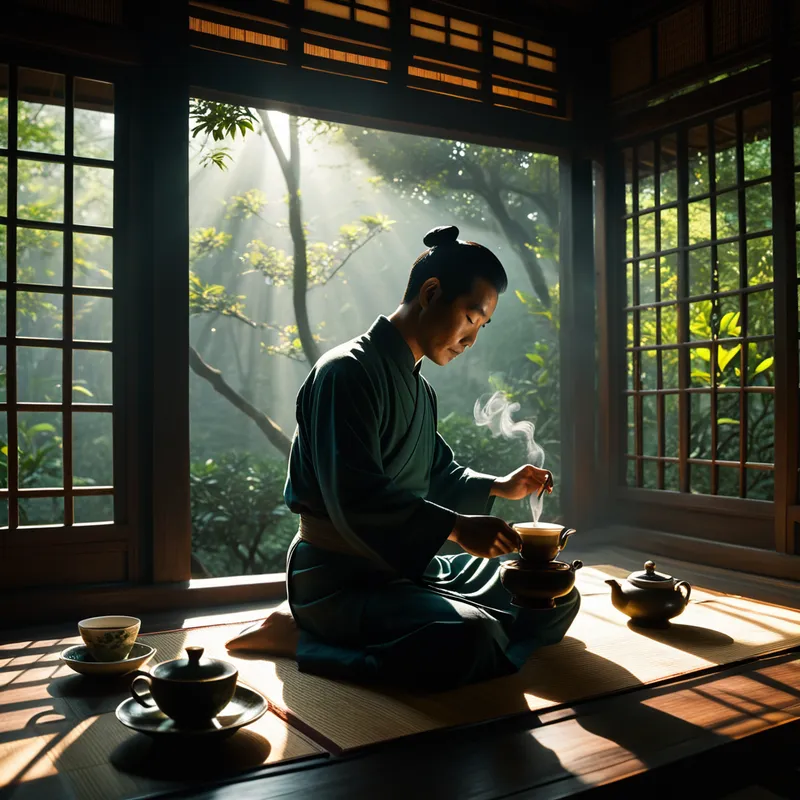
Tea Ceremony Myth Meaning & Symbolism
A ritual of profound simplicity where host and guest meet in a fleeting moment of perfect harmony, transforming the mundane act of drinking tea into sacred communion.
The Tale of Tea Ceremony
Listen. Before the first whisk stirs the emerald powder, there is a silence so deep it hums. It is the silence of the mountain before the hermit descends, the silence of the stream before it finds the stone. This is not a story of gods with flaming swords, but of mortals who dared to make a temple of a single breath.
In a world of clashing swords and shifting alliances, there lived those who sought a different kind of mastery. They were not samurai of the battlefield, but warriors of the inner realm. Their dojo was a small, thatched hut, their weapon a bamboo ladle, their opponent the chaos of their own mind. The central figure is not one person, but an ideal: the teishu, the host. And the guest, the kyaku, who arrives not to be served, but to awaken.
The conflict is the world itself—its noise, its pride, its relentless rush. The rising action is the journey to the nijiriguchi, the crawl-door. To enter, the general must shed his armor, the merchant his ledger, the noble his title. On hands and knees, all become equal, leaving the dust of the ordinary world outside.
Inside, the air is cool and smells of aged wood and charcoal. The only sounds are the hiss of the iron kettle—the kama—and the soft fall of ash. The host moves with a gravity that seems to bend time itself. Each gesture—lifting the natsume, folding the fukusa, whisking the tea into a jade froth—is not performed, but offered. It is a silent dialogue written in air and water.
The resolution arrives not with a shout, but with a sip. The guest receives the bowl, turns it in their hands, honoring its unique imperfection, and drinks. In that moment, the bitter green taste on the tongue is the taste of the present, unadorned and complete. The ceremony ends as it began, in profound silence. The guest departs through the garden, the morning dew on the moss now seen with new eyes. The ritual is over, but the world has been subtly, irrevocably changed. The conflict of self and other, of doing and being, has found a temporary, perfect truce in a bowl of tea.
Cultural Origins & Context
This "myth" is not a singular narrative etched in ancient scrolls, but a living practice whose philosophy was codified and elevated to an art form in the 16th century by the great tea master Sen no Rikyū. Emerging from the fusion of Chinese Zen Buddhist monastic rituals, native Shinto reverence for purity, and the austere aesthetic of the samurai class, the tea ceremony—chadō or sadō—became a cultural crucible.
It was passed down not merely as a set of rules, but as a somatic transmission from master to disciple, a kinesthetic poetry. Its societal function was multifaceted: it was a sanctuary for political rivals to meet on neutral, sacred ground; a spiritual discipline for warriors seeking equanimity before death; and a profound aesthetic statement that rebelled against opulence in favor of wabi-sabi—the beauty of the imperfect, impermanent, and incomplete. It served as a microcosm of an idealized society, governed by harmony, respect, purity, and tranquility.
Symbolic Architecture
At its core, the myth of the tea ceremony is a symbolic map for achieving a state of pure, unmediated presence. Every object and action is an archetypal signpost.
The chashitsu itself is the axis mundi, a temporary universe ordered by intention. The crawl-door is the birth canal into this new consciousness, a ritual death of the ego. The utensils, often simple, asymmetrical, or even cracked, are not mere tools but vessels of wabi-sabi, honoring the beauty of wear, age, and flaw—a radical acceptance of the shadow and the passage of time.
The ceremony is not about drinking tea, but about drinking the moment. The bowl is not a container for liquid, but for the soul's temporary stillness.
The host, the teishu, represents the conscious ego in service to the Self—performing a meticulous, selfless ritual to create a vessel for connection. The guest represents the receptive other, the world, or even the host's own unconscious, invited in and honored. The act of sharing the single bowl is the ultimate symbol of non-duality; for a moment, the boundary between self and other dissolves in a shared, sensory experience.
The Dreamer's Resonance
When this myth stirs in the modern dreamer, it often manifests not as a literal tea ceremony, but as a profound yearning for ritual, order, and mindful connection amidst life's chaos. To dream of meticulously preparing a space, of handling simple objects with intense care, or of sharing a silent, meaningful drink with another, signals a psyche engaged in a somatic process of re-collection.
The body in such dreams is often calm, movements deliberate. This reflects a psychological process of integrating fragmented parts of the self. The dreamer may be, in their waking life, overwhelmed by digital noise, superficial interactions, or a sense of existential haste. The dream-ritual is the psyche's attempt to create a temenos, a protected space where the soul can gather itself. It is a somatic prayer for purity (clarity of intention), respect (for oneself and one's inner processes), and tranquility. The dream is an invitation to cultivate slowness and to find the sacred not in escape, but in absolute immersion in a simple, present act.
Alchemical Translation
The tea ceremony is a flawless model of psychic alchemy—the individuation process where the base metal of ordinary, distracted consciousness is transmuted into the gold of authentic presence. The entire ritual is an alchemical opus in miniature.
First, nigredo (the blackening): This is the journey through the garden, the pause at the stone basin to cleanse hands and mouth. It is the symbolic shedding of the persona, the "dirt" of the outer world. The crawl-door is the descent into the prima materia of the unconscious.
Then, albedo (the whitening): The purification. The scouring of the bowl, the precise folding of the cloth. Every action in the serene room is a purification of thought, a whitening of the psyche, burning away impurity through focused attention.
Citrinatio (the yellowing) and rubedo (the reddening) occur in the climax. The whisking of the vibrant green powder—a yellowing into a new, vital substance—and the sharing of the bowl, which represents the rubedo, the final stage of conjunction. Here, the opposites are married: host and guest, action and receptivity, bitterness and sweetness, art and nature, the individual and the communal.
The alchemy is complete not when the tea is made, but when the moment is fully lived and then released. The ultimate transmutation is the realization that enlightenment is not a permanent state, but a series of perfectly attended, fleeting moments.
For the modern individual, the myth teaches that transformation is not a grand, one-time hero's journey, but a daily, humble practice. It is the alchemical translation of chaos into order, of encounter into communion, of time into timelessness, performed with nothing more than hot water, powdered leaves, and unwavering attention. The goal is not to possess the gold, but to become, however briefly, the vessel in which the transformation can occur.
Associated Symbols
Explore related symbols from the CaleaDream lexicon: