The Dream of Mindfulness: The Stillness at the Heart of the Storm
The Somatic Echo
Before it is a concept, mindfulness is a felt sense—a subtle but profound shift in the body’s atmosphere. It is not the absence of noise, but a sudden, deep resonance within it. In the dream state, this often manifests as a visceral sensation of pregnant silence. The dream-body feels heavy, yet weightless; porous, yet defined. There is a slowing of the internal clock, a drop in pressure behind the eyes, a settling in the gut. It is the somatic echo of the psyche turning its gaze inward, not to analyze, but simply to be with. The breath you may not have noticed becomes the anchor; the heartbeat, a distant, steady drum. This is the pre-cognitive ground from which the dream of mindfulness grows—a felt shift from being lost in the narrative to becoming aware of the space in which the narrative unfolds.
The Dreamer's Log
The dreamer stands in the center of a vast, silent data sanctum. Monolithic pillars of obsidian and brass hum with cascading streams of light—information, memories, anxieties flowing in perpetual, chaotic motion. In the dreamer’s hand rests a single, cold, brass key. The imperative is not to insert it, but to simply hold it, to feel its weight and texture, while watching the frantic light show without attempting to decipher a single line.
In the alchemical vessel of this dream, the key is not for unlocking, but for grounding; the act of holding stillness amidst the system’s noise is the first transmutation of raw data into sovereign awareness.

The False Lead
Mindfulness in dreams is not passivity. It is not spiritual bypassing dressed in the robes of calm. A dream of watching a catastrophe unfold with detached curiosity is not mindfulness; it is dissociation. The core distinction lies in the quality of presence. True dream-mindfulness carries a subtle but potent charge of engaged witnessing. You are not floating above the fray; you are rooted within it, feeling the tremors without becoming the earthquake. It is the difference between ignoring a crying child in a dream and sitting beside it, offering the silent, unwavering acknowledgment of its distress without immediately rushing to fix it. The false lead is the lure of numbness, which promises peace but delivers emptiness. The real path is one of vibrant, compassionate neutrality.
Psychological Architecture
Beneath the serene surface of the mindful dream lies the intense architecture of Shadow work. To witness without judgment is to invite every exiled part of the self—the anxious child, the furious critic, the ashamed protector—into the room of awareness. This is the essence of the Internal Family Systems model, played out on the dream stage. The mindful dream-space becomes a holding environment for these “parts.” You do not become the angry one or the scared one; you become the Self—the conscious, compassionate presence that can finally say, “I see you. You are here.” This is the individuation process in its most grounded form: not a heroic conquest of the unconscious, but a gradual, fearless befriending of it. The pressure here is immense—it is the heat of allowing shame to exist, of letting grief breathe, of observing obsession without feeding it. It is the alchemy of turning identification into observation, and observation into integration.
Mythic Resonance
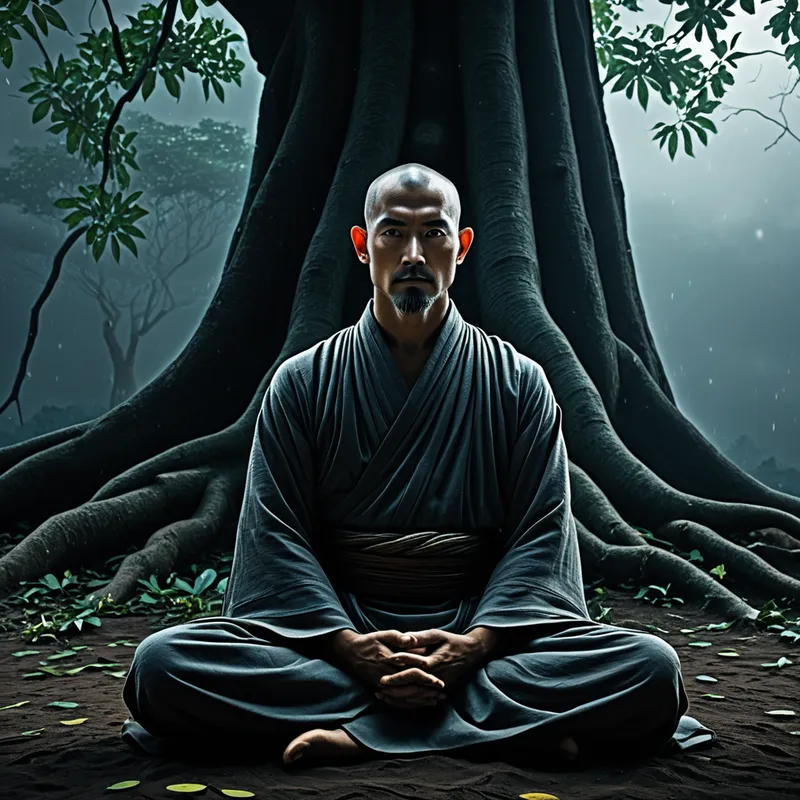
This process echoes in the myth of the Buddha beneath the Bodhi tree. Faced with the onslaught of Mara’s armies—manifestations of doubt, desire, fear, and death—the Buddha did not fight. He did not argue. He simply touched the earth. That gesture of grounding, of calling the very planet as witness to his unwavering presence, is the ultimate mythic act of mindfulness. He acknowledged the terrifying projections of his own psyche without being claimed by them, allowing them to pass through the open space of his awareness. Similarly, in the Greek tradition, the Oracle at Delphi demanded the seeker first “Know Thyself”—not as an intellectual pursuit, but as a state of purified, receptive presence necessary to receive the chaotic, poetic truths of the god. Both myths frame mindfulness not as an end, but as the essential, grounded beginning of any true transformation.
Symbolic Nodes
- Perfectly Still Water or Mirrors: Reflecting reality without distortion, symbolizing the clear, non-reactive mind.
- A Single, Unmoving Object in a Chaotic Scene: An anchor—a stone, a key, a lone tree—representing the stable witness.
- Watching from a Balcony or Window: The self observing the internal drama from a place of slight, compassionate separation.
- A Slow, Measured Breath or Heartbeat Audible Over Noise: The somatic anchor becoming the primary reality.
- A Vast, Empty Space (Room, Plain, Sky): The consciousness that contains all experience.
- A Silent Guide who Only Observes: An archetypal representation of the witnessing Self.
Archetypal Resonance
The energy of mindfulness resonates most powerfully with The Sage Archetype. The Sage’s core desire is to find the truth through understanding and awareness, not through action or possession. This mirrors the mindful dream’s essence: a shift from doing to knowing, where knowing is a deep, intuitive seeing. The somatic echo of stillness is the Sage turning inward to consult the inner library of being. The alchemical potential lies in the Sage’s gift: using the light of awareness to dispel the shadows of illusion and reaction, transforming the leaden chaos of unconscious impulse into the gold of conscious insight. The shadow of the Sage—the Dogmatic or Judgmental voice—is precisely what mindfulness dissolves; it is the part that thinks it already knows, thereby closing off the fresh, curious, and non-judgmental observation that is the theme’s true heart.
The Alchemical Process
The transmutation here is from identification to presence. The raw material is the psyche’s habitual, sticky entanglement with its own contents—thoughts as facts, feelings as commands. The prima materia is the moment of unconscious suffering. The applied heat is the conscious, sustained effort to pause. This pause is the crucible. It is not comfortable; it is the pressure of allowing an impulse to arise without obeying it, of feeling a wave of sadness without constructing a story around it. In this white-hot space of intentional stillness, the elements of the psyche begin to separate. Thought from thinker, emotion from reactor, sensation from identifier. The solve (dissolution) is the unbinding of the self from its patterns. The coagula (recombination) is the integration of these observed parts back into a whole that is now conscious, sovereign, and spacious. The gold produced is not enlightenment, but sovereignty: the capacity to choose your relationship to your inner world.
The Integration Protocol
Question 1: In the dream, what was the one thing I was able to simply observe without immediately needing to change, fix, or flee from?
Question 2: Where in my waking body do I feel the echo of that dream stillness—and where do I feel the resistance to it?
Question 3: If the part of me that wants to analyze or control the dream could sit down and simply watch with the part that is afraid, what would they silently witness together?
Action 1 (Somatic Anchoring): For one minute today, place your hands flat on a solid surface—a desk, a wall, the ground. Feel only the points of contact, the temperature, the pressure. When your mind wanders, return to the literal, physical sensation of support. This grounds the witness in the body.
Action 2 (Unstructured Witnessing): Set a timer for five minutes. With a pen and paper, allow yourself to write down every thought, sensation, or image that arises. Do not craft sentences. Use fragments, symbols, single words. The instruction is not to create a narrative, but to document the flow of consciousness as an observer would catalog phenomena.
Action 3 (Ritual of Spaciousness): Clear a small, defined physical space—a shelf, a corner of a table. Place upon it a single, simple object (a stone, a cup of water). Each day for a week, spend two minutes simply looking at this space and object. Do not clean or adjust it. Practice letting the space be, and practice letting yourself be with it, without agenda. This externalizes the internal act of creating a holding environment.
Final Validation
To dream of mindfulness is to be invited into a profound and often difficult grace. It asks you to lay down the weapons of judgment and the armor of narrative, to stand vulnerably present before the raw fact of your own existence. This is not a passive or easy state; it is the most active form of courage the psyche knows. The very tension you feel—the urge to do something with the awareness—is proof of the process working, the old alloys melting in the heat of your attention. Trust the stillness that found you in the dream. It is not a retreat from your life, but the discovery of the deep, sovereign ground from which a truly authentic life can finally be built. You are not becoming empty; you are becoming spacious enough to hold it all.