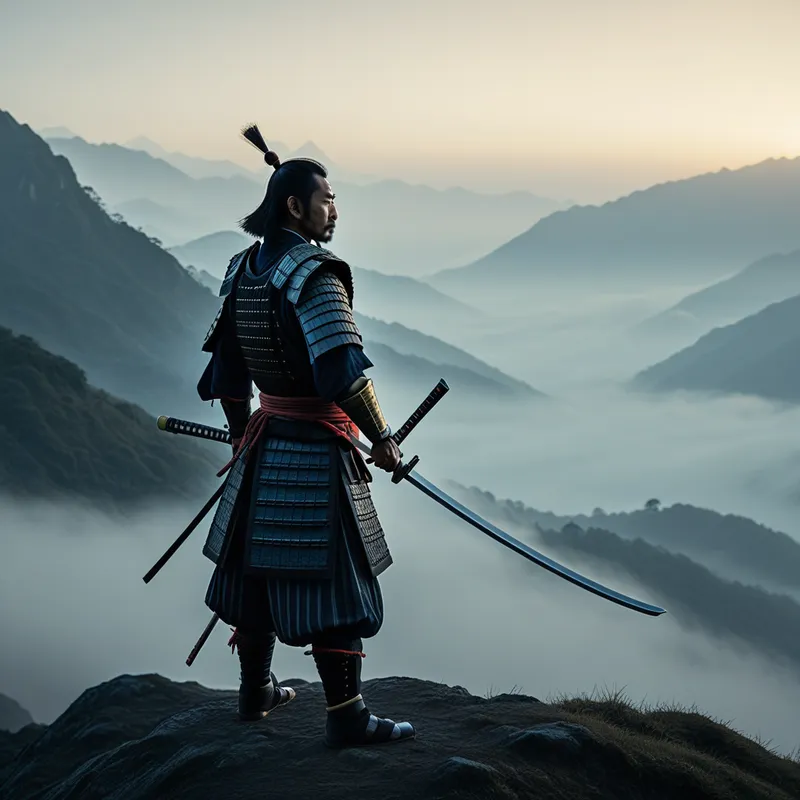
Samurai Myth Meaning & Symbolism
The myth of the Samurai is the story of a warrior's soul, forged between duty and honor, death and life, to achieve a state of transcendent, disciplined peace.
The Tale of Samurai
Listen. The wind does not howl through the pines of Okuyama. It whispers a single, relentless question. In the stillness of the predawn dark, before even the birds dare to speak, a figure kneels. The air is cold enough to bite, but he does not shiver. His breath forms no cloud, for his spirit has drawn it all inward, to a single, still point.
This is the Samurai. His world is not one of grand, single battles, but of ten thousand mornings like this. His castle is his posture. His army is his breath. Before him lies his soul given steel form: the katana. Its curve is the arc of the moon, its edge the line between life and death. He polishes the blade not to make it sharp—it is already sharp enough to split a falling hair—but to polish the mirror of his own mind. Any flaw in the steel, any ripple in the polish, reveals a flaw in his spirit. This is his first duty: to know himself, utterly.
The conflict is never merely with the rival clan on the far hill. The true enemy resides within the fortress of his own heart: the trembling fear, the hot surge of anger, the clinging fog of doubt. The rising action is the daily siege against these inner rebels. He practices the kata until his muscles sing with memory, until the sword is no longer a tool in his hand but an extension of his will. He studies poetry to give voice to the fleeting beauty of the cherry blossom, knowing it will fall. He sits in zazen, facing the wall of his own unconscious, watching thoughts rise and fall like waves, learning not to be swept away.
Then comes the moment of ultimate test. Not in a glorious charge, but in a silent room. He faces his lord, or he faces an unjust death. The resolution is not victory, as the world knows it. It is the achievement of mizu no kokoro—a mind like water. In that clarity, action flows not from desire or aversion, but from a profound alignment with what must be. He may draw his sword to defend the helpless. He may choose to take his own life in seppuku to atone for a failure. Or he may simply bow, sheath his blade, and walk away. The outcome is secondary. The triumph is in the purity of the act, a soul moving through the world with the inevitable, graceful fall of the final cherry petal, detached yet perfectly committed to its path.
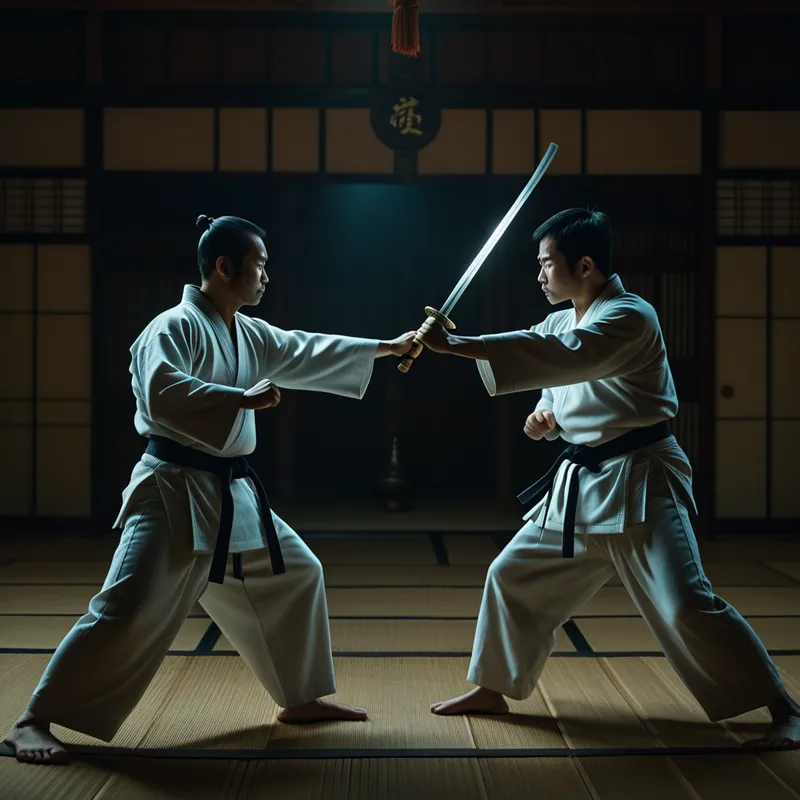
Cultural Origins & Context
The myth of the Samurai is not housed in a single epic poem like the Iliad, but is woven into the very fabric of Japanese history and aesthetics from the late Heian period through the Edo era. It is a historical reality that was consciously mythologized, a social class that became a psychological archetype. The tales were passed down through gunki monogatari like The Tale of the Heike, which lamented the fall of the Taira clan with Buddhist-infused sorrow, and through the direct lineage of martial schools (ryūha).
Its primary tellers were the samurai themselves, through their codes (Bushidō), their death poems (jisei), and their patronage of Noh theater, tea ceremony, and ink painting. The myth served a critical societal function: it provided an ethical and spiritual framework for a warrior aristocracy, transmuting the brute reality of violence and political service into a path of moral cultivation and artistic sensitivity. It answered the central existential dilemma of a life dedicated to mastery and mortality: how to live, and die, with meaning.
Symbolic Architecture
Psychologically, the Samurai represents the conscious ego's journey toward integration, where discipline is not repression but the art of channeling primal forces. The Samurai's armor is the persona—the necessary, structured face shown to the world. The katana is the discriminating intellect and will, a tool of immense power that must be constantly refined and ethically directed.
The greatest battle is fought in the silent dojo of the self, where the warrior faces the shadow not to destroy it, but to understand its place in the whole.
The core conflict is the tension between giri and ninjō. This is the eternal human struggle between the demands of the collective (society, family, duty) and the desires of the individual heart. The myth does not offer an easy resolution, but a path of bearing the tension honorably. The ultimate symbol is not the bloodied blade, but the sheathed sword. Mastery leads to restraint. True strength is revealed in the ability to not strike, to hold the power of life and death in perfect equilibrium—a state of dynamic, poised stillness.
The Dreamer's Resonance
When this myth stirs in the modern dreamer, it often signals a profound confrontation with the psyche's need for discipline, integrity, and conscious choice. Dreaming of a samurai may not be about literal combat, but about facing an internal or external situation requiring unwavering principle and courage.
The somatic process is one of centering. The dreamer may feel a tightening in the hara, a grounding pressure. Psychologically, it is the process of "polishing the mirror"—confronting aspects of the self that are clouded by fear, procrastination, or self-deception. A dream of a broken katana may speak to a perceived loss of personal power or integrity. A dream of performing a flawless kata suggests the integration of complex life skills into effortless, instinctual action. The samurai in dreams calls the dreamer to account, to adopt a stance of rigorous self-honesty and to prepare for a necessary, decisive action in their waking life.
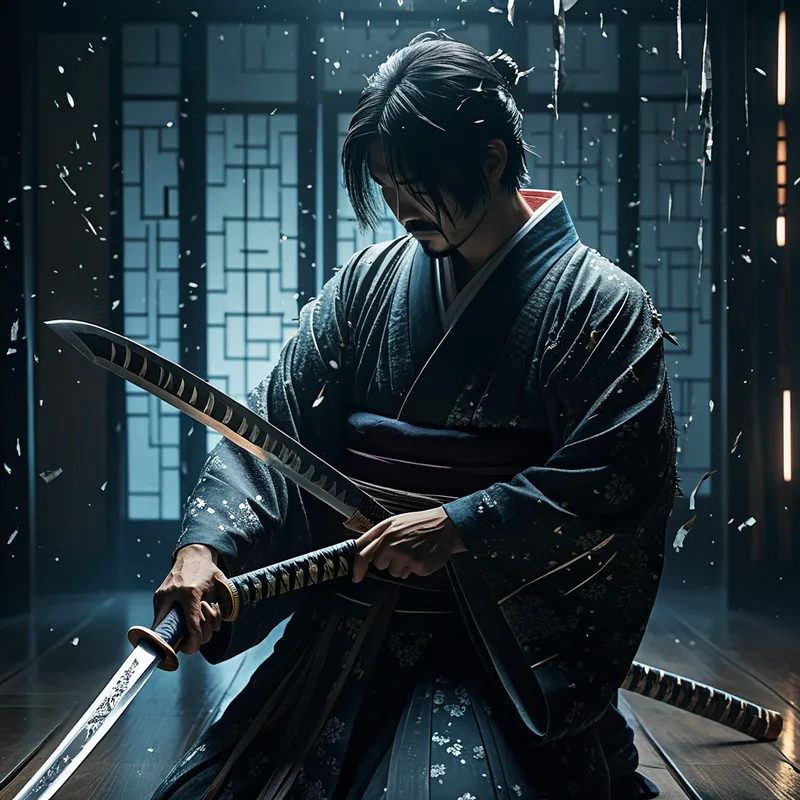
Alchemical Translation
The Samurai's path is a precise alchemical recipe for psychic transmutation. The base metal of the raw, untamed psyche—full of chaotic impulses, fears, and desires—is subjected to the fierce, contained fire of discipline (shugyō). This is the nigredo, the blackening, the confrontation with the shadow in the lonely dojo of introspection.
Individuation is the forging of the soul: the heat of conflict, the hammer of discipline, and the quenching in the waters of acceptance, producing a blade that is both unbreakable and flexible.
The repeated practice of kata and meditation is the albedo, the whitening, where patterns are purified and consciousness is refined. The moment of clear, unattached action—whether in crisis or in creation—is the rubedo, the reddening, the gold of the integrated Self. The ultimate goal is not to become a weapon, but to become the artist of one's own life. The katana is then laid down, or used only to cut through illusion. The warrior becomes a sage, whose battlefield is the human heart, and whose victory is a profound, compassionate peace that understands the cost of its own existence. The modern individual walks this path whenever they choose rigorous self-development over complacency, ethical action over convenience, and meet life's inevitable endings with a spirit of conscious, graceful acceptance.
Associated Symbols
Explore related symbols from the CaleaDream lexicon: