Sin Myth Meaning & Symbolism
The myth of Sin, the luminous Moon God, reveals a cosmology where wisdom, time, and kingship are born from the rhythmic journey through darkness.
The Tale of Sin
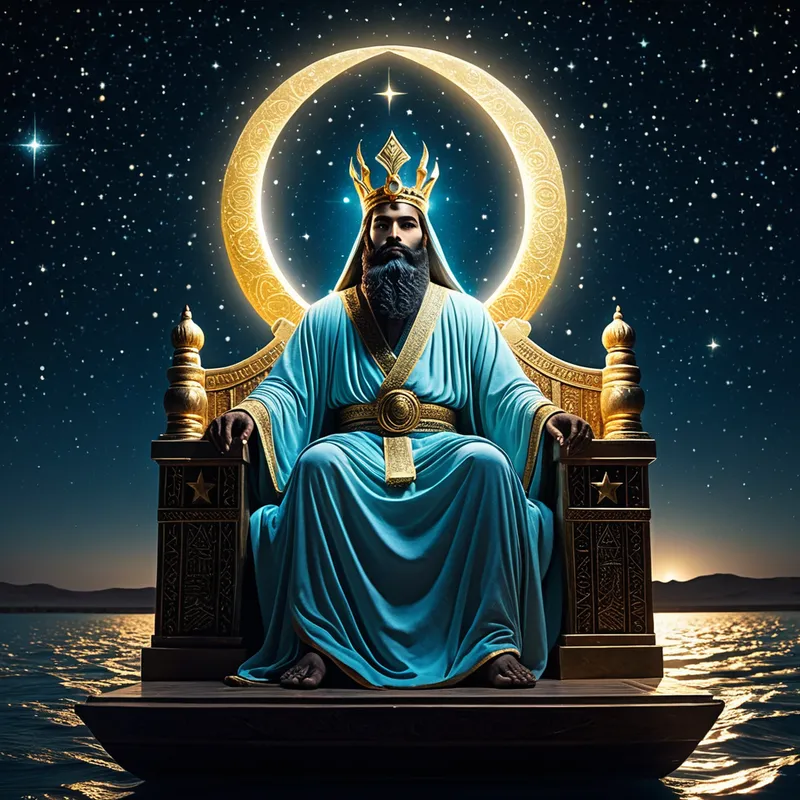
Hear now the tale of the Measurer, the Illuminator of the Night, the Lord of the Secret Oracle. Before the first king took up his scepter, before the first city raised its walls to the sun, there was the darkness. And in that darkness, a slow, silent boat began to sail.
It was not a boat of wood and pitch, but of lapis lazuli and electrum, and its passenger was no mortal man. He was Sin, whose beard was the flow of the night river, whose crown was the sharp, silver crescent that hooks the fabric of the sky. His light was not the fierce, revealing blaze of Utu, but a cool, contemplative glow that silvered the edges of things, that made the world soft and full of secrets.
For twenty-nine nights, he would wane, his luminous boat growing slender, a sliver of pearl dissolving into the star-salted black. The world below held its breath. The wild beasts grew bold, and shadows stretched long, whispering of chaos. This was the time of the unseen, of oracles muttered in sleep, of decisions ripening in the dark womb of potential.
Then, on the thirtieth night, from the deepest dark, a miracle. A thin curve of light would pierce the veil. Sin was reborn. His boat would fatten with light, swelling to a radiant, full disc—a shining melammu that bathed the sleeping land, revealing the contours of the earth, calming the restless, and marking the passage of time itself. He sailed his appointed course, a celestial shepherd not of sheep, but of months and seasons, of tides in the womb and tides in the soul.
His most precious cargo was wisdom. In his city of Ur, by the reeds of the great river, he bestowed the art of the bārû—the reading of livers, the flight of birds, the patterns in oil on water. His light fell upon the wet clay, and the scribe’s stylus moved, inscribing the law, the hymn, the star-catalog. He was the silent witness, the keeper of accounts divine and human. And when a king would rise, it was Sin who would place in his hand the true scepter: not merely power, but the measured, cyclical wisdom to wield it, a wisdom drawn from the very rhythm of appearing and disappearing, of knowing when to shine and when to retreat into fruitful dark.
Cultural Origins & Context
This was not a bedtime story, but the bedrock of reality for the peoples of Sumer, Akkad, and Babylon. The myth of Sin is woven into thousands of years of theology, royalty, and daily life, preserved on countless cuneiform tablets from temple archives. As the god Nanna-Suen, he was a central pillar of the Anunnaki.
His primary cult center was the great ziggurat of Ur, a man-made mountain aiming to touch his celestial realm. Here, a powerful priesthood maintained the precise rituals to ensure his cyclical journey—and thus the order of time—continued uninterrupted. The myth functioned as a cosmic clock and a divine mandate. Kings from Ur-Nammu to Nabonidus explicitly tied their legitimacy to Sin’s favor, portraying themselves as his chosen sons, ruling with the “wisdom” and “long-lasting days” he bestowed.
The myth was passed down not around campfires, but in scribal schools, temple liturgies, and royal inscriptions. It was a living doctrine that explained the universe: time was not linear, but a sacred, repeating loop governed by a benevolent, calculable intelligence in the sky.
Symbolic Architecture
At its core, the myth of Sin is a profound symbol of consciousness itself, not as a constant sun, but as a rhythmic, reflective light.
The moon does not generate light; it receives and reflects it. Thus, true wisdom is not invention, but reception—a reflective capacity born of cyclical withdrawal.
Sin represents the lunar principle of the psyche. This is the intelligence of cycles, intuition, reflection, and the unconscious. His waxing and waning mirror the natural rhythms of life—growth and decay, activity and rest, inspiration and gestation. He is the god of the in-between: between day and night, between one month and the next, between the spoken word and the silent thought.
His association with divination and oracles points to his domain as the liminal space where the unseen patterns of the future—the intentions of the gods or the deep currents of fate—become faintly visible. He is not the hero who slays the monster in bright daylight, but the sage who interprets the monster’s shadow by moonlight. His “authority” is not brute force, but the authority of natural law, of inevitable rhythm, of knowing the right time for all things.
The Dreamer's Resonance
When this myth stirs in the modern dreamer, it often manifests not as a clear image of a bearded god, but as a profound somatic experience of phase.
To dream of a brilliant, overwhelming full moon illuminating a dark landscape may signal a moment of deep intuitive clarity, where something hidden in the psyche is brought to light. It can feel like sudden understanding, a “luminous” insight into a personal pattern or relationship. Conversely, to dream of a new moon, of a profound and empty darkness in the sky, may reflect a necessary, if frightening, period of psychic withdrawal. This is the soul’s winter, a time when conscious identity wanes to allow for unconscious restructuring. The dreamer may feel lost, without guidance, or creatively barren.
The recurring symbol of the boat is crucial. Dreaming of a small vessel moving calmly through darkness suggests the dreamer is in the midst of a transitional phase, carried by a deeper, rhythmic process they do not control but must trust. Anxiety in such dreams often stems from the ego’s resistance to this natural cycle, its fear of the dark phase where it is not in charge.
Alchemical Translation
For the individual on the path of individuation, the myth of Sin models the alchemy of integrating the lunar consciousness. Our modern world worships the solar principle: constant output, perpetual visibility, unwavering identity. The individuation process requires us to reclaim the moon.
The alchemical work is not to forever shine, but to learn the sacred art of waning—to willingly enter the dark nigredo where the old, rigid ego-structures dissolve, so that a new, more authentic consciousness can be born.
The first step is observation and measurement—Sin’s primary function. This is the practice of self-reflection, of keeping a journal, of noting one’s own inner cycles of energy, mood, and creativity without immediate judgment or intervention. It is becoming the scribe of one’s own soul.
The second is honoring the dark phase. Psychic growth is not linear. The myth teaches that retreat, depression, confusion, and fallow periods are not failures, but essential, fertile parts of the cycle. This is when the unconscious does its deepest work, composting old material to nourish new growth. To resist this is to fight the tide.
Finally, it is receiving and reflecting authority. The “scepter” Sin gives is not patriarchal rule over others, but inner sovereignty born of this cyclical wisdom. It is the authority that comes from knowing one’s own rhythms, trusting one’s intuition (the “oracle”), and acting in alignment with one’s deeper, timed nature rather than external demands. One becomes a ruler not of a kingdom, but of one’s own being, illuminated not by the harsh, constant light of persona, but by the gentle, revealing, and merciful light of the Self, waxing and waning in its own perfect, mysterious time.
Associated Symbols
Explore related symbols from the CaleaDream lexicon: