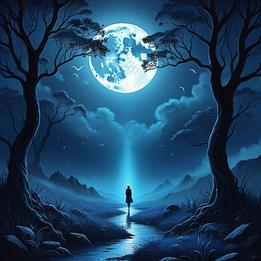
Moonlight
Moonlight represents illumination of the unconscious, creative inspiration, and the cyclical nature of life and emotions.
Moonlight Dream Meaning
Moonlight represents illumination of the unconscious, creative inspiration, and the cyclical nature of life and emotions.
Interpretive Themes
Unconscious Revelation
highMoonlight exposes what daylight conceals.
Cyclical Change
highReflects lunar cycles and personal transitions.
Creative Inspiration
mediumAssociated with nocturnal creativity and muses.
Connection
mediumSoft light fostering vulnerability and connection.
Spiritual Guidance
lowOften linked to lunar deities and rituals.
Mythological Resonance
Selene
GreekGoddess whose moonlight chariot illuminated lovers' trysts and inspired prophetic dreams as she crossed the night sky.
Tsukuyomi
JapaneseMoon god whose silvery light revealed truth and order in the darkness, governing time and cycles.
Cultural Lenses
Global/Universal Perspective
View Context →Universally associated with night, femininity, and tides. Historically linked to lunar deities across cultures; modernly represents romance and mystery in global arts.
Jungian Perspective
View Context →Symbolizes the anima (feminine aspect) and illumination of the collective unconscious. Represents intuitive wisdom and the shadow self revealed through indirect light.
East Asian Perspective
View Context →In Chinese and Japanese traditions, moonlight signifies poetic inspiration, seasonal festivals (Mid-Autumn), and transient beauty. Associated with yin energy and artistic refinement.
South Asian Perspective
View Context →Linked to Hindu moon god Chandra, governing emotions and mind. In rituals, moonlight purifies; in modern Bollywood, it romanticizes nocturnal scenes.
Middle Eastern Perspective
View Context →Historically, Islamic lunar calendar marks sacred times; moonlight in Persian poetry symbolizes beloved's face. Modernly, it retains spiritual and romantic connotations.
European Perspective
View Context →In folklore, associated with werewolves and madness (lunacy). Romantic era arts glorified moonlight for sublime beauty; now common in Gothic and fantasy genres.
African Perspective
View Context →Many traditions view moonlight as time for storytelling, rituals, and community gatherings. Symbolizes ancestral guidance and natural cycles in oral histories.
North American Perspective
View Context →Indigenous cultures see moonlight as feminine power and dreamtime. In contemporary arts, it evokes nostalgia, frontier nights, and cinematic romance.
Latin American Perspective
View Context →In Mesoamerican myths, moon deities like Coyolxauhqui govern cycles. Modernly, moonlight inspires magical realism in literature and festive nocturnal celebrations.
Oceanian Perspective
View Context →Polynesian navigation used moonlight; Aboriginal Dreamtime stories feature moon ancestors. Today, it symbolizes connection to sea and land in Pacific arts.
Modern Western Perspective
View Context →Often commercialized for romance (e.g., moonlight dinners). In psychology, represents introspection; in environmental movements, symbolizes natural light preservation.
Freudian Perspective
View Context →Interpreted as sexual symbolism (feminine receptivity) and repressed desires emerging in dreams. Moonlight softens reality, allowing subconscious wishes to surface.
Gestalt Perspective
View Context →Viewed as part of the dreamer's whole self—perhaps representing a need for gentle awareness or integration of hidden aspects into conscious life.
Cognitive Perspective
View Context →Seen as mental processing of low-light experiences, memory consolidation during sleep, or metaphor for unclear thoughts becoming gradually illuminated.
Evolutionary Perspective
View Context →Rooted in ancestral adaptation to lunar cycles for navigation, safety, and social activities at night. May trigger innate responses to low-light environments.
Historical Authorities
Want a deeper analysis?
Get a personalized interpretation of your entire dream including this symbol.
Interpret My DreamThe Oracle's Prediction
Combine multiple symbolsDeepening of an existing emotional connection or self-understanding.
Timeframe
Lunation (~29 Days)
Intensity
Deep
Common Appearances & Contexts
| Context | Emotion | Interpretation |
|---|---|---|
| Context Walking alone | Emotion contemplative | Interpretation Self-reflection and solitude. |
| Context Meeting someone | Emotion romantic | Interpretation Emotional intimacy emerging. |
| Context Creating art | Emotion inspired | Interpretation Creative flow activated. |
| Context Lost in woods | Emotion anxious | Interpretation Uncertain path ahead. |
| Context Water reflection | Emotion peaceful | Interpretation Inner harmony achieved. |
| Context Dancing freely | Emotion joyful | Interpretation Uninhibited self-expression. |
| Context Old house | Emotion nostalgic | Interpretation Past memories resurfacing. |
| Context Chasing shadow | Emotion frustrated | Interpretation Elusive self-understanding. |
| Context Singing softly | Emotion melancholic | Interpretation Emotional release occurring. |
| Context Climbing hill | Emotion determined | Interpretation Progress through darkness. |
| Context Watching stars | Emotion awestruck | Interpretation Cosmic connection felt. |
| Context Hiding object | Emotion secretive | Interpretation Concealed truths present. |
Interpret Your Full Dream
Beyond this symbol, every dream carries a unique story. Share your dream for a personalized AI-powered interpretation.