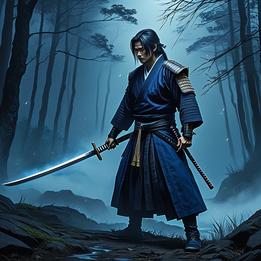
Katana
A traditional Japanese sword symbolizing honor, discipline, and the duality of creation and destruction. It represents the warrior's soul and the sharp edge of decisive action.
Katana Dream Meaning
A traditional Japanese sword symbolizing honor, discipline, and the duality of creation and destruction. It represents the warrior's soul and the sharp edge of decisive action.
Interpretive Themes
Cultural Lenses
Jungian Perspective
View Context →Represents the archetype of the Warrior or the Hero, embodying focused will, conscious action, and the disciplined ego confronting the shadow. The sharp edge symbolizes discrimination and the ability to make clear psychic cuts.
Freudian Perspective
View Context →A potent phallic symbol representing masculine power, aggression, and sexual potency. Its sheathing and unsheathing may symbolize sexual intercourse, while its use could indicate repressed aggressive or competitive urges seeking expression.
Gestalt Perspective
View Context →You are the katana. What part of you is this sharp, disciplined tool? Perhaps it's your intellect, your decisive will, or a skill you've honed. The dream explores your relationship with this aspect of yourself—is it integrated or threatening?
Cognitive Perspective
View Context →Likely reflects waking-life thoughts about precision, cutting through complexity, or facing a high-stakes decision. The brain uses this familiar, culturally-loaded symbol to process concepts of risk, control, expertise, and moral boundaries.
Evolutionary Perspective
View Context →Taps into deep-seated adaptations for tool use, hierarchical status, and threat assessment. The katana symbolizes an ultimate survival tool, triggering responses related to dominance, skill-based prestige, and the management of lethal conflict within social groups.
East Asian Perspective
View Context →In Japan, the katana is the 'soul of the samurai,' inseparable from bushido (the warrior's code) of loyalty, honor, and self-discipline. It is a spiritual art object, representing the wielder's character. Modernly, it remains a potent national and cultural icon.
Global/Universal Perspective
View Context →Universally recognized as a symbol of supreme martial skill, lethal power, and honor. It transcends its Japanese origin to represent the idealized warrior, the master craftsman, and the razor's edge between life and death in global consciousness.
Modern Western Perspective
View Context →Heavily influenced by cinema and anime, it symbolizes cool, detached expertise and hyper-competence. It can represent a fantasy of absolute control, aesthetic minimalism, or a fascination with Eastern philosophy, often divorced from its historical moral context.
European Perspective
View Context →Viewed through a lens of historical chivalry and the knightly sword, but with exoticism. It represents a foreign, refined form of martial honor often associated with mystery, precision engineering, and a different philosophical approach to war and personal conduct.
South Asian Perspective
View Context →May resonate with concepts of the 'khanda' or other divine weapons (astras) from Hindu epics. Can symbolize dharma (righteous duty), the destructive power of time (Kala), or a tool of divine justice wielded by a warrior following their sacred path.
Middle Eastern Perspective
View Context →Could be analogized to the scimitar or shamshir, symbols of sovereignty, justice, and martial prowess. May connect to themes of spiritual jihad (struggle) as an internal battle, with the sword representing the discipline needed to fight one's lower self.
African Perspective
View Context →While not indigenous, as a symbol it may parallel ceremonial weapons like the throwing knife or sickle sword, denoting status, authority, and the protector role. It can represent a formidable, acquired skill or technology that commands respect and defines social role.
Want a deeper analysis?
Get a personalized interpretation of your entire dream including this symbol.
Interpret My DreamCommon Appearances & Contexts
| Context | Emotion | Interpretation |
|---|---|---|
| Context Forging a katana | Emotion Determination | Interpretation Crafting your purpose. |
| Context Receiving a katana | Emotion Honor | Interpretation Accepting a great responsibility. |
| Context Drawing a katana | Emotion Resolve | Interpretation Committing to a path. |
| Context Cleaning a katana | Emotion Reverence | Interpretation Maintaining your integrity. |
| Context A broken katana | Emotion Despair | Interpretation Loss of honor or failure. |
| Context Sparring with katana | Emotion Focus | Interpretation Testing your skills. |
| Context Sheathing a katana | Emotion Peace | Interpretation Conflict resolution achieved. |
| Context A katana on display | Emotion Awe | Interpretation Admiring perfected form. |
| Context Losing a katana | Emotion Shame | Interpretation Betrayal of self. |
| Context A bloodied katana | Emotion Guilt | Interpretation Consequences of actions. |
| Context A katana in shadow | Emotion Apprehension | Interpretation Hidden power or threat. |
| Context Gifting a katana | Emotion Trust | Interpretation Passing on legacy. |
Interpret Your Full Dream
Beyond this symbol, every dream carries a unique story. Share your dream for a personalized AI-powered interpretation.