
Samson from Hebrew mythology Myth Meaning & Symbolism
A hero of divine strength, bound by a sacred vow, is undone by love and betrayal, finding his ultimate power only in total surrender.
The Tale of Samson from Hebrew mythology
Hear now the tale of the sun-born one, the man who was a weapon. Before his first cry, the air shimmered with a vow. A divine messenger came to a barren woman in the fields of Zorah and declared her son would be a Nazirite to YHWH, set apart from the womb. No razor would touch his head, no strong drink pass his lips, for his strength was not his own; it was a borrowed thunder, a sacred trust woven into the very fiber of his being.
He grew like an oak in contested soil, a judge in the days when the Philistines pressed hard upon his people. His was a raw, untamed power. He tore a young lion apart with his bare hands as if rending a kid. He slew thirty men for their garments to pay a riddle’s debt. He caught three hundred foxes, tied torches to their tails, and set the Philistine harvests ablaze, a wildfire of vengeance. When they came for him at Lehi, he found the jawbone of a donkey and with it, heaped the ground with a thousand men. He was a force of nature, a one-man army, a riddle wrapped in muscle and hair.
But his heart was his Achilles’ heel, a gate left unguarded. In Timnah, he saw a woman, and desire, that great leveler, seized him. He married her, and then another—Delilah. The lords of the Philistines came to Delilah, their whispers slithering like silver: “Entice him, and see wherein his great strength lieth.” Three times she pressed him, and three times he wove a lie—bind me with seven green withes, with new ropes, weave my hair into a loom. And three times he snapped his bonds as if they were thread.
But she pressed him daily until his soul was vexed unto death. In a moment of catastrophic intimacy, the fortress of his vow was breached. He told her all his heart: “There hath not come a razor upon mine head; if I be shaven, then my strength will go from me.” Lulled to sleep on her lap, the sacred trust was severed. The Philistines shaved the seven locks of his head, and the thunder departed. YHWH’s Spirit left him. He awoke to a weakness he had never known, and the cold bite of bronze fetters. They gouged out his eyes and set him to grind grain in the prison of Gaza, a blind beast turning a mill in endless circles.
Yet in the dark, a slow, grim miracle began. His hair began to grow.
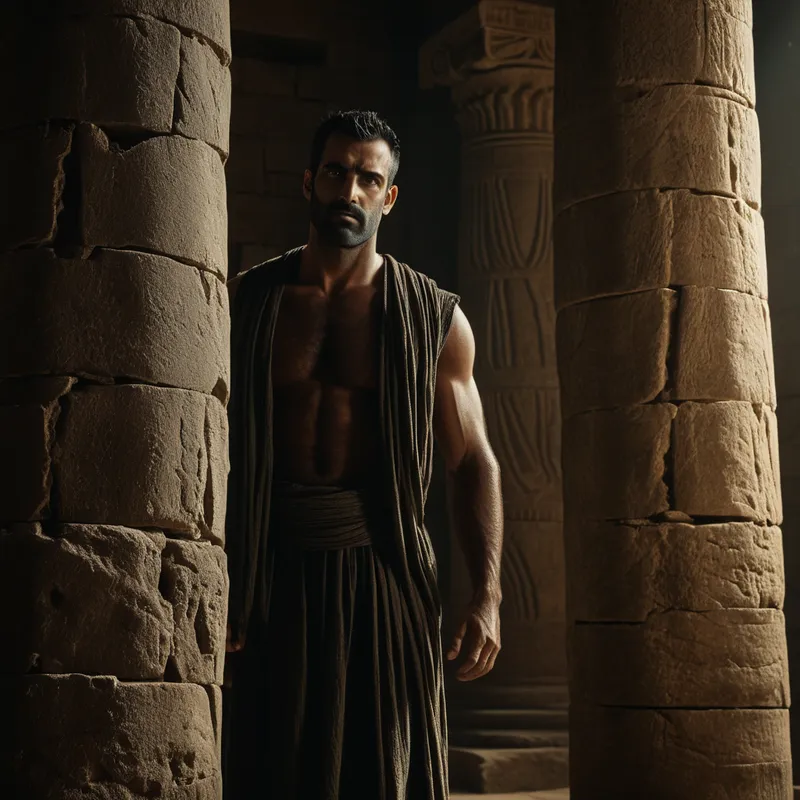
Brought out to entertain the lords in the temple of Dagon, he was a spectacle of broken divinity. Laughing crowds filled the roof. Placing his hands upon the two central pillars that held the house aloft, he called to his God one final time. “Let me die with the Philistines.” Then he bowed himself with all his might. The pillars groaned, stone cracked, and the temple fell upon the lords and all within. In that final, terrible act of surrender, his strength returned, multiplied, accomplishing more in his death than in all the battles of his life.
Cultural Origins & Context
The story of Samson is preserved in the Book of Judges (chapters 13-16), a text that chronicles a turbulent, pre-monarchic period in ancient Israel’s history characterized by a cyclical pattern of apostasy, oppression, cry for help, and divine deliverance through a “judge.” Unlike other judges who lead armies, Samson operates alone, a folkloric superhero whose exploits blend the historical with the legendary. The narrative bears the hallmarks of oral tradition—formulaic repetitions, symbolic numbers (seven locks, three deceptions), and larger-than-life feats—honed over generations before being committed to writing.
Its societal function was multifaceted. On one level, it served as an etiological tale, explaining geographical features like the “Spring of the Caller” at Lehi. On another, it was a cautionary narrative for a tribal society living under the shadow of a more technologically advanced Philistine culture. It explored the dangers of boundary violation, both national (mixing with foreign women) and personal (breaking a sacred vow). Ultimately, it was a theology of paradox, asserting that the divine purpose could be fulfilled even through a deeply flawed, violent, and passionate vessel, and that true power is contingent on faithfulness to a sacred trust.
Symbolic Architecture
Samson is the archetype of the Libido incarnate—raw, creative, and destructive potential bound by a conscious agreement (the Nazirite vow). His long hair is not merely the source of his strength but its symbol; it is the visible sign of the covenant, the conscious connection to the transpersonal source of power.
The vow is the container, and the strength is the content. Break the container, and the content spills into the unconscious, leaving the ego weak and blinded.
His relationships with Philistine women represent the psyche’s fatal attraction to its own Shadow—the “foreign” or disowned aspects of oneself. Delilah, in particular, is the anima figure who becomes possessed by the shadow (the Philistine lords). She is the soul-guide turned soul-destroyer, the intimate other who knows exactly how to untie the knot of one’s identity. The blinding is the ultimate psychological truth: severed from his source, the heroic ego is left in the dark, grinding out a meaningless, repetitive existence (samsara), utterly divorced from its purpose.
The final act at the temple of Dagon is the supreme alchemical moment. It is not a resurgence of the old, autonomous ego-strength. It is an act of total submission—a prayer. His strength returns only when he relinquishes all claim to it for his own salvation, directing it instead toward a complete destruction of the oppressive system. He becomes the sacrificial vessel through which the shadow (the Philistine oppressors) and the captive ego (himself) are destroyed together, clearing the ground for something new.
The Dreamer's Resonance
When the pattern of Samson stirs in the modern dreamer, it signals a critical engagement with the dynamics of personal power and its shadow. Dreaming of possessing immense physical strength that suddenly fails may point to a felt discrepancy between one’s outer capabilities and an inner sense of fraudulent weakness or a fear that one’s power is based on a fragile condition (like reputation, position, or a specific skill).
Dreams of being betrayed by a lover or trusted figure, particularly involving a revelation of secrets or a “cutting” action, directly mirror the Delilah complex. This is the somatic recognition of a boundary violation so profound it feels like a severing of the life-force itself. The dreamer may be in a relationship or situation where they are being “pressed daily,” coaxed into surrendering the very thing that constitutes their integrity or unique gift.
Finally, dreams of blindness, of groping in darkness while performing rote tasks, embody the post-betrayal state. This is the psyche depicting a period of necessary, if painful, incubation. The grinding in the prison is the unconscious work that happens after a fall, where, in the absence of the old heroic identity, the hair—the connection to the Self—begins its slow, unseen regrowth.

Alchemical Translation
The alchemy of the Samson myth models the Nigredo—the blackening, the decomposition—of the heroic ego. The initial phase is the inflation: the individual identified with a divine gift (talent, intellect, charisma) as their personal property. They perform great deeds, but the ego claims the glory. The vow, the conscious container, is forgotten.
The confrontation with the anima/shadow (Delilah/Philistines) initiates the mortificatio. The secret is betrayed, the container shattered, and the inflated ego is humbled, blinded, and enslaved. This is not a mistake but a necessary stage in individuation.
The prison of Gaza is the alchemical crucible. In the dark, where the ego cannot see its own hand, the true work of re-connection to the Self begins autonomously.
The final prayer and pulling down of the temple represent the sublimatio and coniunctio in their most dramatic form. The ego, now fully conscious of its dependence, actively participates in its own dissolution for a purpose greater than its own survival. It aligns its will with the will of the Self. The resulting “death” is the birth of a new psychological reality. The strength is no longer a possessed attribute but a channeled force. The myth teaches that our greatest power is often hidden in our most catastrophic surrender, and that our defining vow—our connection to meaning—must be guarded not by rigidity, but by a conscious, daily renewal, lest we grind away our lives in the dark, forgetting that our hair, and our hope, is always growing back.
Associated Symbols
Explore related symbols from the CaleaDream lexicon: