
Prince Ahmad and the Fairy Peri Banou
Prince Ahmad ventures into a magical world, encountering the enchanting fairy Peri Banou in a story of love, adventure, and supernatural challenges.
The Tale of Prince Ahmad and the Fairy Peri Banou
In the annals of the Arabian Nights, where destiny is woven by djinn and human courage alike, unfolds the story of Prince Ahmad, the youngest son of the Sultan of India. Unlike his brothers, whose ambitions were fixed upon the throne, Ahmad possessed a heart attuned to subtler frequencies. His quest began not for power, but in a simple, filial act: to retrieve a rare and mystical arrow he had loosed into the unknown. Following its improbable flight, he ventured beyond the familiar world, descending into a deep, shadowed chasm that led not to darkness, but to a realm of impossible light.
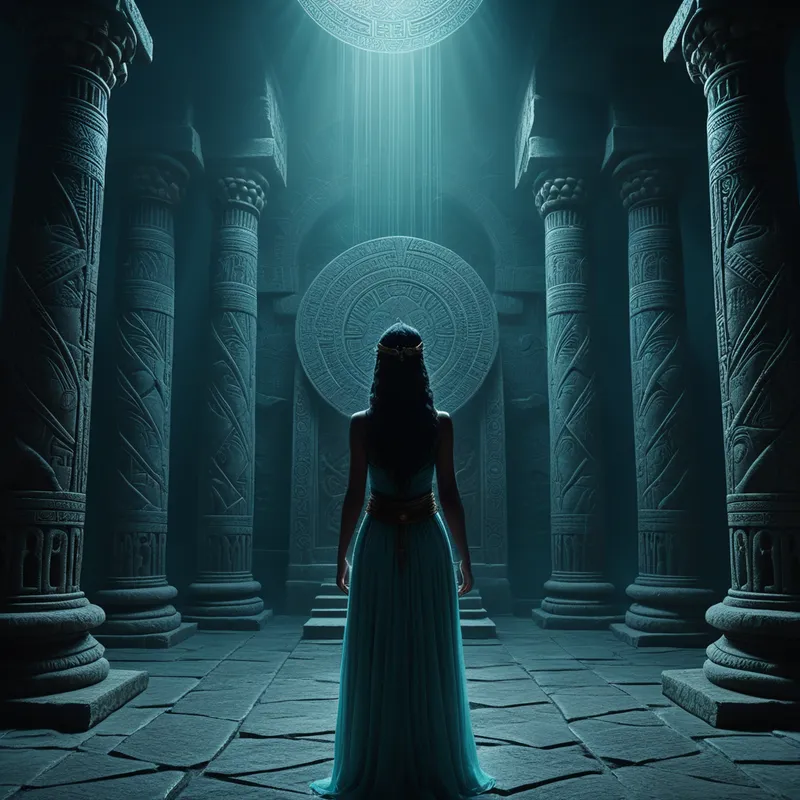
This was the domain of the Peri, the fairies of Persian lore. Here, in a palace that made the most splendid human architecture seem like mud huts, he beheld Peri Banou. She was not merely beautiful; she was an embodiment of the numinous, a creature of grace and power whose very presence recalibrated the soul. Their meeting was not one of mortal conquest but of profound recognition. In her eyes, Ahmad saw the reflection of a destiny he had always sensed but never named. She, the sovereign of a hidden world, saw in him a nobility of spirit that transcended his mortal frame.
Their love was immediate and deep, a union that dissolved the apparent boundary between the human and the fairy realms. Ahmad dwelt in her paradisiacal kingdom, a realm of peace and perpetual abundance governed by love rather than law. Yet, the human world, with its webs of envy and politics, could not be forever ignored. When Ahmad returned to his father’s court, his evident prosperity—gifts of miraculous tents and healing apples from Peri Banou’s realm—stirred not joy, but a venomous jealousy in the hearts of his brothers and their cunning advisor.
The mortal threat to their love was not a dragon to be slain, but the slow poison of suspicion and a manufactured crisis. The Sultan, manipulated by false counsel, demanded ever more impossible feats: the cure of a deadly illness, the acquisition of a man no taller than a foot yet with a voice like thunder. Each time, through the limitless magic and wisdom of Peri Banou, Ahmad succeeded, only inflaming the envy further. The final, cruel request was for a magical tent that could fold into a hand’s breadth yet shelter an entire army. Peri Banou provided even this, but with a sorrowful heart, foreseeing the mortal ingratitude it would reveal.
The climax of the tale is a quiet apocalypse. The corrupted court, in its greed, attempts to turn the fairy’s own gifts against her, demanding Ahmad surrender his wife. This transgression of the sacred bond summons the righteous wrath of the magical realm. Peri Banou does not wage war; she simply reasserts the natural order. With a command, she transforms the hostile sorceress into a stone, a permanent monument to malice, and withdraws, taking Prince Ahmad forever into her hidden kingdom. The gate between the worlds closes, leaving the mortal realm diminished, having exiled the miraculous through its own smallness of heart.
Cultural Origins & Context
The tale is embedded within the vast tapestry of the One Thousand and One Nights, a corpus that is itself a palimpsest of Persian, Indian, Arab, and Mesopotamian folklore. The figure of the Peri is distinctly Persian, originating in Zoroastrian cosmology as beautiful, beneficent spirits of nature, often in opposition to malevolent divs (demons). Their integration into this Islamic-era story reflects the syncretic nature of the Nights, where pre-Islamic mythic beings are woven into new moral and romantic frameworks.
The narrative operates within classic Islamic narrative ethics, where trials are tests of character (fitna), and ultimate success lies not in worldly power but in righteousness, trust in God (tawakkul), and often, the acceptance of otherworldly guidance. Ahmad’s journey is a spiritual itinerary: from the ordinary world, through a crisis (the lost arrow), into a supernatural aid (the Peri), and through a series of initiatory trials. His final withdrawal from the human kingdom is not a tragedy but a triumph, a hijra (migration) to a truer, more harmonious state of being. The story also subtly critiques courtly politics, contrasting the deceit and competition of the Sultan’s palace with the transparent love and generosity of the fairy realm.
Symbolic Architecture
The myth is built upon the fundamental archetype of the coniunctio—the sacred marriage. This is not merely a romantic union but a psychological integration. Prince Ahmad represents the conscious ego, capable of love and courage but limited by his mortal, worldly context. Peri Banou represents the anima in its most developed, divine form: the mediating principle to the depths of the unconscious, a source of life, wisdom, and transformative power.
The chasm Ahmad descends is the threshold to the unconscious itself. His arrow, shot aimlessly yet found, symbolizes a fateful call from the soul, an intuition that leads the conscious mind beyond its own limits.
The repeated tests imposed by the court are the world’s attempt to corrupt or commodify the gifts of the soul. Each miraculous object—the healing apple, the giant-slaying dwarf, the folding tent—is a symbol of the anima’s creative and life-sustaining power. The court’s reaction—envy and a desire to possess and control this power—is the ego’s shadow attempting to dominate the numinous, which inevitably leads to a catastrophic rupture.
The final transformation of the sorceress into stone is profoundly symbolic. It represents the petrification that occurs when the mediating, living spirit (the Peri) is rejected, and the psyche is left with only rigid, lifeless patterns—literally, a heart of stone.
The Dreamer's Resonance
For the modern dreamer or psyche, the tale of Ahmad and Peri Banou speaks to the peril and promise of encountering one’s deepest inner other. To “fall in love with a fairy” is to be captivated by an image, an inspiration, or a creative impulse that feels utterly foreign yet intimately true. This could manifest as a sudden passion for art, a call to a different life path, or the emergence of a profound relationship that feels destined.
The story warns of the “court’s” reaction—the internal and external voices of convention, cynicism, and envy that will demand this numinous experience prove its worth in crude, worldly terms. The psyche’s temptation is to send the soul-image out to perform miracles for the approval of others, which inevitably leads to the soul’s retreat. The myth’s resolution suggests that some unions are so sacred they require a withdrawal from collective expectations, a conscious choice to protect the inner sanctuary. The love that begins as a thrilling adventure must, to survive, become a guarded, private kingdom.

Alchemical Translation
In alchemical terms, Ahmad is the prima materia, the base human consciousness. His descent is the nigredo, the descent into the dark earth (the chasm) necessary for any transformation. Peri Banou is the Queen, the feminine Mercurial principle, the volatile spirit that dissolves and redeems. Their marriage is the albedo, the whitening, where the material is purified by the spiritual.
The magical objects are the multiplicatio—the proofs of the Stone’s power. They are not the goal but evidence of the successful union. The jealous brothers and the sorceress represent the caput corvi (the raven’s head), the corrosive, envious shadow that seeks to destroy the work.
The final withdrawal into the fairy realm is the ultimate rubedo (reddening) and fixatio. The transformed consciousness (Ahmad) is permanently fixed in its connection to the divine principle (Peri Banou). It is no longer a visitor to the unconscious but has taken up permanent residence there, having internalized the fairy kingdom. The stone statue left in the world is the caput mortuum, the dead head or worthless residue of the process—the worldly ego, rigid and lifeless, once it has been stripped of its connection to the soul.
Associated Symbols
Explore related symbols from the CaleaDream lexicon:
- Door — The threshold between the mortal world and the fairy realm, representing the liminal space where consciousness meets the unconscious.
- Cave — The deep chasm Prince Ahmad descends, symbolizing the descent into the unknown depths of the psyche in search of wholeness.
- Fairy — The embodiment of the numinous, benevolent spirit of nature and the unconscious, a guide and soul-image.
- Love — The transformative force that bridges disparate realms of existence, compelling integration and sacrifice.
- Magic Cloak — The unseen protection and grace offered by the soul, allowing navigation through hostile or challenging environments.
- Journey — The archetypal path from a state of lack or longing through trials to a transformed state of being.
- Stone — The petrified, lifeless state of the psyche when it rejects the living spirit, representing rigidity and spiritual death.
- Key — The arrow or the love itself, which unlocks the hidden gate to a deeper reality and one’s destined path.
- Temple — The fairy palace, an inner sanctuary of peace, order, and sacred union that must be protected from profane intrusion.
- Shadow — The embodied envy and malice of the brothers and the sorceress, representing the psyche’s own resistance to transformation.
- Rebirth — Prince Ahmad’s final transition into the fairy kingdom, a death to his old mortal life and a birth into a new, integrated existence.
- Bridge — The love between Ahmad and Peri Banou, which creates a lasting connection between the human and the divine, the conscious and the unconscious.