The Somatic Echo
Before the mind conjures maps or monsters, the body knows. It’s a low-voltage hum in the solar plexus, a subtle but persistent pull behind the sternum. It’s not anxiety’s sharp sting, but a deep, resonant frequency of potential—a magnetic north buried in your marrow. Your breath might feel shallow, not from fear, but from the compression of a life grown too familiar, the walls of your daily rituals pressing in. There’s a restlessness in the hands, a feeling they are meant to grasp a tiller, a tool, a rope leading into the mist. This is the somatic echo of Adventure: the psyche’s tectonic plates shifting, creating a vacuum in the soul that only the unknown can fill. It is the body’s intelligence reporting a fundamental truth: the territory you currently inhabit can no longer contain the being you are becoming.
The Dreamer's Log
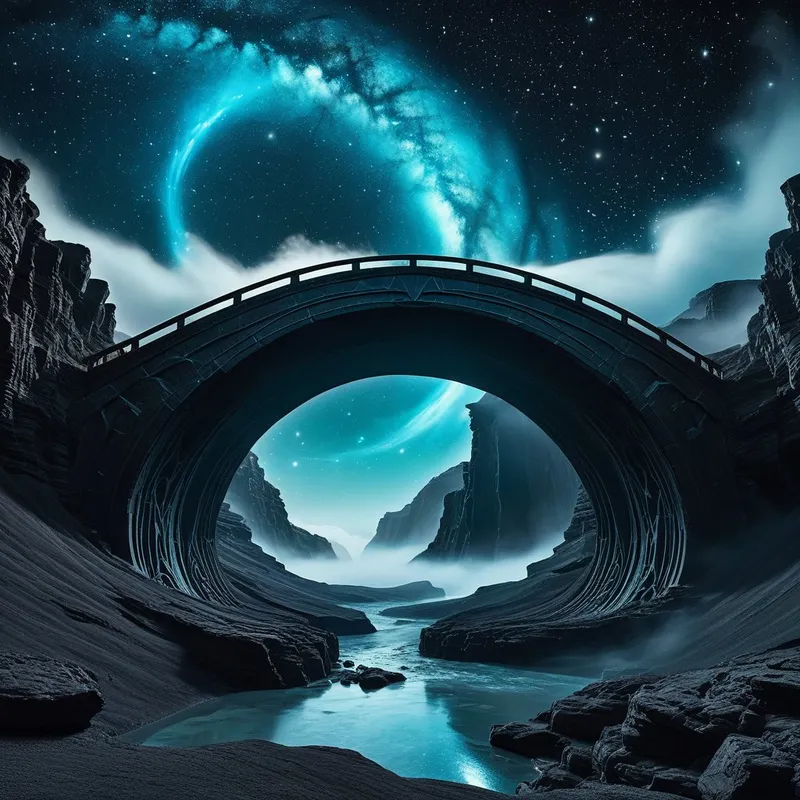
The dreamer stands before a monolithic archway of dark, swirling chrome, inactive and silent. In their hands, they hold not a key, but their own childhood journal, its pages now glowing with pulsing, holographic topographical lines. The archway remains shut, but the maps on the pages begin to bleed light, illuminating a path not forward, but inward, through the floor itself.
This is the alchemy of the true quest: the external gate remains closed until we recognize that the only map we need is the one inscribed on our own forgotten history.

The False Lead
Adventure is not escapism. This is the critical misstep. The soul is not calling you to run away from your life, but to journey toward a more integrated version of it. The shadow of this theme masquerades as impulsive flight—quitting the job, burning the bridges, chasing a geographically distant solution while carrying the same internal baggage. That is the Shadow Explorer in full retreat, mistaking motion for meaning. True adventure is not defined by the mileage covered, but by the depth of the internal frontiers crossed. It is a conscious, often terrifying, choice to engage with the uncharted territories of your own psyche, not to abandon your post but to expand its borders.
Psychological Architecture
To heed the call to adventure is to initiate a profound act of Shadow reclamation. Our conscious lives are often managed by an internal committee—the Manager who keeps the schedule, the Caretaker who tends to others, the Loyal Soldier who guards old wounds. The adventure dream is a coup staged by the exiled parts. It is the voice of the Wild Child, the Forgotten Artist, the Silent Mystic, who can no longer abide the polite containment of the status quo. They rise up in the theater of the night, not to destroy the internal system, but to force a renegotiation of its treaties. The journey outward in the dream symbolizes the necessary descent inward to recover these lost "family members" of the soul. You are not seeking a treasure out there; you are journeying to the dragon’s keep where your own disowned power, creativity, or vulnerability is held captive. Individuation is not a destination of perfection, but the ongoing, adventurous process of making the unconscious conscious, of bringing those exiles home to sit at the council fire of your waking self.
Mythic Resonance
This pattern is the very firmware of human becoming. Consider the Arthurian Grail Quest. The knights do not simply ride out; they enter the Waste Land—a kingdom rendered barren by a spiritual sickness. Their adventure is an externalized search for a cure that can only be found by asking the right, deeply personal question. The quest is futile until Percival, the most "innocent" knight, learns to ask "Whom does the Grail serve?" This shifts the entire paradigm from conquest to compassionate inquiry. Similarly, Inanna’s descent into the underworld is not a lateral move but a vertical plunge. She must pass through seven gates, surrendering a piece of her regalia at each—her crown, her lapis beads, her royal robe—until she stands naked and dead before her shadow sister, Ereshkigal. Her adventure is one of radical deconstruction, where the prize is not an object, but a reconstituted, more complete sovereignty earned through utter vulnerability. The myth tells us: to gain the crown of true self, you must first willingly lay it down.
Symbolic Nodes
- Uncharted Maps & Glowing Compasses: The psyche’s own navigational intelligence emerging.
- Forgotten Paths & Overgrown Gates: Access points to latent potentials or repressed memories.
- Vehicles That Transform (Boats into Wings, Cars into Submarines): The adaptive, alchemical nature of the exploring consciousness.
- Meeting a Guide or Strange Animal: An aspect of your own instinctual or spiritual wisdom taking form.
- A Landscape That Breathes or Changes: The living, responsive nature of the inner world.
Archetypal Resonance
The energy of the Adventure dream is the pure, undistilled call of The Explorer Archetype. Its core drive is the thirst for freedom, authenticity, and the expansion of one’s world through direct experience. The somatic echo—that restlessness, that magnetic pull—is the Explorer’s engine idling, its fuel a mixture of divine discontent and boundless curiosity. This archetype does not seek to destroy the old world (the Rebel) or to save it (the Hero); it seeks to discover a new one, both externally and, more crucially, in the vast interior. The alchemical potential here lies in its shadow integration: to move from the Shadow Explorer’s aimless wandering or alienated isolation into a journey of purposeful seeking, where the frontier explored leads back to a more authentic, sovereign center. The adventure is the process; the integrated Explorer is the result.
The Alchemical Process
The alchemical transmutation here is the conversion of Wanderlust into Soulful Sovereignty. The base material is that raw, often painful, restlessness—the prima materia of dissatisfaction. The heat and pressure are applied by the conscious decision to answer the call despite fear, to leave the shore of the known. This is the nigredo, the dark night of the journey, where you are in the belly of the whale, disoriented and stripped of familiar identity. The trials and encounters of the adventure dream represent the albedo—the washing and purifying by moonlight, where you confront reflections of yourself in monsters, guides, and landscapes. The final rubedo, the reddening, is not finding a pot of gold, but the realization that you are the gold. The sovereignty forged is not over a kingdom, but over the totality of your being. The grief you transmute is for the smaller, safer self you had to leave behind. The terror you alchemize is the fuel for your courage.

The Integration Protocol
Question 1: Where in my waking life do I feel the most potent sense of "compression" or polite containment? What small, wild part of me is being held there?
Question 2: If the landscape of my last adventure dream was a metaphor for my inner world, what does its terrain (rocky, lush, labyrinthine, vast) tell me about my current psychological state?
Question 3: What one piece of "regalia"—a title, a role, a story I tell about myself—would I need to surrender at the first gate to begin a true descent into something new?
Action 1 (Somatic Cartography): For one week, pause three times daily. Place a hand on your sternum. Breathe into that space and ask, "Which direction?" Note the first subtle pull—a memory, a thought of a place, a person, an activity. Don’t analyze; just log it. You are charting the body’s compass.
Action 2 (Dream Journal as Map): Create a two-page spread. On the left, sketch or describe in fragmented, poetic phrases the central landscape or object from your adventure dream. On the right, list the tangible elements of your daily life. Draw lines, however tentative, connecting a dream symbol to a waking-life element. You are not interpreting; you are building a bridge.
Action 3 (The Micro-Expedition): Dedicate one hour this week to a deliberate, purposeless "expedition" in your own city or a nearby natural area. Go without a destination. Your only task is to follow curiosity—turn down the unfamiliar street, stop at the strange shop, sit by the water. Be present not as a consumer, but as an explorer of your own sensory and intuitive field.
Final Validation
It is difficult. To feel the call is to feel a rift between the life you have and the life that whispers to you in the dark. It can feel like a betrayal of your own stability, a terrifying ingratitude. Honor that tension; it is the sign of a soul that has outgrown its container. This is not a flaw, but a testament to your vitality. The adventure dream is not a critique of your present, but an invitation to your future. It is the psyche’s most elegant and urgent delivery system for one essential message: you are not finished. You contain undiscovered countries. The courage to take the first step into that inner wilderness—to read the map written in your own bones—is the very act that transforms the wandering into belonging. You are not lost. You are searching. And in that search, you will find that the greatest treasure, the ultimate sovereignty, was the seeker all along.