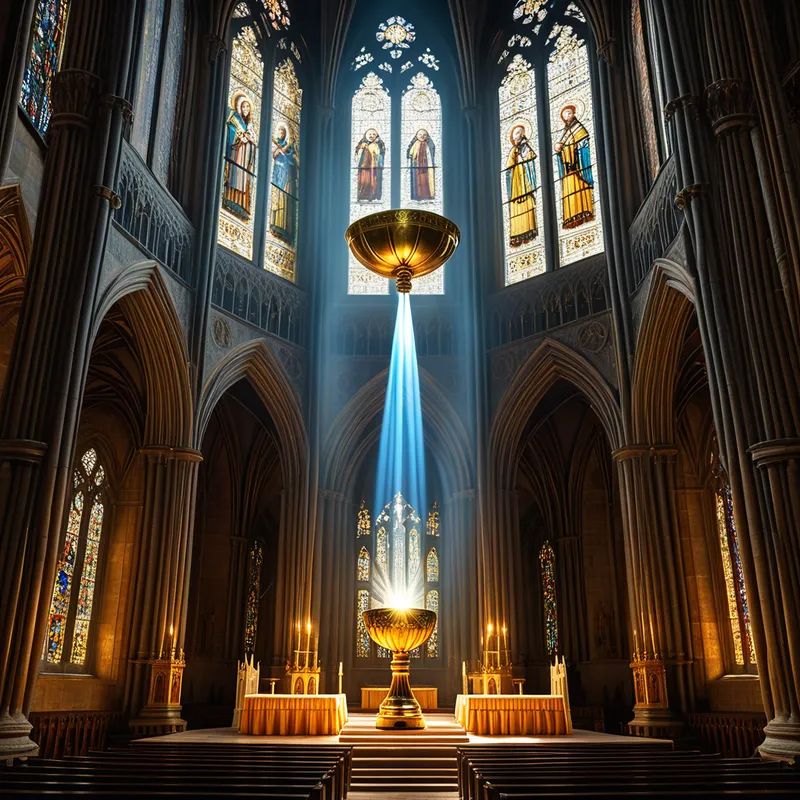
Transubstantiation Myth Meaning & Symbolism
The sacred mystery where ordinary bread and wine are transformed into the divine substance of a god, enacting an eternal sacrifice and communion.
The Tale of Transubstantiation
Listen, and let the veil between worlds grow thin.
The night was not like other nights. The air in the upper room was thick with the scent of roasted lamb, bitter herbs, and an unspoken dread that clung to the walls like shadow. The man they called Rabbi sat among them, his face etched with a sorrow as deep as creation. The festival lamps flickered, casting dancing ghosts upon their faces—faces marked by fear, by love, by utter confusion.
He took the bread. Not a symbol, but substance. The common, coarse loaf of their shared meal, baked from the dust of the earth, crushed grain, water, and fire. He held it, and the room grew still, the very silence becoming a presence. He gave thanks, his voice a low river in the dark. Then he broke it. The sound was not just of crust fracturing; it was the sound of a covenant being shattered and remade. “Take,” he said, and his words were not sound but substance themselves, falling into the air like stones into a pond. “This is my body, given for you.”
They took it. And in that moment, for those whose hearts were open, the bread was no longer mere bread. It was not a metaphor. It was a threshold. The substance of the earth became the substance of the divine. They did not eat bread; they consumed a mystery—the very life-force of the one who spoke the world into being, now offered, broken, shared.
Then the cup. Dark wine, the blood of the grape, the joy and suffering of the vine pressed into a single vessel. He took it, gave thanks again, and the wine caught the lamplight like a dark jewel. “This cup,” he intoned, and the words vibrated with the weight of eternity, “is the new covenant in my blood, which is poured out for you.”
They drank. And as the wine passed their lips, a second alchemy unfolded. The veil of appearance tore from top to bottom. The wine, the fruit of the sun and soil, became the vital essence, the sacred river of life that coursed through the heart of the divine. To drink was to ingest a promise, to take into one’s very core the principle of a love so vast it could bleed for creation.
He commanded them, “Do this in remembrance of me.” And in that command, he did not institute a mere ritual. He planted a seed of perpetual miracle. He bound the eternal to the moment, the infinite to the finite, the divine life to the cycles of grain and grape. The supper ended. The betrayal unfolded in the garden. The body was broken on the wood, the blood poured out on the earth. But the act in the upper room was not undone; it was inaugurated. It became a door, left forever open, through which the ultimate sacrifice would forever enter the present, transforming the ordinary into the ultimate, feeding the hungry hearts of the world until the end of time.
Cultural Origins & Context
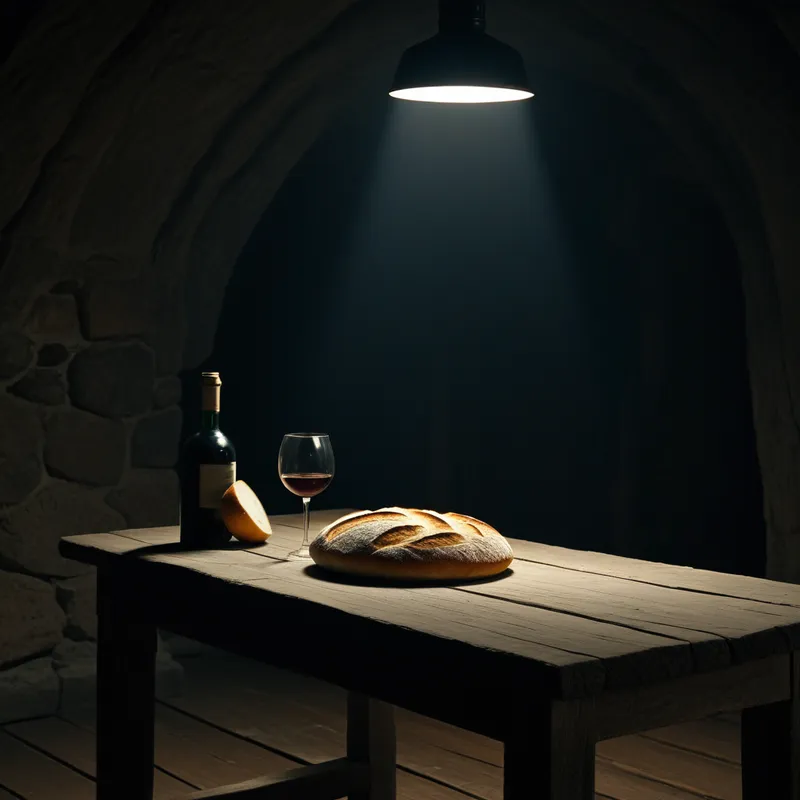
This mystery, which would come to be named Transubstantiation, did not emerge fully formed from a single night. It grew from deep roots in the Hebrew imagination. The Passover Seder itself was a ritual of remembrance so potent it was believed to make participants contemporaneous with their ancestors’ liberation. Prophets like Jeremiah spoke of a “new covenant” written on the heart. This cultural soil—where memory was participatory and covenant was life-blood—was the necessary precondition for the myth.
For centuries, the telling and retelling of the “Last Supper” narrative was oral, liturgical, and embedded in the shared meal of the early ecclesia. It was not a story told about something, but a story enacted as something—the very means of divine presence. By the Middle Ages, as philosophical language (particularly Aristotelian metaphysics) sought to articulate the faith, the doctrine was formally crystallized at the Fourth Lateran Council (1215). The myth’s societal function was dual: it was the ultimate unifier, creating a sacred community (communio) through shared divine substance, and it was the ultimate boundary, defining orthodox belief against perceived heresy. It placed a paradox of unimaginable intimacy—eating God—at the very center of communal life.
Symbolic Architecture
At its core, the myth of Transubstantiation is a master symbol of radical immanence. It declares that the divine is not remote, but profoundly, scandalously available, hidden within the most humble elements of earthly existence.
The ultimate mystery is not that spirit becomes matter, but that matter is revealed to be spirit in disguise.
The Bread represents the body, the incarnate, earthly life. It is the product of process: sowing, reaping, threshing, grinding, baking. It symbolizes the human condition—fragmented, communal (“one bread, one body”), and sustaining. The Wine represents the blood, the animating spirit, the passion, joy, and suffering that is the inner essence of life. It is the product of crushing and fermentation, a necessary decay that yields sweetness and potency.
The act of Consecration is the symbolic pivot. It represents the moment where a higher consciousness (the Logos) speaks meaning into inert substance. It is the Fiat Lux (“Let there be light”) applied to the existential reality of the individual. The change is not in physical properties (the accidents), but in deepest reality (the substance). Psychologically, this mirrors the moment of profound insight where the nature of a thing—a relationship, a trauma, a personal gift—is utterly reconfigured, even while its outward form remains the same.
Finally, Communion symbolizes assimilation. The divine substance is not merely observed; it is taken in, digested, and becomes the very fabric of the communicant’s being. It is the symbol of ultimate integration, where the sacred Other becomes the sacred Self.
The Dreamer's Resonance
When this mythic pattern stirs in the modern dreamer, it speaks of a psyche at the brink of a fundamental re-identification. To dream of eating a common food that transforms into something luminous, potent, or alive in the mouth is to experience the somatic signature of this archetype.
The dreamer may be going through a process where an old, “nourishing” aspect of life (a job, a belief, a self-image)—symbolized by the bread—is being revealed in its true, deeper substance. Perhaps what seemed merely functional is discovered to hold a core of sacred purpose. Conversely, what seemed like a painful emotional vintage (the wine of suffering, regret, or passion) is being transmuted into a vital essence, a necessary covenant for a new phase of life.
Such dreams often carry a sense of awe, terror, or profound solemnity. The somatic feeling is crucial: a warmth spreading from the core, a sense of being “filled” with a foreign yet familiar power, or a trembling at the threshold of a mystery. It indicates the unconscious is performing its own consecration, attempting to integrate a numinous content so potent it can only be approached through the metaphor of ingestion and assimilation.

Alchemical Translation
In the alchemy of the soul, Transubstantiation is the opus magnum—the great work of psychic transmutation. It models the final stage of individuation, where the lead of the ego-personality is turned into the gold of the Self.
The first step is the Offertory: presenting the raw, base materials of one’s life—the “bread” of one’s daily struggles and the “wine” of one’s passions and pains—upon the altar of consciousness. This requires honest self-appraisal, a lifting up of one’s entirety without denial.
The central, critical operation is the Epiclesis—the invocation. This is the active engagement of a transcendent function, the focused attention and intention that calls forth meaning. In psychological terms, it is the ego’s humble petition to the deeper Self: “See this. Bless this. Transform this according to your deeper pattern.” It is the act of sincere reflection, therapy, prayer, or artistic creation that seeks not just to understand, but to reconstitute an experience.
The goal of psychic life is not to escape matter, but to discover the divine substance within it, thereby sanctifying the world.
Then occurs the Transformation. The substance changes. The neurosis is revealed as a misplaced sacredness. The childhood wound is understood as the precise crucible that forged resilience. The addiction is seen as a thirst for the divine. The outer facts remain (the accidents), but their inner meaning and their power over the psyche are utterly altered.
Finally, the Feast: the integration. The transformed substance is assimilated. The insight becomes character. The healed wound becomes wisdom. The individual no longer just has an experience; they are that experience, now redeemed. They become, in a sense, what they have consumed—a being in whom the human and the divine substance coexist, a living testament to the alchemy where the most ordinary life is revealed to be the vessel of the extraordinary.
Associated Symbols
Explore related symbols from the CaleaDream lexicon: