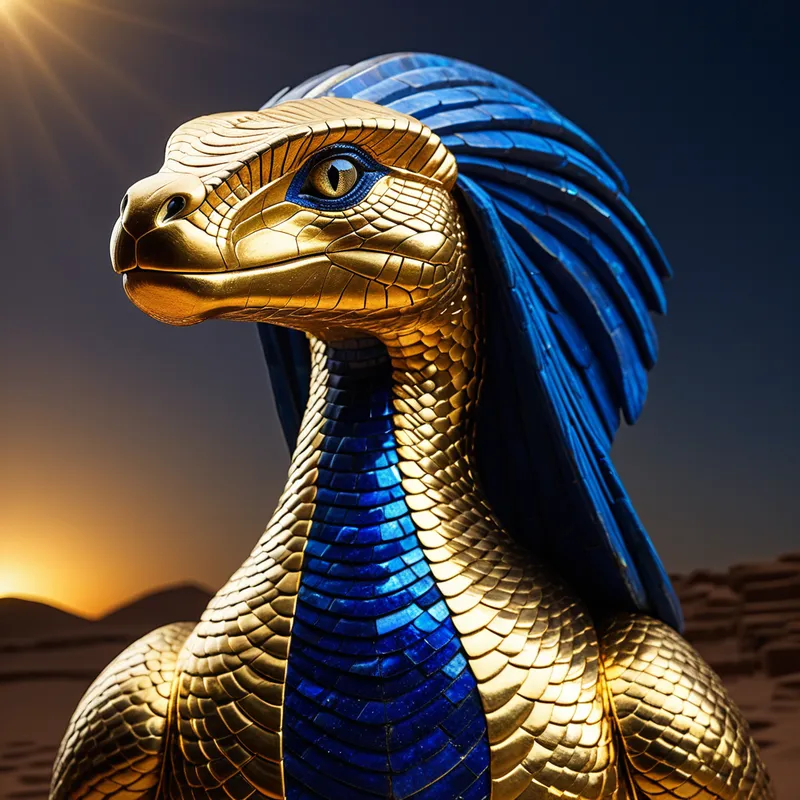
Uraeus Myth Meaning & Symbolism
The sacred cobra, born of the sun god's eye, becomes the living fire upon the king's brow, a symbol of sovereignty and awakened consciousness.
The Tale of Uraeus
Hear now the tale of the fire that became a guardian, the tear that became a sovereign. In the time before time, when the sun-disk, Ra, sailed his barque across the vault of heaven, his gaze was law. But his gaze was not one, but two. The second was his Eye, a being of terrible and beautiful power, a goddess who could walk apart from him. She was his fury, his protection, his daughter.
One day, as Ra grew aged upon his throne, a murmur of rebellion stirred in the lands he had made. Men schemed in shadows, forgetting the searing truth of the light that gave them life. The Eye of Ra saw this. A great wrath kindled within her, a heat that rivaled her father’s own core. She transformed, becoming the lioness-goddess Sekhmet. She descended to the black soil of Egypt, and her rage was a sandstorm of claws and teeth. She did not simply kill; she devoured. The river ran red, not with water, but with the essence of the ungrateful.
Ra watched from on high. His initial satisfaction at the quelling of rebellion turned to horror. His own fury, once unleashed, would not be recalled. The Eye, in her form as Sekhmet, thirsted for an endless slaughter that would leave the world a silent, blood-drenched waste. The sun god knew he must stop his own divine aspect, lest all creation be unmade.
He acted with cunning born of desperation. He commanded his swiftest messengers to bring vast quantities of red ochre from the desert and barley from the fields. These they ground and mixed, and into the vats of the world, they poured seven thousand jars of beer, staining it the deep, bloody crimson of the Nile in flood. They poured this potent, sleeping draught across the fields where Sekhmet prowled at dawn.
The lioness-goddess, her muzzle wet, saw what she believed was a great lake of blood. A terrible joy seized her. She stooped and drank, and drank, and drank, until the fields were dry. But the beer was heavy, a liquid dusk. Her steps faltered. The fiery rage in her veins cooled and thickened. She lay down upon the earth, her great head nodding, and fell into a deep, dreamless sleep. When she awoke, the bloodlust had passed. She was once again the Eye, but tempered, changed.
And from that moment of transformation, from the meeting of Ra’s cunning and the Eye’s pacified fury, a new power was born. As the Eye returned to her father’s brow, a residue of her essence remained—not the mindless destroyer, but the focused, vigilant protector. This residue coalesced, took form. It was a living flame given the shape of a cobra, hood flared, body coiled in poised potential. Ra placed this fiery serpent upon his own crown. It was the Uraeus. No longer a force of indiscriminate annihilation, it had become the concentrated symbol of rightful authority, the defender of cosmic order—Maat—against the chaos of rebellion. It was the promise that from the brink of self-destruction, a higher, conscious power could emerge.
Cultural Origins & Context
The Uraeus was not merely a story; it was a living, breathing symbol woven into the very fabric of Egyptian kingship and cosmology. Its image, the reared cobra, is one of the most persistent icons in three millennia of Egyptian art, fixed to the brow of every pharaoh’s crown, headcloth, and helmet. The myth explains its origin as a direct emanation from the sun god himself, making the king’s sovereignty a divine mandate, literally “fire from heaven.”
This myth was part of the deep theological undercurrent that validated the pharaoh’s role as the intermediary between gods and people. The Uraeus was the instrument of this mediation. It was the “Eye of Ra” in its benevolent, protective aspect, now physically attached to the ruler. Priests and scribes would have known this myth, and its recitation likely formed part of coronation rituals and temple dramas, reinforcing the idea that the pharaoh carried a sliver of the sun god’s own defensive power. It served a critical societal function: it transformed the potential terror of absolute power (the raging Sekhmet) into a legitimized, focused force for national stability and protection (the vigilant Uraeus). It told the people that the king’s wrath, like Ra’s, was not arbitrary, but a necessary flame to burn away the weeds of chaos.
Symbolic Architecture
At its core, the Uraeus myth is an alchemical drama about the transformation of raw, unconscious power into conscious, sovereign authority. The key elements form a profound symbolic architecture.
The Eye of Ra represents a totality of perception and energy that exists within a deity (or, psychologically, within the Self). It is undifferentiated power—it can be creative vision, protective love, or annihilating fury depending on its relationship to the central consciousness (Ra).
The untamed power of the psyche is a wildfire; consciousness is the hearth that contains it, making it a source of warmth and light rather than destruction.
Sekhmet is that power in its shadow aspect—unconscious, autonomous, and destructive. She is the rage that consumes the one who holds it, the talent that turns tyrannical, the instinct that refuses integration. Her rampage symbolizes what happens when a potent psychic force splits off and operates without the guidance of the central ego or the greater Self.
The red beer is the symbol of divine cunning and transformation. It is the “trick” the conscious mind (Ra) must play on its own unconscious fury. It represents the act of redirecting energy, not through brute suppression, but through symbolic substitution and integration. The blood-lust is not fought; it is quenched and transformed into a stupor that allows for a rebirth.
Finally, the Uraeus itself is the new, synthesized form. It is the previously destructive power now contained, focused, and placed in service of a higher order. It is no longer a lioness raging across the plains, but a cobra coiled on the brow—alert, poised, and lethal only when necessary to protect the integrity of the whole. It symbolizes awakened consciousness sitting atop the seat of identity, transforming blind instinct into vigilant wisdom.
The Dreamer's Resonance
When the pattern of the Uraeus stirs in the modern dreamer, it often signals a critical phase in the relationship with one’s own personal power. To dream of a cobra, especially one associated with the head or crown, is to encounter the psyche’s own demand for sovereignty.
You may dream of a serpent uncoiling from your forehead, or feel a burning sensation on your brow. You might be in a situation of powerlessness, and a fiery, protective anger rises within you, taking serpentine form. Alternatively, you could dream of a destructive, out-of-control force (a fire, a raging animal) that is suddenly quelled by a strange, clever solution, leaving behind a sense of calm authority.
Somatically, this process can feel like a gathering of tension in the head and spine, a “rising” energy that seeks a point of focus. Psychologically, it is the process of confronting a Sekhmet within—perhaps a long-suppressed rage, a formidable talent you fear, or an instinctual drive that feels overwhelming. The dream is the psyche’s ritual, showing that this raw force can be and must be transformed. It is not to be eradicated, but to be brought under the conscious governance of the “royal self,” to become a protector of your psychological boundaries and integrity, rather than their destroyer.

Alchemical Translation
The journey from the Eye to Sekhmet to the Uraeus is a perfect map for the individuation process—the alchemical transmutation of the lead of unconscious compulsion into the gold of conscious, willed authority.
The process begins with the recognition of the Shadow in its most potent form: our own capacity for righteous, consuming fury (Sekhmet). This is not a minor irritation, but a force that threatens to lay waste to our inner and outer worlds if left unaddressed. The ego (Ra) initially may have welcomed this force to deal with a “rebellion”—perhaps to overthrow an internalized oppressor or break a stagnant pattern. But it risks being overthrown in turn.
Individuation is not the avoidance of one’s inner Sekhmet, but the sacred duty of inviting her to the throne room, not as a destroyer, but as the crowned guardian of the realm.
The alchemical operation is the red beer: the conscious, creative act of re-framing. This is the therapeutic or introspective work where we take the raw emotion and “dye” it, change its meaning. We channel rage into the assertive setting of boundaries. We transmute destructive self-criticism into disciplined craft. We redirect chaotic passion into focused devotion. We “intoxicate” the blind instinct with the symbolism of a higher purpose, putting it to sleep so it may wake transformed.
The result is the Royal Marriage, symbolized by the Uraeus upon the crown. The once-autonomous, terrifying power is now integrated. It becomes the function of consciousness itself—the vigilant attention that protects the psyche’s wholeness (Maat). For the modern individual, this is the achievement of true sovereignty. It is not power over others, but the hard-won authority over oneself: the ability to hold one’s deepest, most dangerous potentials in a state of poised, conscious readiness, using their fire not for destruction, but for the unwavering defense of one’s authentic being and purpose. The Uraeus is the mythic proof that our greatest demons, once faced and transformed, become our most sacred guardians.
Associated Symbols
Explore related symbols from the CaleaDream lexicon: