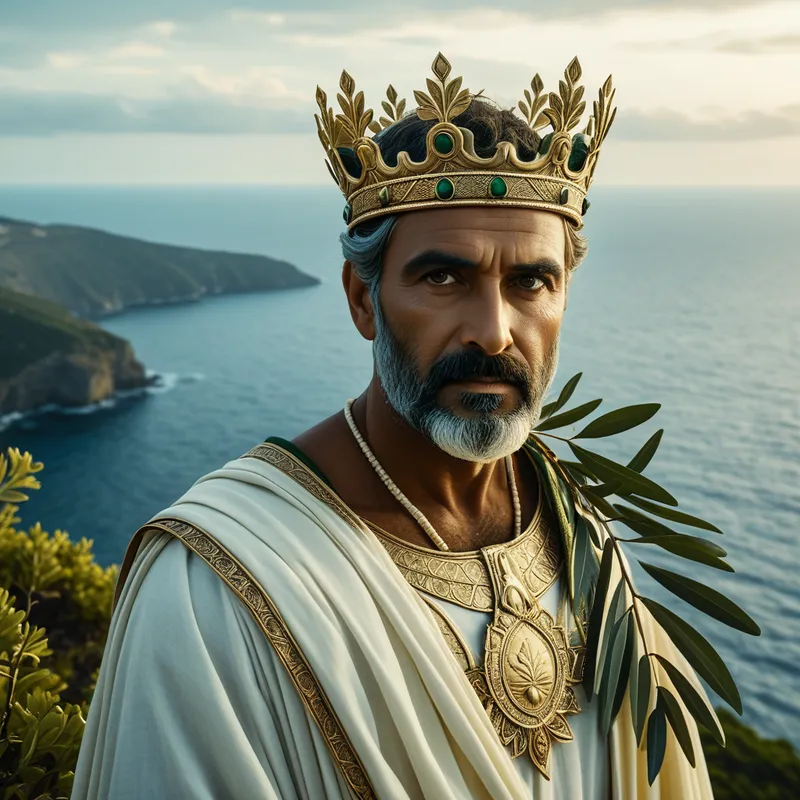
Pelops Myth Meaning & Symbolism
A prince is butchered, served to the gods, restored with an ivory shoulder, and wins a bride through treachery, founding a dynasty under a terrible curse.
The Tale of Pelops
Hear now a tale of a king’s feast that became a god’s crime, of a boy who died and was remade, and of a victory bought with a promise of blood.
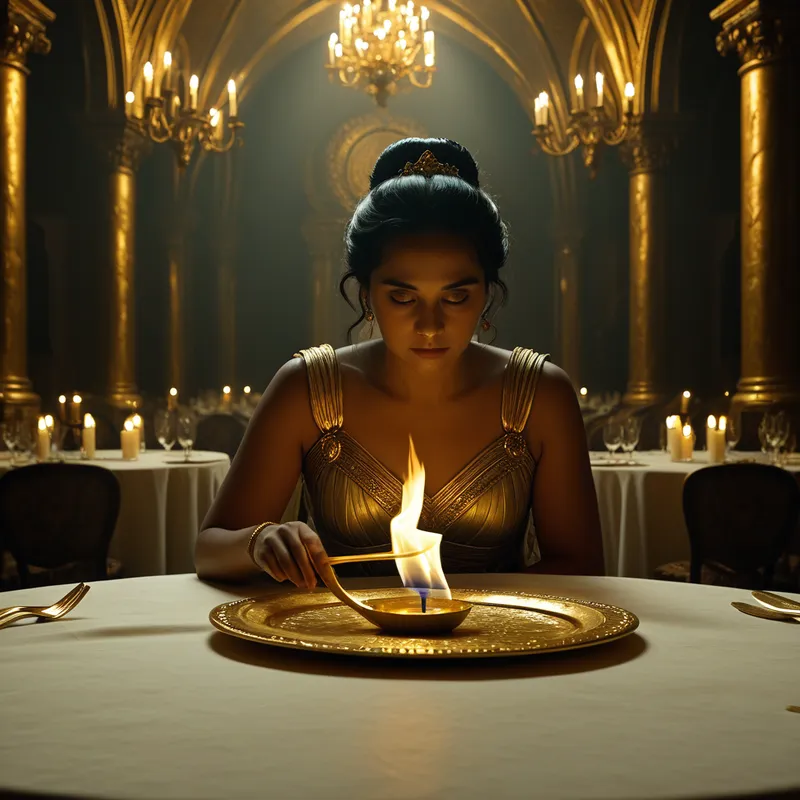
In the sun-baked land of Lydia, King Tantalus sat at the table of the gods. He was their favorite, a mortal who dined on ambrosia and heard their secrets. But pride is a poison that turns nectar to gall. To test the gods’ omniscience, to prove he could deceive them, he committed an atrocity that chills the blood. He slew his own son, the young prince Pelops. He butchered the boy’s fair form, boiled the flesh in a great cauldron, and served the steaming stew to the divine assembly.
A terrible silence fell over Olympus. The gods perceived the abomination. All but one turned away in revulsion. Demeter, lost in her own bottomless grief for her stolen daughter, absently partook of the gruesome meal, consuming the boy’s left shoulder.
Justice was swift and terrible. The gods refused the feast. Hephaestus was summoned. The broken pieces of the young prince were gathered, and in a act of divine reparation, the boy was restored to life in the great cauldron. For the shoulder consumed by Demeter, a piece of gleaming, polished ivory was fashioned and set into his flesh. Pelops breathed again, marked forever by a shoulder that shone like the moon.
But a stain cannot be so easily washed away. Tantalus was cast into the underworld to suffer eternal, tantalizing torment. Pelops, now an outcast bearing his father’s shame, sailed across the wine-dark sea to the land of Pisa. There, King Oenomaus had a daughter of legendary beauty, Hippodamia. The king, haunted by an oracle that foretold his death by his son-in-law, devised a savage contest. Any suitor must race him in a chariot from Pisa to the Isthmus of Corinth. Victory would win the princess. Defeat meant death, for Oenomaus would spear the loser from behind.
Thirteen heads of failed suitors already adorned the palace walls. Pelops, gazing upon Hippodamia, knew he must race. But he would not rely on speed alone. He went to the shore and called upon his former lover, Poseidon, who gifted him a chariot drawn by immortal, winged horses. Still, Pelops sought a surer path. He sought out the king’s charioteer, Myrtilus, son of Hermes. “Help me,” Pelops whispered, “and you shall have the first night with the bride.”
Myrtilus, tempted, agreed. On the eve of the race, he replaced the bronze linchpins of his master’s chariot with ones of wax. The next day, the thunder of hooves shook the earth. As the chariots flew, the wax melted. Oenomaus’s chariot shattered, and the king was dragged to his death by his own horses. Pelops was victorious.
But when Myrtilus came to claim his reward, Pelops’s heart turned to ice. He could not bear the thought. Instead, he took the charioteer to a high cliff and cast him into the roaring sea. As he fell, Myrtilus cursed the house of Pelops with all his dying breath. And so, a dynasty was founded on a butchered body, a ivory shoulder, a broken chariot, and a betrayed promise. The curse would echo for generations, through Atreus and Thyestes, and into the blood of Agamemnon himself.
Cultural Origins & Context
The myth of Pelops is not a simple folktale; it is a foundational charter for the ancient Greek world. It originates in the deep, pre-Olympian past of the Peloponnese—a name which means “Island of Pelops.” This land-mass, the southern heart of Greece, was literally named for him. The story was central to the rituals and identity of the city of Olympia, where the great Games were held. Pindar’s First Olympian Ode, composed for a victor in 476 BCE, begins with the myth of Pelops, explicitly linking the athletic contest to this primal story of chariots, victory, and divine favor.
The tale was told and retold by epic poets, tragedians, and local priests. It functioned as an etiological myth, explaining the origin of the ivory shoulder blade relic said to be kept at Olympia. More profoundly, it established a template for sacred kingship—a kingship that emerges from a horrific rupture (dismemberment), requires divine intervention for legitimacy (restoration by the gods), and is secured through a combination of favor, cunning, and violence. It served as a grim reminder that power, even divinely sanctioned power, is often born from and intertwined with crime, oath-breaking, and a debt of blood that must eventually be paid.
Symbolic Architecture
The myth is a dense matrix of symbols speaking to the very process of becoming a sovereign self. Pelops begins as an innocent, sacrificed not for a higher purpose but for his father’s monstrous vanity. His dismemberment represents a total psychic dissolution, the annihilation of the naive ego.
The self cannot be built from whole cloth; it must first be broken apart from its familial and naive moorings.
His restoration is not a return to innocence, but a reconstitution with a difference. The ivory shoulder is the key. Ivory, a precious, beautiful, but lifeless material, replaces living flesh. It is a divine prosthesis, a mark of both favor and otherness. Pelops is no longer entirely human; he carries a piece of the numinous, a hard, shining emblem of his trauma and his survival. He is, psychologically, the individual who has integrated a complex—a part of the psyche that is magnificent, enduring, but not quite “alive” in the same way as the rest. It is his strength and his flaw.
The chariot race is the archetypal ordeal for the hand of the maiden—the anima. But here, it is utterly corrupted. Oenomaus represents the possessive, tyrannical old king who cannot let life (the daughter) move forward. Pelops’s victory, achieved through bribing Myrtilus (the “servant” or auxiliary function of the old order) and technical treachery, shows that the new consciousness does not win through pure heroism, but through shadow-work, cunning, and making a pact with ambiguous forces. The betrayal and murder of Myrtilus, however, immediately reinvests the new kingdom with the curse. The shadow, once used, must be integrated or acknowledged, not simply discarded, or it returns with a vengeance.
The Dreamer's Resonance
When this myth stirs in the modern psyche, it manifests in dreams of profound violation and strange restoration. One may dream of being taken apart, piece by piece, in a clinical or ritual setting. There is terror, but also a strange sense of necessity. This is the psyche signaling a necessary deconstruction, often following a betrayal by a parental or authority figure (the Tantalus wound).
Dreams of having a limb or body part made of stone, crystal, or polished bone point directly to the “ivory shoulder.” This is the dreamer’s nascent strength—a part of them that has become resilient, perhaps even magnificent, due to trauma, but which feels alien, unfeeling, or separate from the organic flow of emotion. It is both a trophy and a burden.
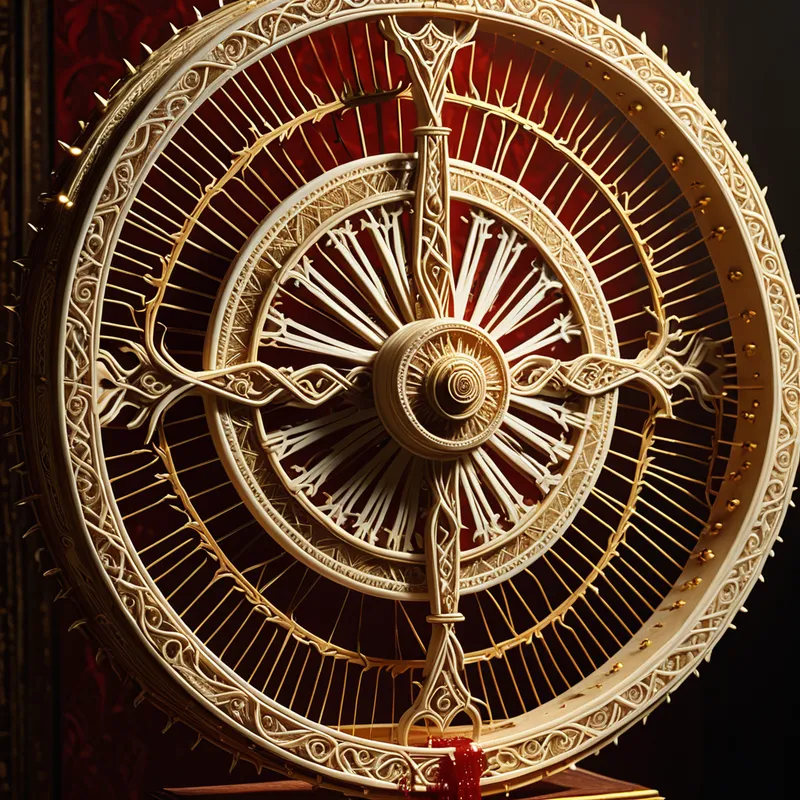
The chariot race appears as dreams of frantic, high-stakes competition where the rules are unknown or the vehicle is sabotaged. The figure of Myrtilus—the helper who then becomes a persecutor—may appear as a friend, colleague, or inner voice that offers a cunning but morally dubious solution to a life problem. To dream of pushing this figure off a cliff signifies a conscious act of repressing guilt or reneging on a painful obligation, with the intuitive knowledge that this act will have long-term consequences (the curse).

Alchemical Translation
The Pelops narrative is a brutal alchemical recipe for the individuation of a ruler—a person who must wield conscious authority in their own life. The nigredo, the blackening, is the horrific feast: the utter annihilation of the childish self by the paternal complex (Tantalus). The ego is dissolved in the cauldron of unconscious suffering.
The albedo, the whitening, is the restoration with the ivory shoulder. This is not a return to purity, but the emergence of a differentiated, enduring core. The ivory is the lapis, the philosopher’s stone in nascent form—something incorruptible extracted from the chaos. It represents a conscious attitude forged in the fire of betrayal, a resilient principle one can rely upon.
The curse is not a punishment, but the law of psychic economy: what is excluded from consciousness does not vanish; it accrues interest in the dark.
The chariot race is the rubedo, the reddening or application of this new self in the world. Winning the anima (Hippodamia) and the kingdom requires engaging the shadow (the deal with Myrtilus). The fatal error, the point where the process often fails, is in the final separatio. Pelops attempts to separate himself completely from the shadowy means of his victory by murdering Myrtilus. He wants the crown without the stain. But the psyche does not allow this. The murdered ally becomes a haunting curse, the unintegrated shadow that will plague his lineage.
The true alchemical completion, therefore, is hinted at in the myth’s very persistence. It is the ongoing struggle of the descendants—Atreus, Agamemnon, Orestes—to consciously work through the inherited curse. For the modern individual, the myth teaches that sovereignty comes from surviving dissolution, integrating the shining, hard-won wisdom of trauma (the ivory), and having the courage to consciously bear the guilt and complexity of one’s choices, rather than pretending one’s hands are clean. The curse is the work itself, the lifelong task of remembering what was broken, what was replaced, and what promise was made in the dark to keep moving forward.
Associated Symbols
Explore related symbols from the CaleaDream lexicon: