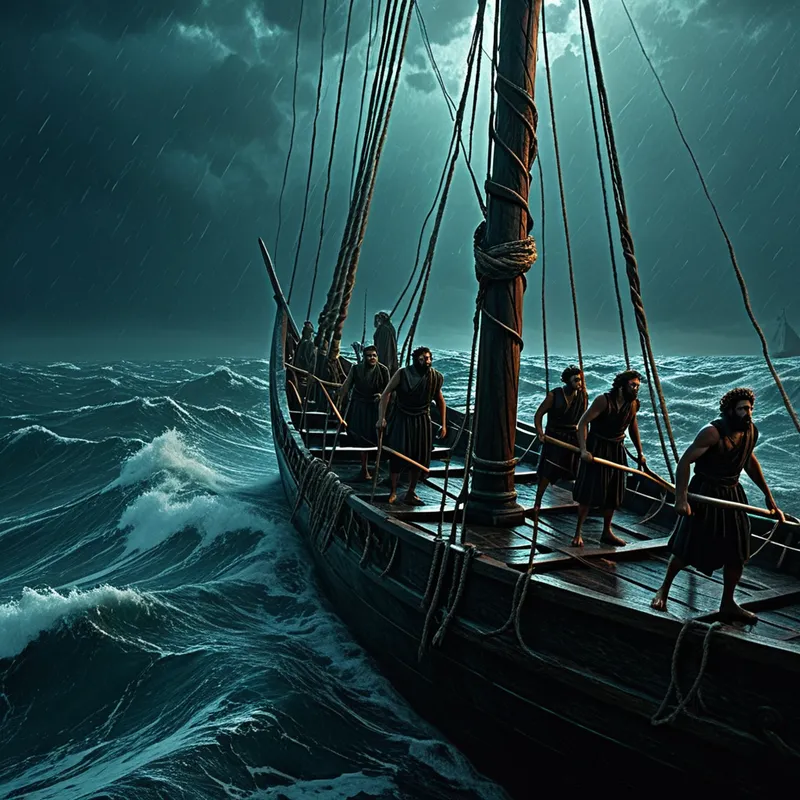
Odysseus' voyage in Homer's Od Myth Meaning & Symbolism
A warrior's decade-long, divinely-tormented voyage home becomes the archetypal map for the human journey through loss, temptation, and the reclamation of self.
The Tale of Odysseus' voyage in Homer's Od
Hear now, you who gather in the firelight, of the man of many turnings, the one who was driven far and wide after he had sacked the sacred citadel of Troy. This is the story of Odysseus, whose name means “trouble,” and whose journey home became a ten-year war against the world and the will of the gods.
The sea was his new battlefield, a pathless, gray waste. His fleet, laden with the spoils of victory, was a speck upon the wrath of Poseidon</ab title>. The first port was a bitter feast: the land of the Lotus-Eaters, where his men tasted the honey-sweet fruit and forgot the way home, their eyes clouded with blissful oblivion. Odysseus, his heart a knot of longing for rocky Ithaca, dragged them back to the ships, weeping.
Then came the island of the Cyclopes, a race of lawless giants. In the vast, reeking cave of Polyphemus, they were trapped like mice. The monster devoured men whole, their screams echoing off walls of stone. But Odysseus, the weaver of wiles, offered the giant wine stronger than any mortal brew. As Polyphemus lay in a stupor, Odysseus and his men heated a great stake of olive wood in the fire and drove it into his single, blazing eye. The giant’s roars shook the mountain. They escaped, clinging to the bellies of his sheep, but Odysseus’s pride shouted his true name to the blinded beast—a boast that unleashed Poseidon’s unending fury upon their wake.
The winds of Zeus then blew them to the floating island of Circe. With her wand and potions, she transformed his advance party into swine, grunting in the mire of her sty. Only Odysseus, shielded by the magic herb moly given by Hermes, could withstand her. He held his sword to her throat, and in that moment of confrontation, her magic broke into desire. For a year, they lingered in her halls of ease, until his men’s whispers of home stirred him once more.
But to go home, he had to go down. Circe sent him to the very edge of the world, to the dank shore where the rivers of the dead meet the living. There, Odysseus dug a trench and poured libations of blood. The shades swarmed, thirsty and whispering. He saw his mother, who died of longing for him. He saw the prophet Tiresias, who foretold a hard homecoming: his halls full of wolves, his journey not complete until he carried an oar so far inland that men would mistake it for a winnowing fan.
The trials multiplied. He steered past the Sirens, their song a promise of all knowledge, by having his crew bind him to the mast while their ears were sealed with wax. He navigated the clashing rocks and chose the path past the six-headed Charybdis and the man-eating Scylla, losing six good men to her snapping jaws. On the island of the Sun, his starving men, against all oath, slaughtered the sacred cattle of Helios. For this sacrilege, Zeus shattered their ship with a lightning bolt. All drowned. Only Odysseus, who had not partaken, survived, clinging to the wreckage.
For seven years, he was captive of the nymph Calypso, who offered him immortality and ageless youth in her perfumed caves, if he would only forget his mortal wife, Penelope. He sat each day on the shore, staring at the empty horizon, his heart eroded by a salt of longing no immortal could understand. His release came only by the command of the gods.
Washed ashore on Phaeacia, a broken man, he told his tale. Moved by his suffering, the Phaeacians gave him a magic ship that flew across the sea like a thought, delivering him at last, asleep, to the hidden cove of Ithaca. He awoke to a land he did not recognize, disguised by Athena as a beggar. The final trial awaited in his own hall: the suitors, devouring his substance and courting his wife. With the steady hand that once strung the great bow at Troy, he strung his own bow again, and in a storm of arrows and blood, he reclaimed his home, his throne, and his name. The wanderer had returned, but he was no longer the man who had left.

Cultural Origins & Context
This epic, known as the Odyssey, is attributed to the poet Homer and is believed to have been composed in the 8th century BCE, though its roots dig deep into an oral tradition centuries older. It was not a text to be read, but a performance to be heard, chanted by professional bards called rhapsodes at festivals and in the halls of chieftains. Its dactylic hexameter rhythm was a mnemonic device, a river of sound carrying the story forward.
The poem functioned as the ancient Greek world’s grand narrative of navigation—not just of the Mediterranean, but of the human condition. It emerged from a culture transitioning from a heroic, warrior-based ethos (the world of the Iliad) to one concerned with nostos (homecoming), identity, and the founding of civic order. Odysseus’s journey modeled the Greek ideal of metis (cunning intelligence) over brute force, and his ultimate restoration as king affirmed the cultural necessity of the household (oikos) as the foundation of society. It was a mythic map for a people whose lives were defined by sea travel, guest-host relationships (xenia), and the ever-present caprice of the gods.
Symbolic Architecture
The voyage of Odysseus is not a travelogue but a profound cartography of the soul’s midlife passage. Each island is not a geographic location but a state of consciousness, a psychic complex the ego must encounter and integrate or escape.
The journey home is the journey into the self; every monster is a disowned part of the psyche, every enchantress a seduction by unconscious contents.
The Cyclops represents the brutal, lawless, and narcissistic aspect of the unconscious—the monstrous “I” that consumes others without reflection. Blinding it is a necessary, violent act of differentiation, but boasting one’s name to it signifies the enduring inflation of the ego, which inevitably summons retribution (Poseidon’s wrath, or the repressed contents returning with force).
Circe and Calypso embody the Great Mother archetype in her dual aspect: Circe as the devouring mother who infantilizes and animalizes (turning men to swine), and Calypso as the possessive mother who offers eternal, static bliss at the cost of one’s destiny and mortality. To resist them is to choose the difficult path of individuation over the comfort of eternal childhood.
The descent to the Underworld is the quintessential nekyia, the night-sea journey into the collective unconscious. Consulting the shades, especially the androgynous seer Tiresias, represents a necessary dialogue with the ancestral and archetypal layers of the psyche to gain wisdom for the path ahead.
Finally, the return to Ithaca in disguise signifies the most profound transformation. The hero cannot simply resume his old identity. He must become the “nobody” he told Polyphemus he was, the beggar, the stranger in his own life, to see it truly and purge it of the parasitic forces (the suitors) that have occupied his psychic space in his absence.
The Dreamer's Resonance
When this myth stirs in the modern dreamer, it often signals a profound disorientation and a crisis of identity. The dreamer may find themselves lost at sea, on a strange island, or in a labyrinthine building that represents home but feels alien. These are dreams of the nostos complex—the deep, often painful pull to find one’s authentic center after a long period of exile, whether literal or psychological.
Dreaming of being tied to a mast while hearing irresistible music points to a conscious ego (Odysseus) navigating a powerful, potentially overwhelming emotional or instinctual current (the Sirens’ song), requiring strict containment to avoid being dashed on the rocks of possession. Dreams of confronting a one-eyed giant or monster often correlate with facing a singular, overwhelming problem or a narcissistic force in one’s waking life that seems to consume all resources.
Recurring dreams of being held in a beautiful but stifling place, offered comfort at the price of stagnation, mirror the Calypso bind: the soul’s temptation to abandon its difficult, unique journey for a passive, painless existence. The dream is the psyche’s map, and the Odyssean pattern reveals that the dreamer is, however painfully, on the path of reclaiming their rightful kingdom.

Alchemical Translation
The alchemy of the Odyssey is the opus contra naturam—the work against nature’s pull toward entropy and dissolution. It is the process of gathering the scattered fragments of the self, forged in the fires of experience, into a cohesive, conscious whole.
The gold sought is not in a distant land, but in the re-cognition of the hearth one left behind. The hero’s quest ends where it began, but he sees the place for the first time.
The initial state is one of separatio: Odysseus is ripped from his known world (Troy, his old warrior identity). The long voyage is the nigredo, the blackening, the putrefaction in the sea of the unconscious—a decade of being broken down, humiliated, and stripped of all companions and possessions. Each encounter—with the Lotus (forgetfulness), Circe (animalization), the Underworld (confrontation with death)—is a dissolution of a former attachment.
The meeting with Tiresias in the underworld is the pivotal moment of albedo, the whitening, where a cryptic formula for completion is received. The instruction to carry the oar inland until it is mistaken for a winnowing fan is pure alchemical symbolism: it demands the integration of opposites. The oar (the tool for navigating the sea, the unconscious) must be brought to the realm of dry land and agriculture (conscious, cultivated life). The warrior must become a farmer of his own soul.
The final stage, the rubedo or reddening, is the bloody, fiery confrontation in Ithaca. This is not mere vengeance, but the necessary, violent coniunctio (sacred marriage) of the long-absent king with his usurped realm. Odysseus, reunited with Penelope (his anima, his soul’s fidelity), and his father Laertes (the ancestral line), re-establishes order. The wanderer’s psyche is no longer at sea; it has been grounded, made whole, and crowned in its own rightful authority. The voyage ends not with an ending, but with a foundation, from which a new, conscious life can truly begin.
Associated Symbols
Explore related symbols from the CaleaDream lexicon: