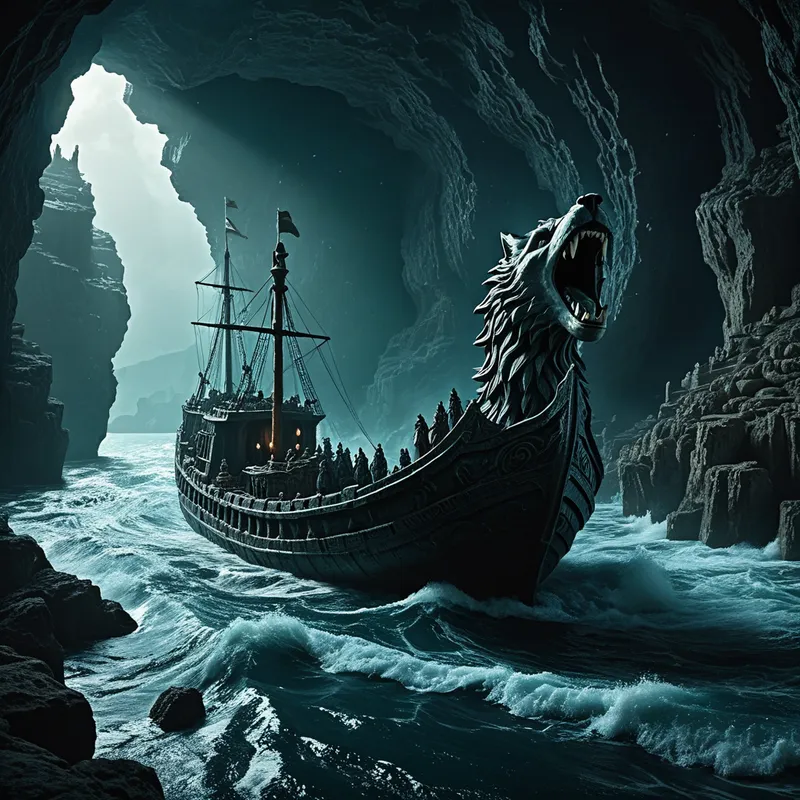
Scylla Myth Meaning & Symbolism
A nymph transformed into a ravenous monster, Scylla dwells in a narrow strait, creating an impossible choice for all who must pass her by.
The Tale of Scylla
Listen, and hear of the strait where the sea itself holds its breath. On one side, the whirlpool Charybdis drinks the deep and spews it forth, a hungry, rhythmic throat in the waves. On the other, sheer cliffs rise from the foam, and in their heart, a cave. This was the domain of Scylla.
Once, she was no monster. She was a nymph of exquisite grace, beloved by the sea-god Glaucus. But Glaucus, in his passion, sought the aid of the dread sorceress Circe, mistress of pharmaka and potent words. He begged for a love philter to win Scylla’s heart. Circe, however, looked upon the sea-god and desired him for herself. When he spurned her, a cold fury took root in her divine heart—a fury not for Glaucus, but for the innocent object of his love.
Circe went to the tranquil pool where Scylla bathed. The water was clear and sweet, reflecting the nymph’s unblemished form. Into this purity, Circe poured a vial of venom distilled from darkest roots and the bile of cursed creatures. She chanted words that twisted reality, that sought not to kill, but to defile.
Scylla stepped into the pool. The water did not feel cold, but alive—a seeping, invasive horror. Where it touched her skin, a burning agony erupted. She screamed, a sound that echoed off the cliffs, but no help came. She stumbled from the pool, her body convulsing, warping. From her loins, six hideous, serpentine necks erupted, each crowned with a head of snapping, triple-rowed teeth and the mad, barking cry of a ravenous wolf. Her beautiful legs fused into a tangle of canine forms, forever restless. The mind of the nymph remained, trapped within a fortress of monstrous hunger, her cave now a tomb of her former self.
From that day, the strait became a place of whispered dread. Any ship that dared the passage faced an impossible calculus: risk the all-consuming maw of Charybdis, or skirt the cliffs and face Scylla. Her six necks would dart from the cave like striking adders, each seizing a sailor from the deck—a scream, a crunch, and then silence, as the monster withdrew to her lair to feed. The greatest of heroes, Odysseus, faced her with grim wisdom. Ordered to silence his men, he steered close to her cliff, choosing to lose six companions to her jaws rather than his entire ship to the whirlpool. He passed, hearing their dying cries, a captain carrying the weight of a necessary, horrific sacrifice.

Cultural Origins & Context
The tale of Scylla is woven most famously into the epic tapestry of Homer’s Odyssey, an oral poem refined over centuries before being transcribed. For the ancient Greeks, a seafaring people, the Mediterranean was both livelihood and labyrinth, filled with very real dangers—sudden storms, hidden rocks, and narrow passages. Scylla and Charybdis gave a name and a face to the ultimate nautical nightmare: the unavoidable, lose-lose scenario.
Bards would recite these passages not merely as adventure, but as a profound lesson in navigation, both literal and existential. The myth functioned as a cognitive map for peril. It externalized the terror of the unknown sea into a narrative that could be understood, remembered, and discussed. It taught that some dangers are geographical facts of life, and that leadership sometimes involves choosing which part of your crew, your heart, or your cargo you are willing to lose. The story was a cultural container for the anxiety of trade, exploration, and war, reminding listeners that the path home is often lined with impossible choices.
Symbolic Architecture
Scylla is not merely a monster; she is a monument to corrupted potential. Her myth is a masterful depiction of the psyche’s fragmentation under the force of a toxic projection.
The true horror of Scylla is not her form, but the preserved consciousness within it. She is the ego trapped in a complex, forced to witness its own destructive hunger.
Her transformation by Circe’s poisoned pool symbolizes how a soul can be invaded and reshaped by another’s unresolved envy, rage, or rejected desire—what we would call psychological projection of the shadow. Scylla did nothing to earn her fate; she was the innocent bystander annihilated by a goddess’s spite. This speaks to the experience of receiving a “curse”—a negative identity, a debilitating complex, or a traumatic wound that feels externally imposed, twisting one’s nature into something self-alien and ravenous.
The six heads represent a fractured, multi-directional consciousness. Where there was one unified being, there is now a committee of insatiable, animalistic impulses. The strait itself is the archetypal narrow place, the liminal threshold where one is most vulnerable. Scylla and Charybdis together embody the classic double-bind: a choice between two catastrophic outcomes, where any action leads to loss. This is the essence of psychological paralysis, where every path forward seems to demand a sacrifice of part of the self.

The Dreamer's Resonance
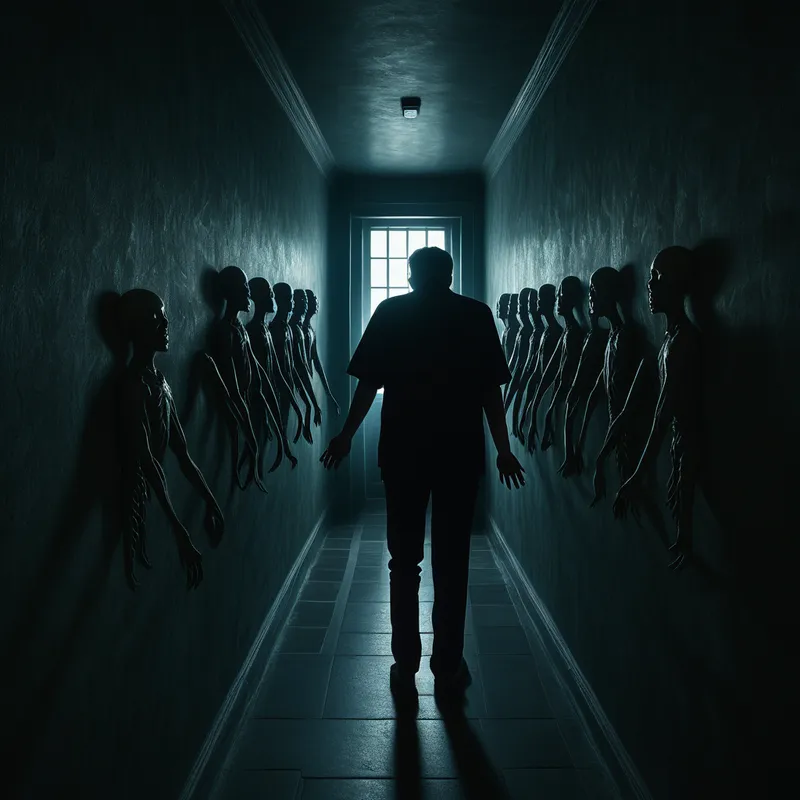
When Scylla emerges in the modern dreamscape, she rarely appears as a classical monster. Instead, her essence manifests as the architecture of an impossible choice. The dreamer may find themselves in a narrowing hallway where the walls begin to sprout grasping hands. They may be trying to navigate a critical meeting or conversation, only to feel that every word they speak is being “snatched” and twisted into something harmful, leaving them feeling attacked from multiple angles at once.
Somatically, this can feel like a tightening in the gut or throat—the physical sensation of being in a bind. Psychologically, it signals that the dreamer is in the grip of a complex, likely one that feels both foreign and intimately destructive. The dream is presenting the structure of a no-win scenario sourced from either an internal conflict (e.g., a part of you that needs expression feels it will destroy another part that needs safety) or an external situation where one feels like an innocent victim of another’s “poison”—betrayal, slander, or emotional manipulation. The dream Scylla asks: What part of yourself feels seized and devoured when you try to move forward?
Alchemical Translation
The alchemical journey modeled here is not one of slaying the monster, but of integrating the truth of the narrow passage. Odysseus does not defeat Scylla; he acknowledges her as a permanent, geographic fact of his journey home. He makes the conscious, agonizing choice to sacrifice a part to save the whole.
Individuation is not about avoiding the strait, but about learning to steer through it with eyes open, accepting the cost of passage as the price of the journey.
For the modern psyche, the “alchemical translation” involves several steps. First, recognizing the poison pool: identifying the source of the toxic transformation—the external criticism, the past trauma, the internalized belief—that warped a natural instinct into a ravenous complex. Second, acknowledging the monstrous form: confronting the part of oneself that has become reactive, hungry, and fragmented without identifying wholly with it. One must say, “This rage, this fear, this insatiability is in me, but it is not all of me.”
Finally, one must navigate the strait. This is the act of conscious choice within limitation. It means identifying what must be “fed to the monster”—perhaps a naive ideal, a dysfunctional loyalty, or the hope of a lossless victory—in order for the core vessel of the self to continue its voyage. The goal is not to become un-monstrous, but to understand the monster’s place in your ecology. The integrated self learns to hear the barking of the heads not just as a threat, but as a signal: you are in the narrow place. Choose, sacrifice, and keep sailing. The transformation from victim of the curse to navigator of its terrain is the ultimate psychic transmutation Scylla’s myth offers.
Associated Symbols
Explore related symbols from the CaleaDream lexicon: