
Noah's Rainbow Myth Meaning & Symbolism
After a world-destroying flood, a rainbow appears as a divine sign of a new covenant, promising mercy and marking a profound psychic reset for humanity.
The Tale of Noah's Rainbow
Listen. The memory of water is long, and it remembers a time when it covered everything.
The world had become a cacophony of violence, a twisted song where every thought of the human heart was only evil, all the time. The fabric of creation groaned under the weight of it. And Yahweh, who had breathed life into the dust, looked upon His work and His heart was filled with a profound, grieving pain. The decision was not wrath, but a terrible surgery: to cut away the infection, to let the deeps rise and the windows of heaven open, and wash the slate of the world clean.
But in the midst of the gathering darkness, there was one man: Noah. A man who walked with God, a quiet island of integrity in a raging sea of corruption. To him came the impossible instruction: build an ark, a mountain of pitch-sealed wood, a womb of gopher wood to hold the seed of all that crawls, flies, and walks. For forty days and forty nights, the deluge fell. The fountains of the great deep burst forth. The world drowned in its own forgotten prayers.
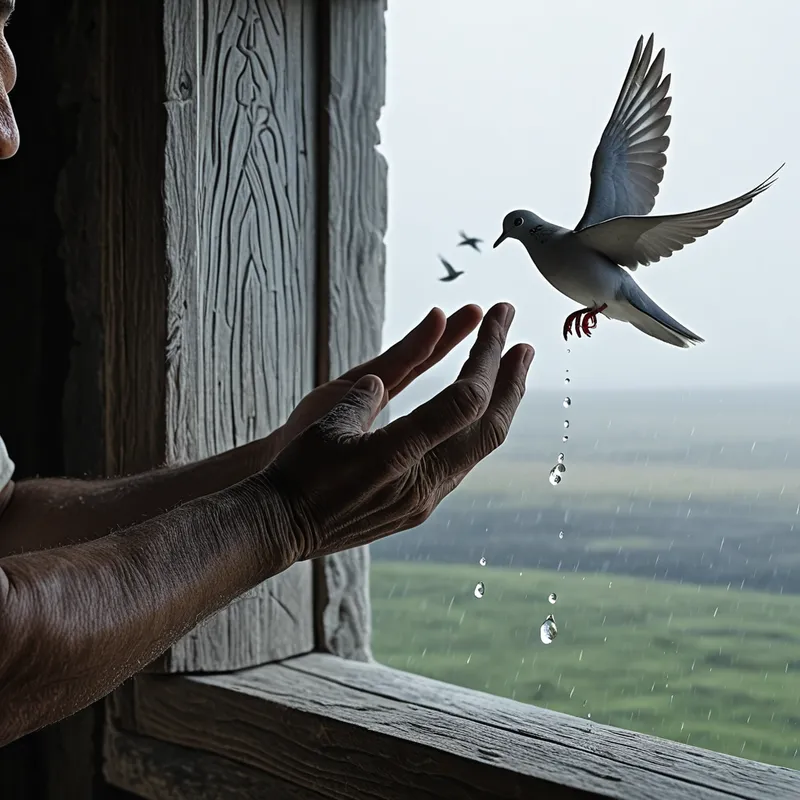
The ark rode the chaos, a sealed capsule adrift on an endless, grey ocean. Inside, the stench of animals, the creak of timbers, the sound of a family holding its breath for a year. Finally, the waters receded. The great vessel came to rest on the bones of Mount Ararat. A raven was sent out, and it found no home. A dove returned, its feet empty. Then, after another wait that must have felt like eternity, the dove returned a final time, and in its beak was a freshly plucked olive leaf. Life had pushed through the mud.
Noah built an altar. He offered sacrifices from the clean animals, and the smoke of gratitude and atonement rose into the clear, scarred sky. And Yahweh smelled the pleasing aroma. His heart shifted. He spoke a promise into the silence of the new world: "Never again." Never again would He curse the ground because of humankind. Never again would He strike down every living creature. The rhythm of seedtime and harvest, cold and heat, summer and winter, day and night—these would not cease.
Then He set His bow in the clouds.
It was not placed there anew, but laid down. A warrior hanging up his weapon, turning it away from the earth. "This is the sign of the covenant I am making between me and you and every living creature with you, a covenant for all generations to come: I have set my rainbow in the clouds, and it will be the sign of the covenant between me and the earth. Whenever I bring clouds over the earth and the rainbow appears in the clouds, I will remember my covenant... Never again will the waters become a flood to destroy all life."
The first rainbow was not merely refraction. It was a signature in light and water, a divine promise etched across the vault of heaven, a bridge between a grieving God and a chastened world.
Cultural Origins & Context
This narrative is embedded in the Torah, specifically the book of Genesis (chapters 6-9). It exists within a corpus of ancient Near Eastern flood myths, most notably the Epic of Gilgamesh, suggesting a shared cultural memory of catastrophic deluges. However, the Biblical account is radically theologized.
It was a story told and retold by priestly custodians and wisdom teachers, not as mere history, but as foundational theology. Its primary function was to answer profound existential questions for the early Israelite community: Why is there suffering and evil? Why does God not simply destroy wickedness? What is God's fundamental posture toward creation? The story establishes the concept of the covenant—a relational contract based on divine promise rather than human perfection. It served to explain the natural phenomenon of the rainbow, investing it with sacred meaning, and fundamentally, to assure a vulnerable people of a stable, merciful cosmic order despite human failings.
Symbolic Architecture
The myth is a dense symbolic architecture built around the interplay of chaos and order, judgement and mercy, death and rebirth.
The Flood represents the unconscious itself—the primal, formless waters of Tehom returning to engulf a conscious order that has become corrupt and rigid. It is a necessary, if terrifying, dissolution.
The Ark is the protective vessel of the psyche, the conscious ego-complex (Noah and his family) that safeguards the potential for life (the animals, the seeds). It is the principle of discernment and obedience that allows one to navigate a period of total psychic inundation.
The covenant is not a reward for righteousness, but a unilateral promise made in the full knowledge of continued human failing. It is grace inscribed on the sky.
The Rainbow is the ultimate symbol. It is a bridge, a connection between heaven and earth after a catastrophic separation. It is composed of light and water—the very elements of the storm now reconciled into a sign of peace. Most powerfully, it is a laid-down weapon. The divine warrior's bow is now aimed away from the earth, its string slack. It signifies a fundamental shift in the divine-human relationship: from periodic, catastrophic intervention to enduring, patient relationship.
The Dreamer's Resonance
When this myth stirs in the modern dreamer, it often signals a profound process of psychic reset. Dreaming of overwhelming floods speaks to a feeling of being emotionally or psychologically drowned by circumstances, repressed contents, or a life structure that has become toxic.
Dreaming of an ark, a sealed room, or a bunker suggests the ego is in a necessary but isolating phase of preservation, holding the core self together while a storm of change rages outside. The release of birds—especially doves—in a dream points to a search for hope, for a sign that the "waters are receding" and new ground is emerging.
To dream of a rainbow, particularly one that appears after a storm in the dream narrative, is a powerful sign from the deep psyche. It indicates the resolution of a period of intense inner conflict or despair. It is the soul's own covenant with itself, a promise that the period of punitive self-judgement or catastrophic fear is over, and a new, more compassionate internal order is being established.

Alchemical Translation
The alchemical journey mirrored here is the Nigredo followed by the Albedo.
The Nigredo is the flood: the blackening, the dissolution of the old, inflated, or corrupt persona. Everything one thought was solid is washed away in a dark night of the soul. This is a painful but necessary mortificatio—the death of an old way of being.
The ark's journey is the Albedo: the whitening, the purification. It is a period of introverted incubation. Inside the vessel, the chaotic elements (the animal instincts) are contained and re-ordered. One must wait, tend to what has been saved, and trust the process without sight of land.
The emergence from the ark and the offering is the beginning of Citrinitas (the yellowing), a return of the spirit to the renewed earth. But the climax of the opus is the rainbow—the Rubedo, the reddening, the symbol of the Coniunctio Oppositorum.
The individuated Self does not emerge perfect, but under a new covenant: an acceptance of one's shadow and a promise of self-compassion, symbolized by the bow that will not be turned against oneself.
The rainbow is the transcendent function made visible. It unites the opposites: judgement and mercy (God's nature), heaven and earth (the realms), light and water (the elements), destruction and promise (the narrative). For the modern individual, the triumph is not surviving the flood, but internalizing the rainbow. It is the hard-won knowledge that after every inner catastrophe, the psyche has the innate capacity to establish a new covenant with itself—a promise of enduring value and mercy, written in the very substance of your trials. The weapon of self-annihilation is laid down, and in its place, a bridge of breathtaking color arcs across the cleared sky of your being.
Associated Symbols
Explore related symbols from the CaleaDream lexicon: