Judgement Myth Meaning & Symbolism
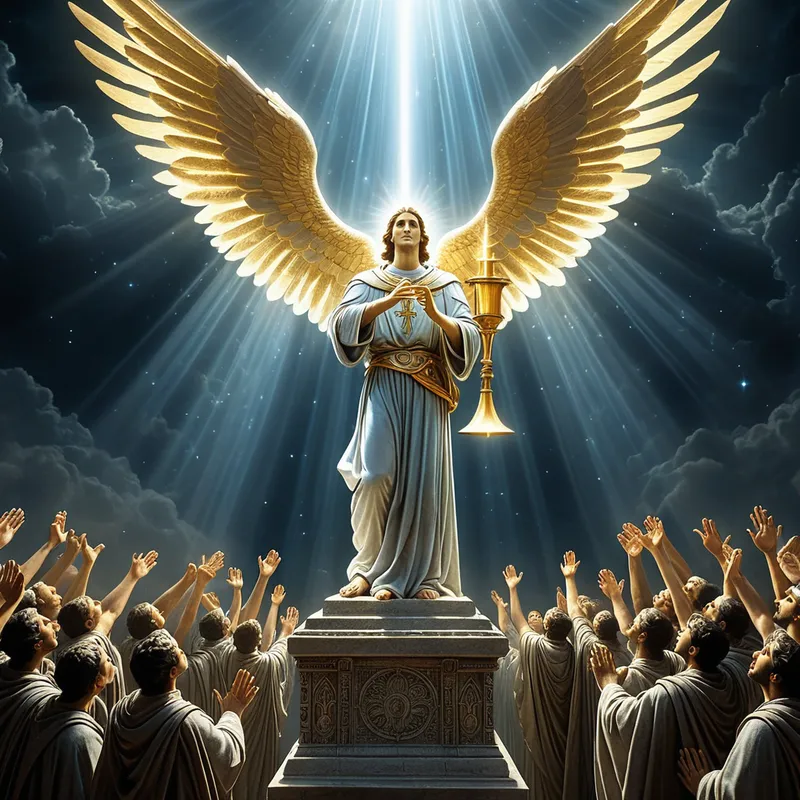
A celestial trumpet sounds, calling the dead from their graves to rise, be judged, and be reborn into a new and eternal existence.
The Tale of Judgement
Hark, and listen to the silence before the sound. It is a silence that has weight, the deep and dusty quiet of a forgotten field where stone sleeps upright. Here lie the sleepers, entombed not in earth, but in their own finished stories. Their names are carved, their deeds are summed, their lives are closed books on a shelf of memory.
Then, it comes.
Not a crack of thunder, not a roar of wind, but a single, pure, clarion note. It pierces the veil of worlds, a vibration from a realm of pure idea. It is the sound of a question asked of the universe, now returning as an answer. From the boundless azure, a figure descends. Not with fury, but with the terrible gravity of truth. It is the Archangel Gabriel, herald of the ultimate dawn. Her wings are not of feather, but of crystallized light, and in her hands rests a trumpet of spiraling gold.
The note swells. It does not assault the ears; it resonates in the marrow. It vibrates in the sealed chambers of the heart. In the grey field, the stone begins to hum. A fine dust shakes from the lids of the coffins. A crack, hair-thin, appears. Then another.
And the sleepers stir.
Not a groaning of zombies, but a sigh of profound recognition. A man, his face still lined with the worries of a life long gone, opens eyes that are suddenly clear. A woman, her hands remembering the weight of a child, pushes against the stone that is no longer a prison, but a shell. Children, old in death, become young in awakening. They rise, naked and unashamed, from their sarcophagi. They do not look at the earth they are leaving, but upward, their faces bathed in the angelic radiance. Their arms are not raised in supplication, but in greeting—as one greets a long-awaited sunrise, or a truth finally understood.
The angel does not speak words. The trumpet’s call is the speech. It is a call that contains its own verdict: Awake. Remember. Arise. It is not a weighing of sins on a scale, but a revelation of essence. The call strips away the narrative of the life lived—the failures, the triumphs, the masks worn—and asks only for the core being beneath to stand and be seen. To be acknowledged by the source from which it came.
One by one, they answer. They step forward, not to a throne of wrath, but into the streaming light itself. As they pass into that brilliance, their forms do not vanish, but become more vivid, more real. The worn face of the laborer smooths into an expression of serene strength. The anxious clutch of the mother relaxes into an open, receiving grace. They are not being judged from without; they are judging, from the deepest part of themselves, what is essential and what was merely costume. They are answering the final, most important question of their existence: Who are you, now that the story is over?
And with that answer, given not in words but in the simple act of rising, the field of stone is transformed into a shore of a new, boundless sea. The graves are empty shells. The call fades, not into silence, but into a new, living harmony. The awakening is complete. The judgement was the awakening itself.
Cultural Origins & Context
The imagery of the Judgement card finds its roots not in a single, codified Tarot myth, but in a rich tapestry of Western esoteric and religious thought woven into the cards by occult scholars of the 18th and 19th centuries. While the earliest Tarot decks featured a simple "Angel" card, the Hermetic Order of the Golden Dawn, and later artist A.E. Waite and illustrator Pamela Colman Smith, crystallized the iconography we recognize today.
They drew directly from Christian eschatology—the doctrine of the Last Judgment, where the archangel Gabriel's trumpet summons the dead for resurrection and final reckoning. This potent narrative was lifted from a purely theological context and alchemized into a psychological and spiritual metaphor within the Major Arcana. Its societal function within Tarot culture shifted from a threat of future punishment to a map of internal process. It became a story told not to frighten the faithful, but to guide the seeker. It passed from teacher to student as a key to understanding the moment of profound self-evaluation that precedes any genuine rebirth, whether in a mystical initiation, a psychological crisis, or a simple, life-altering decision.
Symbolic Architecture
At its heart, the myth of Judgement is not about external condemnation, but about an internal, irrevocable call to authenticity. The sleepers in the tombs symbolize the parts of ourselves we have buried: forgotten talents, abandoned dreams, unresolved grief, or outgrown identities. We encase these in the stone of "that's just how I am" or "that part of my life is over."
The trumpet is the sound of the soul's discontent with the lie of finality. It is the crisis that shatters complacency.
The Archangel Gabriel represents a higher consciousness or the Self (in Jungian terms) breaking through. This is not a gentle nudge; it is a clarion call that cannot be ignored—a sudden insight, a devastating loss, a peak experience, or a deep therapy session that demands we review our life. The resurrection is the active response. It is the painful, courageous work of integrating those buried parts, of acknowledging our whole story—shadow and light—and standing in that truth. The "judgement" is the moment of radical self-honesty where we assess what serves our essential being and what must be left behind in the empty tomb.
The Dreamer's Resonance
When this myth stirs in the modern dreamscape, it often manifests not as biblical pageantry, but as potent, visceral symbolism. To dream of a sudden, resonant alarm—a phone ringing with no caller ID, a school bell in an empty hallway, a siren that only you hear—is to feel the Judgement call in the psyche. Dreams of excavating a basement, opening a sealed room in a childhood home, or finding a forgotten diary are encounters with the "tombs."
The somatic experience is key. The dreamer may feel a profound vibration in their body, a shaking, or a sense of being "called" or pulled awake within the dream itself. There is often a mixture of dread and exhilaration. This signals a psychological process of individuation reaching a critical juncture. The psyche is issuing a final summons to confront what has been repressed or ignored. The dream is the internal Gabriel, sounding the trumpet for a long-overdue soul reckoning. To ignore it leads to a sense of existential stagnation; to heed it, though terrifying, is the first step toward psychic rebirth.
Alchemical Translation
The alchemical journey of the individuation process mirrors the Judgement myth perfectly. Alchemy’s final stage, after the blackening (negredo), whitening (albedo), and yellowing (citrinitas), is the reddening (rubedo)—the achievement of the philosopher's stone, or the fully integrated Self. Judgement represents the fiery, transformative moment just before this completion.
The call to rise from the grave is the command to unify the lead of the persona with the gold of the spirit, creating a living philosopher's stone—the authentic self.
In our lives, this translates to the moment when we can no longer tolerate the disconnect between who we pretend to be and who we truly are. The "angel's call" might be a burnout that forces a career change, a relationship ending that demands self-reflection, or simply the quiet, accumulating weight of inauthenticity. The alchemical fire is the discomfort of that truth. The "rising dead" are the reclaimed energies: the passion we called foolishness, the sensitivity we called weakness, the ambition we buried to keep the peace.
By answering the call—by engaging in that profound self-assessment and choosing to integrate our buried selves—we perform the ultimate alchemy. We transmute the base narrative of a "life sentence" (our fixed identity) into the gold of a conscious existence. We are not judged by an external god; we become the conscious participants in our own divine act of creation. The coffin lid cracks, and we step out, not into a pre-determined heaven, but into the boundless possibility of a life truly our own.
Associated Symbols
Explore related symbols from the CaleaDream lexicon: