Meiping Vase Myth Meaning & Symbolism
A celestial artisan's quest to contain the essence of chaos, creating a vessel that holds the tension between perfect form and the wild, untamable spirit within.
The Tale of Meiping Vase
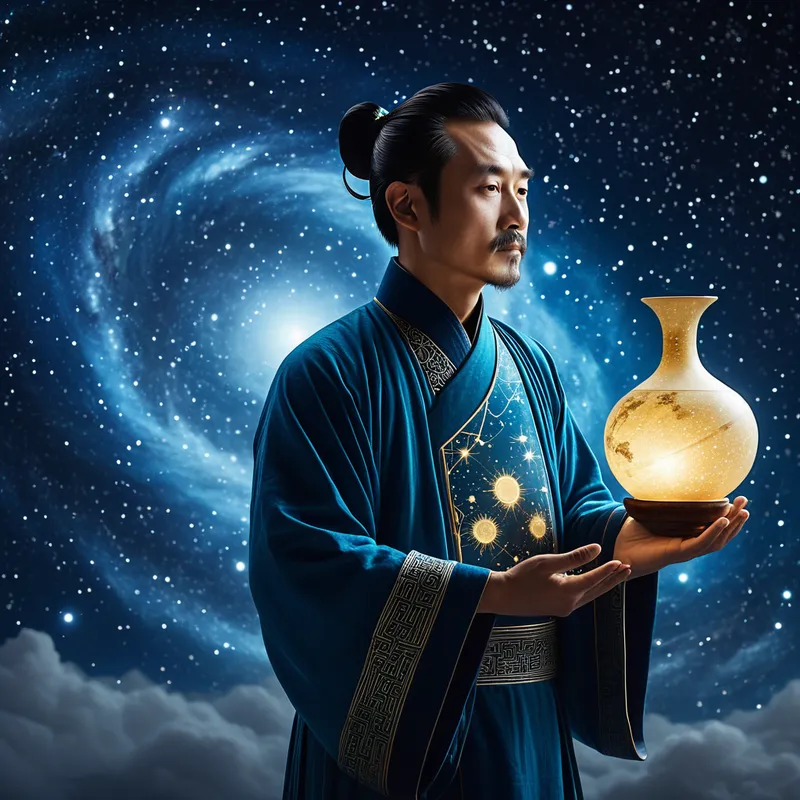
Listen, and hear the whisper from the time before time, when the sky was still being polished and the earth was learning to be firm. In the celestial workshops of the Jade Emperor, there labored an artisan whose name was not spoken, for his essence was his craft. His fingers were shaped from the clay of the first riverbanks, his breath the mist of the primordial dawn.
His task was not to forge weapons or carve thrones, but to give shape to harmony itself. Yet, a discord had arisen in the ten thousand things. A spirit, born from the first sigh of chaos before order was imposed, roamed the heavens. It was the Hun without its Po, a wild, untetalled song of pure potential. It was beautiful and terrifying—a storm of jade-green light, a melody that promised both creation and dissolution. It could not be destroyed, for it was a fundamental note of the cosmos, yet it could not be left to roam, lest it unravel the delicate tapestry of seasons and stars.
The celestial artisan felt this discord in his very bones. He went to the kiln fired by the heart of a dormant sun and gathered clay tempered with crushed moonstone and the tears of the Xi Wangmu. For nine and forty days he did not sleep, his hands moving not by thought but by a deeper, dreaming rhythm. He did not seek to build a cage, but a home. He shaped a vessel with a broad, generous shoulder—a cosmos in miniature, capable of holding vastness. He drew the clay upward into a narrow, steadfast neck—a mountain path leading to the heavens, a channel for focus.
As he worked, the wild spirit was drawn to the forming vessel. It shrieked and flowed, filling the space, testing the seams. The vase shuddered on the wheel, threatening to collapse into formlessness. The artisan did not force it. Instead, he sang a song of the earth’s patience, of the river’s persistent path, of the unfurling of a lotus from the mud. His song was not a command, but an invitation to relationship.
On the fiftieth day, he placed the vessel into the sun-heart kiln. This was the moment of truth—the marriage of form and spirit under transformative fire. The heavens held their breath. The kiln glowed with an otherworldly light, and from within came a sound like a thousand winds and a single, clear bell. When the fire died and the ashes cooled, the artisan reached in.
There it stood. The Meiping. Its surface was the cool, serene green of deep jade, flawless and calm. But within its confines, if one listened closely, one could hear the faint, eternal echo of the wild song, now tempered, given a shape to resonate within. It held chaos, not by suppression, but through a form so perfectly conceived that the chaos itself chose to abide there, becoming the essence of its vitality. The artisan placed a single branch of winter plum blossom within it, and the wild spirit sighed, content, giving the blooms an eternal fragrance. The vessel had not captured the spirit; it had communed with it, and in doing so, created a new kind of order—one that included the wildness at its heart.
Cultural Origins & Context
The myth of the Meiping Vase is not a single, codified epic from a classic text like the Shanhai Jing. Instead, it is a myth that lives in the space between art, philosophy, and craft. It is the story told by the potter’s hands, the lore passed down in imperial workshops, and the poetic allegory understood by scholars of Dao and Yijing.
Its origins are woven into the very practice of creating the Meiping, a vase form from the Song Dynasty renowned for its elegant, stable silhouette—broad-shouldered and tapering to a small, neat neck. Historically used for storing wine or displaying the prized branches of plum blossom (mei), the vase itself became a cultural symbol of scholarly refinement, resilience (the plum blooms in winter), and contained beauty. The myth arises to explain not just the object's use, but its soul. It answers the question: why does this form feel so complete, so resonant?
This narrative was likely nurtured within Daoist and later Chan (Zen) Buddhist circles, where the relationship between form and emptiness, discipline and spontaneity, was a central contemplation. The artisan is the archetypal Zhenren, acting in Wu Wei. The myth served a societal function beyond entertainment; it was a metaphysical blueprint for harmony. It taught that true order is not rigid control, but the creation of a vessel—be it a family, a society, or a self—strong and graceful enough to hold the inevitable, creative chaos of life.
Symbolic Architecture
At its core, the myth of the Meiping Vase is a profound exploration of the Yin-Yang dynamic made manifest in a single object. The vase is the meeting point of irreconcilable opposites.
The flawless, serene jade exterior represents the cultivated self—the persona, social norms, conscious discipline, and perfect form (Li). The narrow neck symbolizes focus, discernment, and the conscious gateway through which contents (experiences, impulses) must pass. The broad, hidden interior, however, is the domain of the wild spirit—the untamed Shadow, the raw creative drive, the chaotic wellspring of emotion and instinct. This is the Hundun within.
The greatest vessel does not silence the storm; it gives the storm a geometry in which to sing.
The celestial artisan represents the unifying consciousness, the ego that does not identify solely with the perfect form (the vase) nor the chaotic content (the spirit), but undertakes the sacred work of relating them. His fire is the alchemical process itself—the heat of conflict, introspection, and transformation that fuses these opposites into a new, indissoluble whole. The final vase is a symbol of the complexio oppositorum—the complex of opposites. It is not a resolution that eliminates tension, but a container for that tension, which becomes the source of its vitality and beauty.
The Dreamer's Resonance
When the motif of the Meiping Vase appears in modern dreams, it signals a critical phase of psychic containment and integration. The dreamer is likely grappling with a powerful, potentially overwhelming force within themselves—a surge of creative energy that feels chaotic, a grief or rage that seems formless and destructive, or a profound intuition that defies logical articulation.
To dream of crafting such a vase suggests the active, often arduous process of building internal structure—developing healthy boundaries (the neck), creating space for emotion (the belly), and seeking a form of self-expression that can hold one's depth. To dream of a cracked or shaking Meiping indicates a fear that one's current coping mechanisms or self-concept are insufficient to contain inner pressures. The psyche is warning of potential fragmentation.
Conversely, to dream of a serene, intact vase holding a vibrant, luminous storm points toward successful, ongoing integration. It is an image of the Self, where consciousness provides a stable, beautiful form for the powerful and sometimes terrifying contents of the unconscious. The dream is a somatic affirmation: you are not the chaos, nor are you the rigid, empty form. You are the vessel that holds both, and in that holding, you are whole.
Alchemical Translation
The myth models the individuation journey with exquisite clarity. We all begin with the "wild spirit" of our innate, undifferentiated potential and primal drives—our total psyche in its raw state. The first half of life often involves building the "vase": developing an ego, a persona, skills, and a place in the world. This is necessary and good. However, the danger is in mistaking this constructed form for the totality of the self, thereby repressing the wild spirit into the shadow.
The alchemical work begins when the repressed spirit inevitably rebels, causing the vase to shudder. This is the crisis—the midlife upheaval, the creative block, the depression, the relationship fracture. The instinct may be to build a thicker, stronger vase (more control, more discipline) or to let the spirit shatter it entirely (acting out, dissolution).
The alchemy lies in the artisan's song: to listen to the chaos, to learn its nature, and to adapt the form not to imprison it, but to resonate with it.
The "fire of the sun-heart kiln" is the crucible of deep self-confrontation and acceptance. It is the heat of holding the tension between "who I think I should be" (the perfect form) and "what I also am" (the wild spirit). The transmutation occurs when we realize our task is not to eliminate one in favor of the other, but to become the artisan of a more capacious vessel. The narrow neck becomes conscious choice and discernment; the broad shoulders become compassionate self-acceptance.
The final, integrated Meiping is the symbol of the individuated Self. It represents a personality that has internalized its own depths. The wild spirit, once a threat, becomes the source of one's unique vitality, creativity, and authenticity. It is no longer chaos, but contained power. One becomes, like the vase holding the plum blossom, a stable, beautiful form through which the eternal and wild essence of life can express itself in the world. The myth teaches that wholeness is not the absence of conflict, but the capacity to hold it creatively.
Associated Symbols
Explore related symbols from the CaleaDream lexicon: