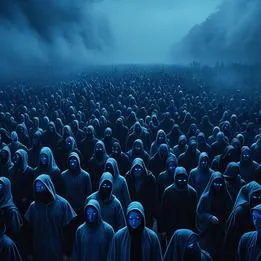
Social Norms Dream Meaning
Unwritten rules governing acceptable behavior within a group, reflecting collective values and expectations.
Common Appearances & Contexts
| Context | Emotion | Interpretation |
|---|---|---|
| Breaking a rule | Guilt | Internal conflict emerging. |
| Being judged | Shame | Fear of social rejection. |
| Following a crowd | Relief | Safety in conformity. |
| Rebelling openly | Liberation | Asserting individuality. |
| Teaching norms | Pride | Upholding values. |
| Norm shifting | Confusion | Adaptation required. |
| Isolated for nonconformity | Loneliness | Social cost of difference. |
| Enforcing norms | Power | Control dynamics. |
| Norms dissolving | Anxiety | Loss of structure. |
| Celebrating tradition | Joy | Cultural bonding. |
| Hidden violation | Fear | Secrecy and exposure. |
| Adapting to new | Curiosity | Learning and growth. |
Interpretive Themes
Conformity vs. Individuality
highCore identity conflict in dreams.
Belonging and Exclusion
highReflects social anxiety or integration.
Authority and Compliance
mediumMay indicate internalized control.
Cultural Integration
mediumCommon in transitional life phases.
Moral Judgment
lowLinked to conscience or guilt.
Cultural Lenses
Jungian Perspective
View Context →Represents the collective unconscious and persona—the mask worn for social acceptance. Dreams may reveal tension between authentic self and societal expectations, urging individuation.
Freudian Perspective
View Context →Symbolizes the superego's internalized parental and societal rules. Dreams often express repressed desires conflicting with these norms, revealing unconscious guilt or rebellion.
Gestalt Perspective
View Context →Viewed as projections of internalized rules. Dreams encourage owning these norms as parts of the self, exploring conflicts between 'shoulds' and authentic desires.
Cognitive Perspective
View Context →Reflects schemas and scripts for social behavior. Dreams process daily social interactions, rehearsing or challenging these mental models to reduce anxiety or enhance adaptation.
Evolutionary Perspective
View Context →Rooted in survival mechanisms for group cohesion. Dreams simulate social scenarios to practice norm adherence, avoiding ostracism and ensuring tribal belonging and safety.
East Asian Perspective
View Context →Often emphasizes harmony (e.g., Confucian li). Dreams may highlight duty, filial piety, and collective well-being, with violations causing deep shame historically and in modern contexts.
South Asian Perspective
View Context →Tied to dharma (duty) and caste-based expectations. Dreams reflect spiritual and social obligations, with modern tensions between tradition and globalization shaping interpretations.
Middle Eastern Perspective
View Context →Influenced by religious codes (e.g., Sharia) and honor systems. Dreams often explore community honor, hospitality norms, and familial duties, with modern secular challenges.
European Perspective
View Context →Historically class-based and formal, now more individualistic. Dreams may juxtapose old etiquette with contemporary liberalism, reflecting identity and social mobility struggles.
African Perspective
View Context →Centered on ubuntu (interconnectedness) and elder respect. Dreams emphasize community rituals, oral traditions, and modern clashes with urbanization or colonial legacies.
North American Perspective
View Context →Blends individualism with diverse subcultures. Dreams often highlight personal freedom versus conformity, reflecting melting-pot anxieties and digital-era norm fluidity.
Latin American Perspective
View Context →Rooted in familialism and machismo/femininity norms. Dreams explore collectivism, religious syncretism, and modern shifts toward gender equality and political expression.
Interpret Your Full Dream
Beyond this symbol, every dream carries a unique story. Share your dream for a personalized AI-powered interpretation.