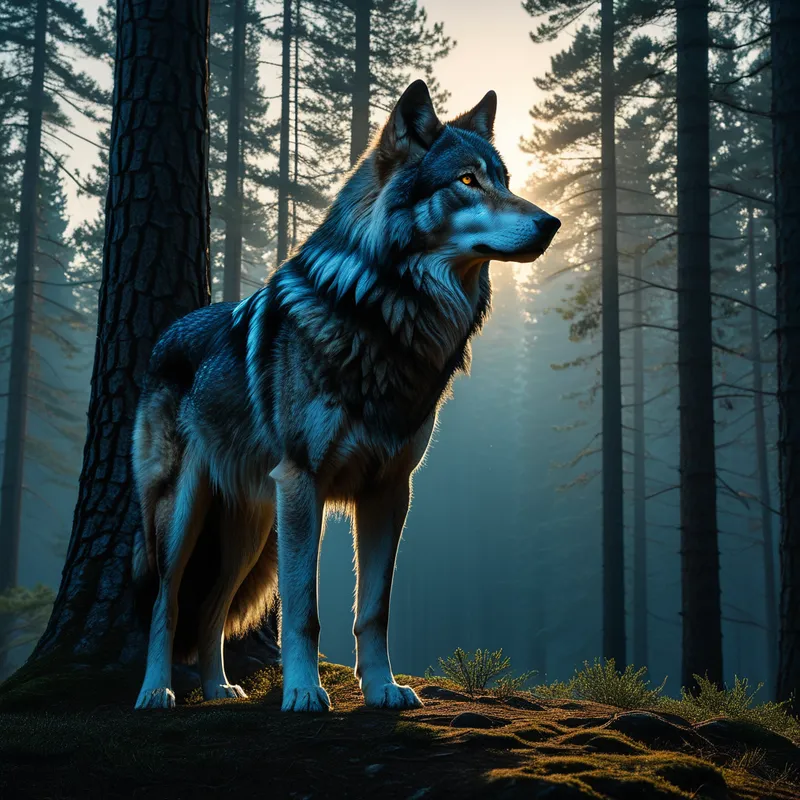
Shape-shifter Myth Meaning & Symbolism
A being of fluid form teaches that identity is not a cage, but a dance between the many souls we carry within.
The Tale of Shape-shifter
Listen. The wind does not always tell the truth. It can carry the scent of pine, then of rain, then of distant smoke—all in one breath. So it was with He Who Walks In Many Skins. In the time when the world was soft and the stories were still being woven into the mountains, he was born of a union between the steadfast earth and the restless spirit-wind. He was not one, but a chorus.
He walked first as a man, with eyes the color of dark water. He learned the songs of the people, the rhythm of the drum that echoed the heartbeat of the world. But his own heart beat to a more complex rhythm. When he hunted, he felt the longing of the deer for the thicket. When he sat by the fire, he heard the crackling logs whisper secrets in the tongue of the trees. He was a stranger in his own skin.
The conflict arose not from malice, but from a deep, tearing loneliness. The people saw his distant gaze, his moments of utter stillness where he seemed not to be there at all. "He is divided," they whispered. "His spirit is not whole." He felt their unease like a wall of cold air. The great conflict was within: a soul too vast for a single form, yearning for the freedom of the hawk, the strength of the bear, the cunning of the coyote, all while anchored by the love for his human kin.
One bitter winter, when the game was scarce and the people’s bellies were tight with hunger, the crisis broke. A child, wandering too far, was taken by the roaring river. The people despaired. It was then that He Who Walks In Many Skins walked to the riverbank. He did not dive in as a man. He stood at the water's edge, closed his eyes, and remembered. He remembered the powerful stroke of the otter, the fearless dive of the merganser. He let the human shape fall away like a heavy cloak. His bones lightened, his form streamlined, fur rippling over his skin. He became the otter, and slipped into the icy current.
With a grace no human could possess, he retrieved the child, pushing the small, cold body to the shore. As the people rushed forward, he pulled himself onto the bank, and before their astonished eyes, the water shedding from him became not fur, but the long hair of a man. He stood, shivering, human once more, the child safe in his arms.
The resolution was not an end, but a beginning. The people no longer saw division, but a sacred wholeness of a different order. He had not betrayed his humanity; he had fulfilled a deeper covenant with all life. He became the bridge. In times of need, he would take the skin of the scout, the protector, the healer—whatever form the moment demanded. He taught that the boundary between self and other, between human and animal, is a veil, not a wall. And when his time in this world was done, it is said he did not die, but simply walked into the forest, his form dissolving into a mist that touched every leaf and stone, becoming part of the ever-shifting breath of the world itself.

Cultural Origins & Context
The shape-shifter is not a singular character from one tribe, but a pervasive and powerful archetype found across countless Native American nations, from the Navajo (Diné) to the Ojibwe, from the Hopi to the Haida. These stories were the living breath of oral tradition, passed down through generations by elders and storytellers around winter fires or during summer gatherings. Their function was multifaceted: they were cosmological maps, ethical teachings, and profound psychological tools.
Societally, shape-shifter myths reinforced the fundamental indigenous worldview of kinship and reciprocity with the natural world. Humans were not above or separate from nature, but participants in a vast, conscious network. The shape-shifter, often a shaman or a cultural hero, embodied this intimate connection. The stories served as reminders that animals possess wisdom, power, and personhood. They taught respect, caution, and the understanding that appearances are deceptive—a lesson crucial for survival and social harmony. The myth was a narrative vessel for exploring the most fluid and mysterious aspects of identity, power, and the soul's journey.
Symbolic Architecture
At its core, the shape-shifter myth dismantles the illusion of a fixed, monolithic self. It symbolizes the psyche's innate plurality and fluid potential.
The shape-shifter is the living proof that the soul is not a statue, but a river—constantly moving, taking on the contours of the banks it passes, yet remaining fundamentally itself.
The act of transformation represents the ability to access different modes of being and knowing. The wolf skin offers fierce protection and communal loyalty; the raven’s wings, perspective and trickster wisdom; the bear’s form, healing introspection and formidable strength. These are not mere disguises, but authentic states of consciousness that reside within the human potential. The myth confronts the terror and the ecstasy of liminality—the threshold state of being "between worlds." This is the psychological space where old identities dissolve before new ones coalesce, a space of great danger and even greater possibility.
The shape-shifter’s journey is ultimately one of integration. It is not about abandoning humanity for animalism, nor rejecting animal wisdom for human reason. It is about achieving a conscious, responsible synthesis. The true master of shapes is not one who is lost in multiplicity, but one who can navigate it, choosing the appropriate "skin" for the task at hand while remembering the core, observing self that witnesses all transformations.
The Dreamer's Resonance
When the shape-shifter archetype stirs in the modern dreamscape, it signals a profound somatic and psychological process of identity deconstruction and reconstruction. To dream of changing into an animal, or of a person who fluidly alters form, is to experience the unconscious pressing against the rigid boundaries of the waking ego.
Somatically, this may manifest as restlessness, a feeling of being "caged" in one's life or body, or sudden, intuitive attractions or aversions to certain animals. Psychologically, the dreamer is likely in a life transition—career change, relationship shift, spiritual awakening—where the old self feels inadequate and new potentials are clamoring for expression. The specific animal that appears is a crucial message. A wolf might call for attention to the balance between solitary strength and pack loyalty; a spider, for confronting fears or recognizing one’s skill as a weaver of destiny.
The anxiety in such dreams often mirrors the mythic conflict: the fear of losing oneself, of becoming monstrous or unrecognizable. The dream-work is the psyche’s attempt to initiate the dreamer into their own inner plurality, to reassure that within the chaos of change lies the potential for a more adaptable, resilient, and complete self.

Alchemical Translation
For the modern individual navigating the path of individuation, the shape-shifter myth provides a masterful model for psychic transmutation. Our culture often demands a consistent, brand-like identity, creating what James Hillman called the "neurosis of the single shape." The alchemical work is to dissolve this leaden, rigid ego-structure in the aqua permanens—the everlasting water—of the unconscious, to retrieve the golden, fluid potential within.
The first stage of this alchemy is not to become something else, but to allow the something else that is already within you to be acknowledged.
This is the nigredo, the dark night of the soul, where one confronts the shadowy, animalistic, or "unacceptable" aspects of the self that have been shape-shifted into symptoms, projections, and compulsions. The next stage, the albedo, is the washing clean: observing these multiple selves without identification or judgment, like the shape-shifter consciously choosing a skin. Finally, the rubedo is the integration—not a fusion into a bland uniformity, but a conscious assembly of a "shape-shifting council" within. The mature individual can access the strategist, the nurturer, the warrior, or the mystic as needed, guided by a central, witnessing consciousness—the true He Who Walks In Many Skins.
The myth ultimately translates into a practice of radical self-permission and profound responsibility. It invites us to stop asking "Who am I?" as if seeking a single, final answer. Instead, we learn to ask, "Which part of me is needed here, now, for the good of my soul and my community?" We become, like the mythic being, a conscious bridge—between our many inner selves, and between the human world and the wider, whispering, animate world to which we forever belong.
Associated Symbols
Explore related symbols from the CaleaDream lexicon: