
Lilinoe Goddess of Mists
Lilinoe is the Hawaiian goddess of mists, embodying mystery, transformation, and the subtle veil between the physical and spiritual realms.
The Tale of Lilinoe Goddess of Mists
In the high, silent places of the islands, where the shoulders of the great mountains meet the sky, the world grows soft. Here, the air itself becomes a breath, a visible sigh. This is the realm of Lilinoe. She is not born of a dramatic clash, but emerges as a presence, a gentle exhalation from the land. In the cool, damp hollows of Pele’s dormant craters and upon the sacred summits like Mauna Kea and Haleakalā, Lilinoe weaves her body from the meeting of earth’s cool breath and the sky’s descending embrace.
The myths speak of her not in epic battles, but in quiet, pervasive influence. She is the sister to the more defined elemental powers—to Poli‘ahu, the snow goddess of Mauna Kea, whose crisp white mantle Lilinoe often veils in shifting grey. In the famous rivalry between Pele and Poli‘ahu, Lilinoe is the subtle intermediary. When Pele’s fires rage up the slopes, it is not always Poli‘ahu’s snow that directly challenges her, but often Lilinoe’s mists that roll in first, a cool, damp blanket that whispers of a different power, softening the landscape, obscuring paths, and muting the fire’s glare. She does not fight; she envelops. She does not destroy; she transforms the view, and in doing so, transforms understanding.
Her most profound tale is one of veiling and revelation. It is said that Lilinoe was the keeper of the waters of life, the mist being the first form of water, the breath before the rain. She would draw her cloak over the land, and within that secret, moistened space, life would stir—seeds would swell, ferns would uncurl their delicate fists, and the spirits of the place, the ‘aumakua, would move unseen. She provided the curtain for the sacred, the hidden process of becoming. To journey through her domain was to consent to uncertainty, to release the need for a clear horizon and instead feel one’s way by the cool kiss of moisture on the skin, by the sound of droplets gathering on leaves. In her mist, the familiar became strange, and the strange became intimate. A traveler might lose their way on a known path, only to stumble upon a hidden spring or a forgotten shrine, guided not by sight, but by a deeper, more intuitive sense. Lilinoe’s story is the story of that guided disorientation, where loss of direction becomes the prerequisite for a truer arrival.
Cultural Origins & Context
Lilinoe’s place in the Hawaiian pantheon is deeply tied to the specific ecology and spirituality of the islands. In a culture that observed and deified the precise nuances of the natural world—the many types of rain, wind, and ocean currents—the mist held its own sacred category. It was not merely weather; it was a kino lau, a physical manifestation of a divine body.
She is most consistently associated with the highest elevations, the zones of transition between the solid earth (honua) and the dome of the heavens (lani). These summits were not just geographical features but wahi pana, sacred places, portals to the divine. The mist that frequently shrouded them was seen as both a protective barrier and a sign of the presence of the gods. Rituals and pilgrimages to these summits involved passing through Lilinoe’s veil, a act of purification and preparation to enter a more rarified state of being.
Her familial connections are telling. As a sister to Poli‘ahu (snow), Waiau (the subterranean water of Mauna Kea), and Kahoupokane (the kapa-making goddess connected to fog), Lilinoe is part of a divine cluster governing the cool, moist, softening aspects of nature that counterbalance Pele’s fierce, creative-destructive heat. This places her within the essential Hawaiian concept of balance—kaulike—where opposing forces are not enemies but necessary complements. Lilinoe represents the subtle, pervasive force that moderates, conceals, and prepares the ground for life, in contrast to the sudden, transformative flash of volcanic fire.
Symbolic Architecture
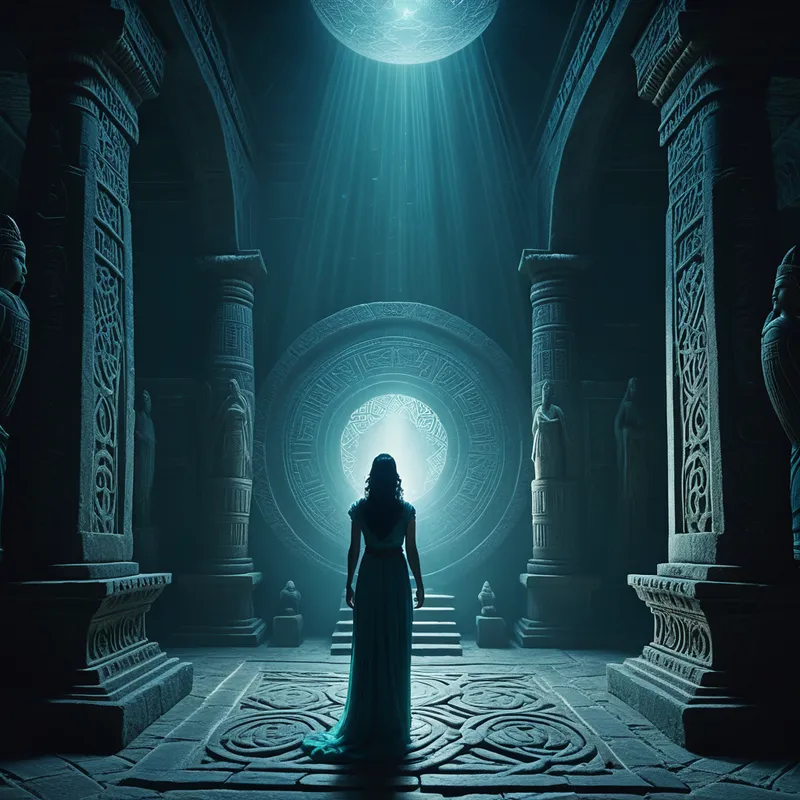
Lilinoe’s power is an architecture of absence and suggestion. She builds not with stone, but with the space between droplets of water. Her domain is the liminal, the threshold where forms blur and identities merge. She is the goddess of the in-between: between mountain and sky, between the seen and the unseen, between the known world and the spirit realm.
Her mist is the visible form of potential. It obscures the literal to invite the symbolic, forcing perception inward. In the psychological landscape, she governs the state of not-knowing, the fertile confusion that precedes insight.
This symbolic function makes her a master of initiation. In traditional Hawaiian society, knowledge (‘ike) was often sacred and graduated, revealed in layers. The mist is the perfect metaphor for this pedagogical mystery. A teacher does not always illuminate with glaring clarity; sometimes, they must first veil the answer, allowing the student to wander in the question, to develop the inner senses required to perceive the truth. Lilinoe is that teacher. She withholds the panoramic view so that one might first notice the dewdrop on the spider’s web, the muffled call of a bird, the cool, specific smell of damp soil—the details that compose the larger truth.
Her essence challenges the modern obsession with transparency and immediate clarity. She asserts that some truths cannot be borne raw, in full sunlight. They require the softening filter, the gentle occlusion that allows for gradual assimilation. The mist protects the tender new growth from scorching sun, just as the unconscious protects the nascent psyche from truths it is not yet ready to integrate.

The Dreamer's Resonance
To encounter Lilinoe in the inner world is to experience the softening of rigid ego-boundaries. She is the presence in dreams where landscapes are shrouded, where familiar people are glimpsed through a haze, their features indistinct but their emotional tone profoundly felt. She is the atmosphere of dreams that deal with mystery, with hidden aspects of the self, or with the slow, osmotic process of healing and understanding.
When one feels lost in the "fog" of life, uncertain of the path forward, Lilinoe may be active. This is not a curse, but an invocation. Her mist asks: Can you stop striving for a distant, clear horizon and instead become exquisitely present to what is immediately around you? Can you navigate by feel, by intuition, by the subtle clues of moisture and sound and temperature? Her resonance calls for a surrender of over-reliance on the sharp, analytical mind (the sun’s glare) and a descent into the body’s wisdom and the heart’s intuitions.
In a psychological sense, she represents the necessary regression that serves progression. To move forward authentically, we sometimes must allow our conscious plans and maps to be veiled, to enter a state of purposeful uncertainty where deeper, older parts of the psyche can realign and offer guidance. She is the patron of therapy, meditation, and any practice where one willingly enters a "misty" state of not-knowing to encounter more authentic knowing. She guards the approach to the Self, ensuring that only those who are willing to be changed by the journey can find the center.

Alchemical Translation
The alchemical process is one of transformation through concealed stages. The mysterium magnum often occurred within the sealed vessel, hidden from view. Lilinoe is that vessel of obscurity. In the soul’s alchemy, her mist represents the solutio stage—not the violent dissolution of fire, but the gentle, pervasive dissolution into a medium where boundaries melt and components begin to commune in new ways. It is the state of suspension, where solid certainties are rendered fluid and possibilities recombine.
In this moist, hidden matrix, the leaden weight of literal identity begins to soften. The ego, no longer able to see its reflection clearly in the hard mirror of the world, must feel its way toward a new, more permeable form.
Her work is the ablutio, the cleansing not by fiery ordeal but by a pervasive, gentle saturation. It is the washing away of dust and grit, not through force, but through insistent, patient presence. This is the transformation of perspective. The mountain does not move, but the experience of the mountain is utterly changed by the mist. So too, the core self may remain, but its relationship to the world and its own history is transformed through the gentle, obscuring work of reflection and re-contextualization.
Lilinoe teaches that revelation is a process of condensation. The diffuse vapor of experience, memory, and feeling must gather on the cool surface of contemplation to form a single, weighty droplet of insight. She is the cool glass that allows the formless to take form. The final "gold" of this process is not a shiny, obvious truth, but a pearl of wisdom formed in the hidden, moist depths of the soul—a truth that carries within it the very mist from which it was born.
Associated Symbols
Explore related symbols from the CaleaDream lexicon:
- Mist — The primary manifestation of Lilinoe, representing the veil between worlds, potentiality, and the softening of harsh realities into ambiguous, fertile mystery.
- Mountain — Her sacred dwelling place, the axis mundi where earth meets sky, representing the lofty, spiritual aspiration that is often shrouded in the mist of the unknown.
- Veil — The fabric of her domain, symbolizing concealment, sacred secrecy, and the protection of mysteries until one is prepared to behold them.
- Transformation Cocoon — The state of being enveloped in her mist, a hidden, moist space where old forms dissolve and new identities slowly coalesce away from the harsh light of judgment.
- Dream — The internal landscape she governs, where logic is softened, boundaries blur, and communication occurs through symbol, feeling, and intuitive resonance.
- Bridge — She is the subtle, often unseen connection between the conscious and unconscious, the physical and spiritual, built not of stone but of moist air and perception.
- Water — In its most ethereal, airborne form, representing the primal, life-giving moisture, emotion, and the fluidity of the psyche.
- Mirror — But a mirror clouded by breath, reflecting not a sharp image of the ego, but a softened, suggestive impression of deeper, more elusive truths.
- Cave — The hidden, moist recess analogous to the mist-shrouded crater, a place of inward retreat, incubation, and encounter with the subterranean or unconscious aspects of self.
- Seed — The potential hidden within her moist cloak, requiring the obscurity and humidity of the earth (or the unconscious) to swell, break open, and begin its growth unseen.