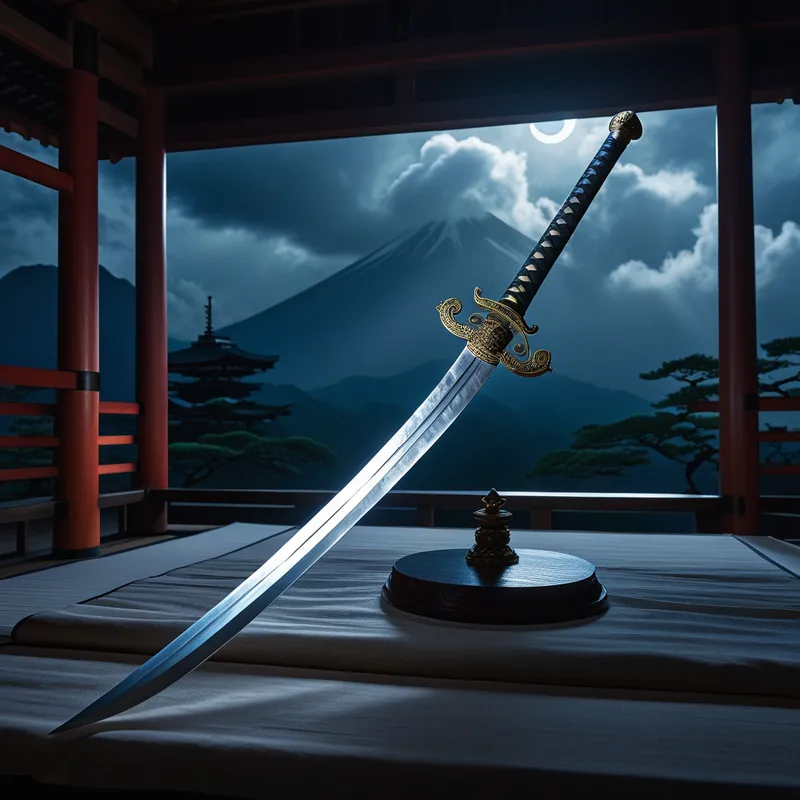
Kusanagi-no-Tsurugi Myth Meaning & Symbolism
A sacred sword born from a serpent's tail, symbolizing imperial authority and the perilous journey to master one's own chaotic, creative power.
The Tale of Kusanagi-no-Tsurugi
Hear now the tale of the sword that cuts the grass, born not in fire but in the belly of a beast, a blade that is both a curse and a crown.
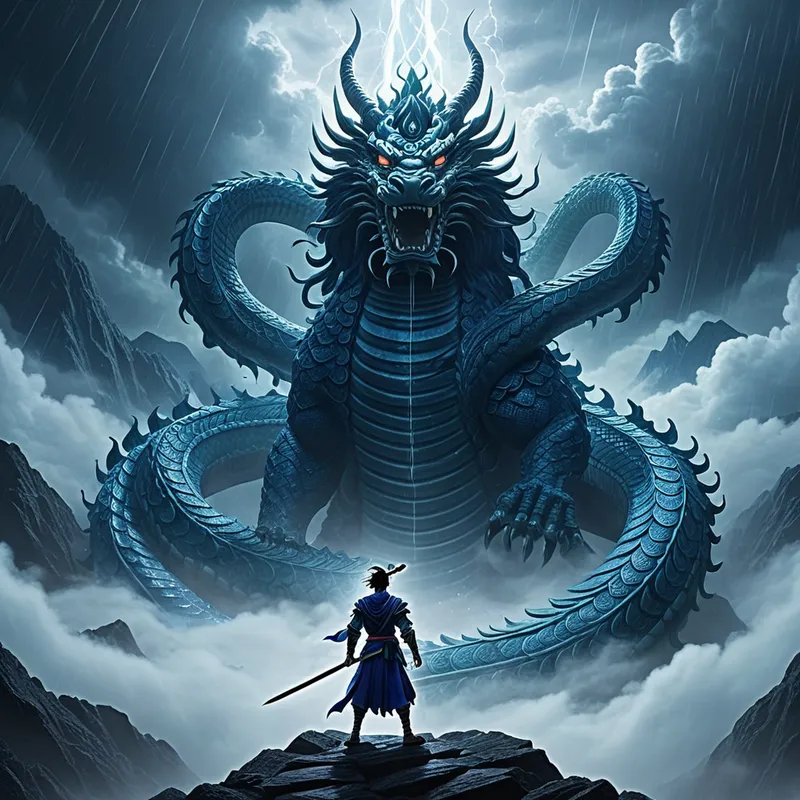
The world was younger, and the kami, the spirits of creation, walked closer to the earth. There was a storm, a tempest given form and will: Susanoo-no-Mikoto, exiled from the High Plain of Heaven for his wild, destructive grief. Cast down to the land of Izumo, he came upon an old man and woman weeping by a river. Their eight daughters had been devoured, one by one in each passing year, by a monstrous serpent with eight heads and eight tails, eyes red as winter sunsets, a body so vast it spanned eight valleys and eight hills. Its name was Yamata-no-Orochi.
Moved by a pity that tempered his rage, Susanoo saw his purpose. He commanded the couple to brew sake of surpassing potency, eight times refined, and to build eight platforms, each with a vat. When the monstrous serpent came, drawn by the scent, each of its eight heads dipped into a vat and drank the sacred wine until, stuporous, the great beast collapsed in a tangled, scaled mountain.
Then Susanoo, the storm god, drew his own sword, Ame-no-Murakumo-no-Tsurugi, and with a fury that echoed thunder, he cut. He severed head from neck, tail from body, until the river ran thick and dark. But as he hewed at the fourth tail, his blade struck something within the flesh that rang with a sound like shattering ice and ringing bell-metal. From the serpent’s own body, he drew forth a sword. It was flawless, its edge shimmering with an inner light, a power extracted from the very heart of chaos.
He offered this sword, this serpent’s gift, to his sister, the sun goddess Amaterasu, in a gesture of reconciliation. It became one of the Three Sacred Regalia, the Sanshu no Jingi, passing down through the celestial lineage to the first mortal emperor, Jimmu. Centuries later, the sword revealed its true name. A prince, trapped in a field set ablaze by his enemies, used the divine blade to cut the burning grass around him, controlling the fire and turning the trap into his salvation. From that day, Ame-no-Murakumo was called Kusanagi-no-Tsurugi, the sword that commands the very element that would consume it.
Cultural Origins & Context
The myth of Kusanagi is woven into the foundational texts of Japan, primarily the Kojiki (712 CE) and the Nihon Shoki (720 CE). These were not mere storybooks but political-theological documents, commissioned by the imperial court to codify a national mythology that placed the ruling Yamato line in an unbroken, divine descent from Amaterasu. The sword, alongside the mirror (Yata no Kagami) and the jewel (Yasakani no Magatama), formed the tangible proof of this mandate.
Its transmission was ritualistic and secret, part of the solemn ceremonies of imperial accession. The sword itself was (and is said to be) enshrined at Atsuta Jingu, hidden from all eyes, its existence affirmed by faith and tradition. This secrecy amplified its power, making it less a physical weapon and more an immovable symbol of sovereignty—the right and the might to rule, extracted from chaos and legitimized by the gods. It functioned as the "bravery" of the emperor, the active, defending principle of the state, forever linked to its origin in a heroic act of subduing a monstrous threat.
Symbolic Architecture
At its core, Kusanagi-no-Tsurugi is a profound symbol of power derived from, and mastered through, confrontation with the chaotic, the overwhelming, and the instinctual.
The serpent, Yamata-no-Orochi, is not merely a monster to be slain. It is the embodiment of undifferentiated, devouring nature—the flood, the plague, the unconscious forces that consume order and individuality. Its eight-fold form speaks to a complexity that is all-encompassing and multidirectional. Susanoo’s strategy is key: he does not meet brute force with brute force. He uses cunning (the sake) to expose the beast’s vulnerability, its own insatiable appetite. The sword is found within the serpent, signifying that true power, the tool for sovereignty, is not applied from the outside but must be discovered and extracted from the heart of the chaos we face.
The weapon that masters the dragon is forged in the dragon's own blood. Sovereignty is not given; it is claimed from the belly of the beast that would claim you.
Thus, the sword represents discrimination—the sharp, discerning intellect, or will, that can cut through tangled, overwhelming situations (the "grass" of confusion or danger). Its final naming episode reinforces this: it does not destroy fire (chaos, passion, conflict) but cuts and controls it, redirecting its energy to serve the hero’s survival and victory. It is the archetypal symbol of bringing conscious order to unconscious chaos, a necessary act for any form of creation or rule.

The Dreamer's Resonance
When this myth stirs in the modern psyche, it often manifests in dreams of confrontation with immense, multi-headed problems or feelings—a suffocating workload, a tangled relationship, a pervasive anxiety that seems to have many sources. The dreamer may feel like the weeping parents, powerless as parts of their life are devoured year after year.
To dream within this myth is to be at the precipice of the individuation journey. The somatic sense is one of being coiled around, pressured, or trapped. Psychologically, it is the moment when the "Susanoo" aspect of the Self—the assertive, perhaps exiled, and stormy part of our nature that we often reject—is activated. This is not a call for polite negotiation, but for a strategic, courageous engagement with the "serpent." The dream may present a tool or an unexpected solution (the sake, a hidden path) that symbolizes the need for a new approach, one that understands the nature of the devouring force.
The emergence of a sword in such a dream is a powerful sign. It indicates the nascent discovery of one's own capacity for discernment and decisive action, a personal "Kusanagi" being forged in the difficult, often messy process of confronting a life-draining complex.

Alchemical Translation
The alchemical journey of Kusanagi is a perfect map for psychic transmutation. It begins with the nigredo, the blackening: Susanoo’s exile and the devastating, repetitive loss to the serpent—states of depression, alienation, and being consumed by an unconscious pattern.
The strategic preparation of the sake represents the albedo, the whitening. This is the conscious work: the brewing of insight (the refined sake), the setting of boundaries (the platforms), the creation of a container to safely engage the complex. One does not attack the chaos directly; one invites it to reveal its nature and its weakness—its addictive, unconscious behavior.
The slaying and the discovery of the sword within the tail is the rubedo, the reddening. This is the climax of the opus. The heroic ego (Susanoo) must act decisively to dismantle the autonomous complex (the serpent). The reward is not external gold but an internal tool of immense value—a newfound strength, a clarified purpose, a sharp insight (the sword) that was always hidden within the structure of the problem itself.
Individuation is the process of finding the sacred blade in the monster's tail. The power you seek to wield over your chaos must first be reclaimed from it.
Finally, the offering to Amaterasu and the later naming as Kusanagi signify the coniunctio, the union. The reclaimed power is integrated into the broader, ruling consciousness of the Self (the solar principle, Amaterasu). It is given a name and a function—"Grass-Cutter"—defining its role in the ongoing governance of the inner realm. The chaotic fire of the serpent is transmuted into the controlled, cutting clarity of the sovereign will. The individual is no longer victim to the devouring unconscious but has extracted from it the very tool needed for wise and effective rule over their own life.
Associated Symbols
Explore related symbols from the CaleaDream lexicon: